Phronesis (φρόνησις): Meaning, Definition & Modern Application
FROH-neh-sis
Practical wisdom. The capacity to discern the right action in specific situations, particularly knowing what not to do.
Etymology
From the Greek verb phronein, meaning “to think” or “to have understanding.” Related to phren (mind, diaphragm), reflecting the ancient belief that thought resided in the chest. Aristotle distinguished phronesis from theoretical wisdom (sophia), insisting that practical wisdom could only be acquired through lived experience. It became the intellectual virtue most essential to ethical action in his Nicomachean Ethics.
Deep Analysis
Aristotle’s treatment of phronesis in Book VI of the Nicomachean Ethics is the most detailed analysis of practical wisdom in the Western philosophical tradition. Phronesis is classified as an intellectual virtue, but it operates in the domain of action rather than theory. Where sophia (theoretical wisdom) deals with what is necessary and unchanging, phronesis deals with what is contingent and particular. The theoretician asks, “What are the eternal truths?” The person of practical wisdom asks, “What should I do in this specific situation, given these specific circumstances, with these specific people?”
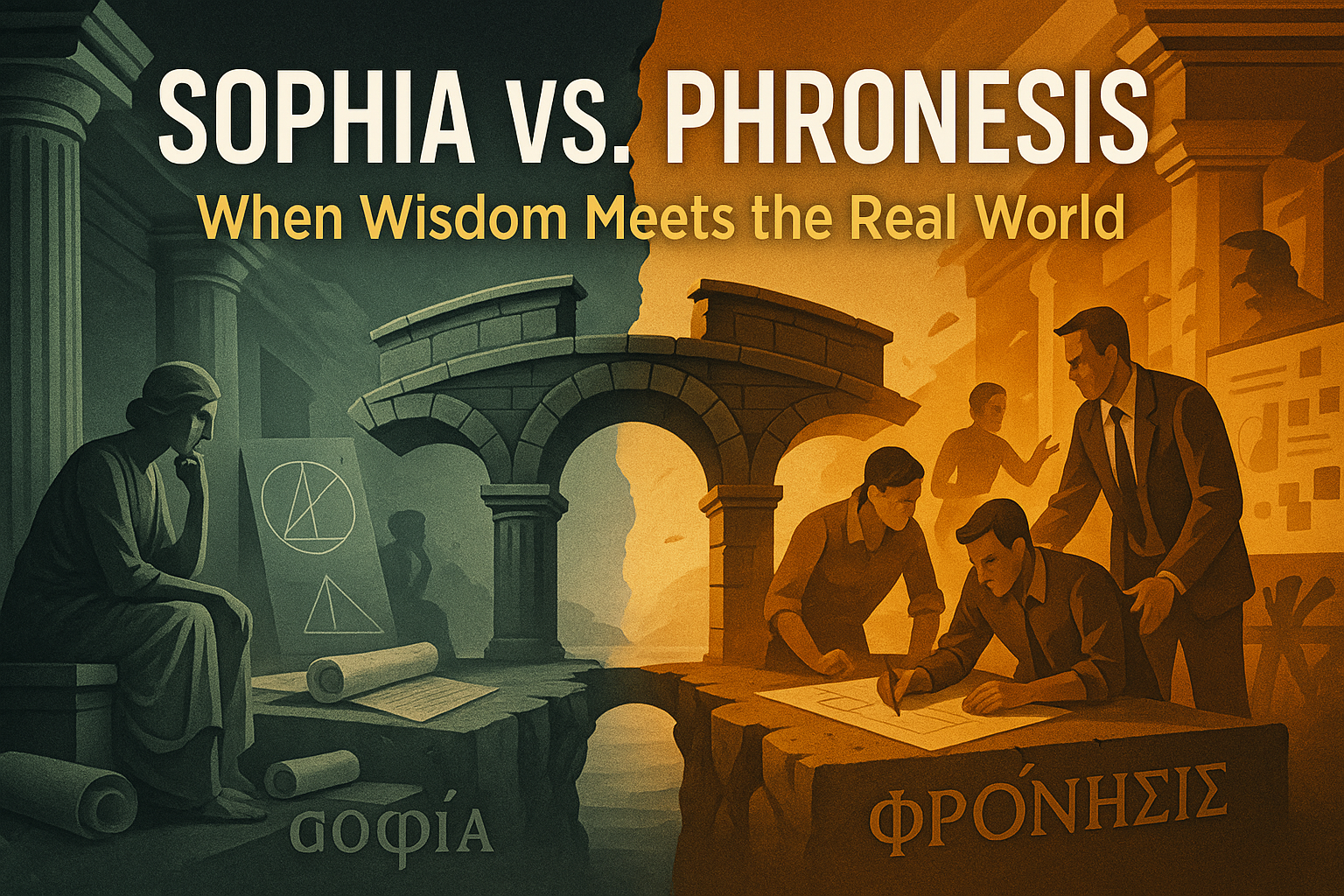
The critical distinction between phronesis and sophia cannot be overstated, because modern culture routinely collapses them. Sophia is knowledge of universal principles and causes. Phronesis is the ability to perceive what a particular situation requires and to act accordingly. A person with sophia understands that justice is a virtue. A person with phronesis perceives that this specific situation, with these specific people and these specific constraints, calls for this specific expression of justice rather than that one. Sophia operates at the level of principle. Phronesis operates at the level of application. Both are necessary. Neither is sufficient alone.
Aristotle argued that phronesis cannot be taught from a textbook because it requires experience, the perception of particulars, and the capacity for deliberation. You cannot learn phronesis the way you learn geometry. Geometry deals with universals that are the same everywhere. Phronesis deals with particulars that are different every time. The doctor who has memorized every medical textbook but has never treated a patient lacks phronesis. The manager who has completed every leadership course but has never navigated a genuine organizational crisis lacks phronesis. Phronesis is developed through the sustained practice of making decisions in complex situations where the right answer is not obvious and the stakes are real.
The role of phronesis as the “master virtue” is one of Aristotle’s most important claims. He argues that you cannot have any of the character virtues, courage, temperance, justice, generosity, in their complete form without phronesis. The reason is that each virtue can become its own opposite without the guidance of practical wisdom. Courage without phronesis becomes recklessness: you face danger when wisdom would counsel retreat. Generosity without phronesis becomes wastefulness: you give when giving is harmful. Justice without phronesis becomes rigidity: you apply rules mechanically when the situation requires flexibility. Phronesis is the intellectual virtue that calibrates all the others, ensuring that each is expressed at the right time, in the right way, toward the right person, and to the right degree.
Arete (excellence) and phronesis exist in a relationship of mutual dependence. Arete without phronesis produces well-intentioned people who make poor decisions because they lack the practical judgment to translate their good character into good action. Phronesis without arete produces clever people who use their practical intelligence to achieve bad ends. The person who is both practically wise and morally excellent, who knows both what is right and how to achieve it in specific circumstances, possesses the complete virtue that Aristotle considers the foundation of eudaimonia.
Sophrosyne (temperance, self-mastery) has a particular relationship to phronesis. While phronesis guides all the virtues, it has a special connection to sophrosyne because practical wisdom requires the emotional regulation that sophrosyne provides. Deliberation under pressure requires a mind that is not overwhelmed by fear, desire, or anger. The person whose emotions are ungoverned cannot perceive clearly what the situation requires, and therefore cannot exercise phronesis even if they possess it in principle. Sophrosyne creates the internal conditions that allow phronesis to operate.
Modern Application
Phronesis can only be developed through action and reflection on action. You can't think your way into wisdom. It manifests more in restraint than activity, helping you avoid the obvious mistakes that derail most people's progress.
Historical Examples
Pericles is Aristotle’s own example of phronesis in the Nicomachean Ethics. Aristotle points to Pericles and “people like him” as embodiments of practical wisdom because they have the ability to perceive what is good for themselves and for other people. Pericles navigated Athenian politics for three decades, managing a fractious democracy, a volatile empire, and a rivalry with Sparta that would eventually produce the Peloponnesian War. His famous strategy at the war’s outset, abandoning the Athenian countryside and relying on naval superiority while avoiding pitched land battle, was a paradigmatic act of phronesis: a decision that was deeply unpopular, counterintuitive, and strategically sound given the specific circumstances of Athens’s strengths and Sparta’s.
Abraham Lincoln demonstrated phronesis throughout his presidency, but the Emancipation Proclamation illustrates it most clearly. Lincoln personally opposed slavery and had the moral conviction that it should end. But he perceived that the specific political circumstances of 1862 required a gradual, strategically framed approach rather than an immediate moral declaration. He framed emancipation as a military necessity rather than a moral imperative, applied it only to states in rebellion, and timed its release to follow a Union victory at Antietam. Each of these decisions reflected phronesis: the perception of what this specific situation, with these specific political constraints, required for the moral goal to be achieved.
Queen Elizabeth I of England exercised phronesis during her long reign (1558-1603) through what historians call her “middle way” in religious policy. Rather than imposing a strict Protestant or Catholic settlement, she perceived that her specific kingdom, recently traumatized by the violent religious reversals under Edward VI and Mary I, required a pragmatic compromise that would allow most English subjects to participate in the established church without violating their consciences. Her famous statement, “I have no desire to make windows into men’s souls,” reflects the practical wisdom of a ruler who understood that the right policy for her specific circumstances was moderation, not ideological purity.
How to Practice Phronesis
After every significant decision this week, write a brief post-mortem: what did you consider, what did you choose, and what happened? Review these at month’s end to spot where your judgment was sharp and where it was clouded. When facing a dilemma, consult someone with more experience before acting, not to follow their advice blindly, but to see the situation through a different lens. Practice the discipline of restraint: before every meeting, identify one thing you could say but should not. Wisdom grows fastest at the boundary between knowing and doing. Build a personal case library of decisions and outcomes that you review quarterly, noting which types of situations still trip up your judgment. Seek out moral complexity rather than avoiding it. When you encounter a situation with no clean answer, sit with the tension and resist the urge to simplify. The discomfort of genuine dilemmas is the soil in which practical wisdom takes root.
Application Examples
A CEO must decide whether to lay off fifteen percent of the company or reduce everyone’s salary by twenty percent. Financial models support either approach. The CEO recognizes that the financial analysis is necessary but insufficient. She considers the specific culture of her company, the psychological impact on remaining employees, the labor market each affected person would enter, and the message each choice sends about the company’s values. She chooses the salary reduction because she perceives that this specific team, in this specific market, at this specific moment, would be better served by shared sacrifice than by selective elimination.
Phronesis in leadership means recognizing that the right decision depends on the specific circumstances in ways that general frameworks cannot capture. The financial models are identical for both options. The difference is in the particulars that only someone embedded in this specific situation can perceive.
A parent must decide how to respond to their teenager’s poor grades. The textbook response is clear consequences for poor performance. But this parent perceives that the poor grades are not a discipline problem but a symptom of their child’s struggle with anxiety that has gone unaddressed. The parent sets aside the standard response and addresses the underlying issue.
Phronesis requires seeing through the surface presentation to the particular reality beneath it. The parent who applies the standard response to a non-standard situation makes the problem worse. The parent who perceives what this specific child needs in this specific moment demonstrates the kind of practical wisdom that no parenting manual can provide.
A project manager has two team members in conflict. Both have valid points. Standard conflict resolution protocol would bring them together for mediation. The project manager perceives that one of the team members is going through a personal crisis that makes them unable to handle confrontation right now. She delays the mediation by two weeks and provides individual support in the meantime.
Phronesis sometimes means doing the right thing at the wrong time is worse than doing it at the right time. The project manager’s perception of the specific circumstances, not just the general problem, allows her to calibrate her response to what the situation actually requires rather than what the protocol prescribes.
A physician must decide whether to tell a terminal patient the full truth about their prognosis. The principle of honesty is clear. But this specific patient, the physician perceives, is in a state of psychological fragility where the unmediated truth could cause more harm than benefit. The physician tells the truth but calibrates how much, when, and in what context, providing full information over several conversations rather than in one devastating disclosure.
Phronesis in ethical practice means understanding that universal principles must be applied with sensitivity to particular circumstances. The physician is not being dishonest by staging the disclosure. She is exercising the practical wisdom that recognizes truth-telling is not a single act but a process that can be conducted well or badly.
Two oncologists review the same patient’s test results. One recommends aggressive treatment based on the statistical probability of recurrence. The other recommends watchful waiting based on their perception of this specific patient’s psychological state, support system, and stated values about quality of life. The first oncologist is applying a protocol. The second is exercising phronesis.
Medical phronesis means that the best treatment for this patient may differ from the best treatment for a statistical average of patients with similar conditions. The oncologist exercising phronesis perceives factors that no protocol can capture: who this person is, what they value, and what this specific diagnosis means in the context of their specific life.
A mediator in an international negotiation perceives that both sides have reached their stated positions through internal political processes that make retreat impossible without losing face. The substantive gap between their positions is small, but the political cost of concession is enormous for both. The mediator constructs a framework that allows both sides to claim they achieved their core objectives while making the necessary concessions under different language.
Phronesis in diplomacy means perceiving the political constraints that surround substantive positions and finding paths that respect both. The mediator’s framework was not dishonest. It was a creative solution that recognized what each side actually needed, which was different from what each side was demanding, and constructed an agreement that served both.
Common Misconceptions
Phronesis is frequently confused with intelligence or analytical ability. Smart people who lack phronesis make terrible decisions in complex situations because their intelligence operates on abstract problems while the situation demands perception of concrete particulars. The brilliant strategist who produces elegant plans that fail on contact with reality lacks phronesis. A second error treats phronesis as teachable in the same way that technical skills are teachable. Aristotle was explicit: phronesis requires experience. You cannot shortcut it through study. Young people can be brilliant, but Aristotle argued they cannot yet have phronesis because they have not lived long enough to develop the experiential base that practical wisdom requires. A third misconception equates phronesis with caution or conservatism. Practical wisdom sometimes counsels bold action. The phronimos (person of practical wisdom) is not the person who always plays it safe but the person who perceives what the specific situation requires, which may be audacity.
Knowing the right thing to do and doing the right thing are separated by a gap that only experience can bridge, and I learned this through expensive failure. I have known the right answer countless times and still failed to achieve the right outcome because I lacked the practical wisdom to execute it.
The clearest example was a team restructuring I led that was strategically sound and tactically catastrophic. I had analyzed the situation thoroughly. I had consulted frameworks. I had benchmarked against other organizations. The plan was textbook-correct. What I failed to perceive was that the specific people involved, their histories, their relationships, their anxieties, required a different approach than the one the textbook prescribed. I implemented the right plan in the wrong way, and the implementation destroyed the value the plan was supposed to create.
Phronesis would have told me what the frameworks could not: that this team, at this moment, with these specific people, needed a gradual transition rather than a decisive restructure. I had all the theoretical wisdom and none of the practical wisdom. The experience taught me to hold my strategic conclusions loosely until I have tested them against the specific reality of the people and circumstances involved.
Since then, I have developed the habit of asking myself, before every significant decision: “What am I not seeing because my framework is blocking it?” The question does not always produce an answer, but it creates space for the kind of perception that phronesis requires. The most dangerous decisions are the ones where the answer feels obvious, because that feeling of obviousness usually means your framework is doing the thinking instead of your judgment.
Frequently Asked Questions
What is phronesis in Greek philosophy?
Phronesis is Aristotle's concept of practical wisdom, the intellectual virtue that enables you to discern the right course of action in specific, concrete situations. It differs from theoretical wisdom in that it can only be developed through lived experience and reflection. Aristotle considered phronesis the most essential virtue for ethical action, arguing that without it, even courage and generosity can misfire and cause harm.
What does phronesis mean?
Phronesis means practical wisdom or prudence. It comes from the Greek verb phronein (to think, to have understanding) and describes the capacity to judge what is good and beneficial in particular circumstances, especially knowing what to avoid. The related word phren originally referred to the diaphragm, reflecting the ancient Greek belief that thought and understanding had a bodily seat in the chest rather than the head.
How do you practice phronesis?
You develop phronesis through a cycle of action, reflection, and adjustment. Make decisions, examine their outcomes honestly, seek counsel from experienced mentors, and practice restraint. Wisdom accumulates through this iterative process over years, not through study alone. Keep a decision journal where you record your reasoning before acting, then revisit it after outcomes become clear to calibrate your judgment over time.
What is the difference between phronesis and sophia?
Phronesis is practical wisdom concerned with particular situations and right action. Sophia is theoretical wisdom concerned with universal truths and first principles. Aristotle valued both but argued that phronesis was more essential for living well, since it directly guides ethical choices in daily life. A person could possess profound sophia about the nature of the universe while still making disastrous personal decisions due to a lack of phronesis.