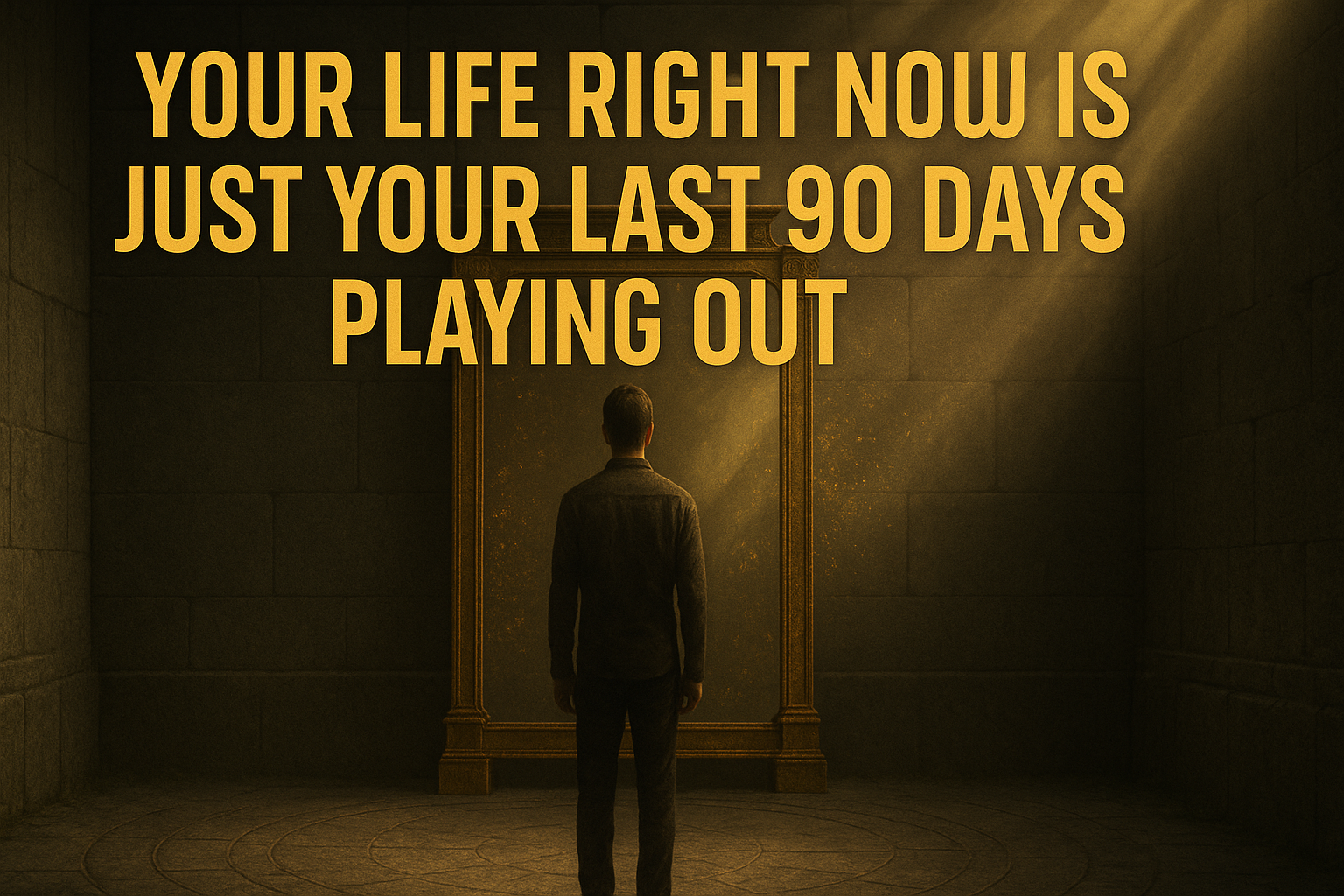
Your Life Right Now Is Just Your Last 90 Days Playing Out
By Derek Neighbors on November 11, 2025
Six months after launching a major initiative, I was sitting in a conference room listening to the team complain about why nothing was working.
Market timing. Resources. Leadership support. Competition. The economy. Every excuse except the obvious one.
I pulled up our Slack history. For the previous 90 days, every decision point had been met with “let’s wait and see.” Every hard conversation had been postponed. Every uncomfortable choice had been avoided. We hadn’t executed poorly. We’d barely executed at all.
The initiative wasn’t failing because of circumstances. It was failing because for 90 days, we’d chosen comfort over commitment. The current reality wasn’t showing us the market or our luck. It was showing us our recent discipline. Or lack of it.
Your life right now, your fitness, your bank account, your relationships, your skills, your opportunities, isn’t a reflection of who you are. It’s a mirror showing you what you’ve been doing for the past 30, 60, 90 days.
That’s not philosophical. That’s physics.
Why this timeframe? Not because 90 days is magic. Because it’s recent enough that you can track it honestly but long enough that your actions compound into visible results. Too short and variance dominates. Too long and causation gets lost in noise. Thirty to ninety days is where consistent action becomes undeniable outcome.
The Self-Deception Pattern
People treat current reality like it reveals their identity.
When things are going well, they’re “talented” or “blessed” or “made for this.” When things are struggling, they’re “cursed” or “not cut out for it” or “unlucky.”
Both are self-deception. Neither your success nor your struggle reveals your essential nature. They reveal your recent actions showing up as results.
The lag time between action and outcome creates the illusion that circumstances are random or that identity determines destiny. But track it honestly for 90 days and the causation becomes undeniable.
Aristotle called human flourishing eudaimonia, actualizing your rational capacity. But you cannot actualize what you’re lying to yourself about. If you’re blaming circumstances when you’re actually avoiding hard actions, you’re not just getting poor results. You’re preventing your own flourishing. The examined life requires honest accounting of what you’ve actually been doing.
We want the credit when things go well but deflect accountability when they don’t. The Stoics called this voluntary delusion. Marcus Aurelius wrote that we’re disturbed not by events but by our view of them. He was being generous. Usually we’re disturbed by refusing to acknowledge that events are consequences of our choices.
The Avoidance Patterns
Identity Inflation When Winning
When results are good, people attribute success to their inherent qualities. “I’m just naturally good at this” or “I have a gift for this.”
The entrepreneur whose business is thriving starts believing they’re a visionary genius, forgetting the 60-hour weeks and relentless execution that created the results.
They’re avoiding acknowledging that results come from actions, not essence. If they believe success comes from who they are rather than what they do, they’ll stop doing what created the success.
The ancients called this hubris, not just arrogance, but the dangerous belief that you’re exempt from causation. That your outcomes aren’t tied to your actions because you’re special.
Success plus identity attribution equals complacency equals inevitable decline.
Identity Crushing When Losing
When results are bad, people attribute failure to their inherent deficiencies. “I’m just not cut out for this” or “I don’t have what it takes.”
The person whose fitness has declined convinces themselves they’re “not athletic” or “have bad genetics,” ignoring that they haven’t worked out consistently in four months.
They’re avoiding the harder truth that they stopped doing what works. Blaming identity is more comfortable than acknowledging they quit the behaviors that created results.
This violates arete, the obligation to actualize your capacity. Excellence requires honest assessment of what you’ve actually been doing, not what you wish you’d done. You’re not incapable. You’re just not currently doing what capability requires, and you’re lying to yourself about why.
Struggle plus identity attribution equals resignation equals giving up.
Circumstance Blame
When results don’t match desires, people attribute the gap to external factors. “The market is bad” or “I don’t have the right opportunities” or “Other people have advantages I don’t.”
The person whose career has stalled blames office politics or a bad manager, ignoring that for 90 days they’ve been doing the minimum, avoiding difficult projects, and waiting for recognition without earning it.
They’re avoiding accountability by externalizing causation. Some circumstances do matter. But most people use circumstance blame to avoid looking at their recent actions.
Epictetus, who was literally a slave, taught that external circumstances are adiaphora - indifferent. What matters is what you do with them. He had zero control over his circumstances. He still pursued excellence.
Gap between desire and reality plus circumstance blame equals powerlessness equals stagnation.
The Delayed Cause Fantasy
When current reality is uncomfortable, people attribute it to distant past events. “My childhood” or “that trauma” or “that failure from years ago.”
Someone struggling financially in their 40s blames growing up poor, ignoring that for the past 90 days they’ve been spending more than they earn and avoiding hard conversations about money.
Past events shape you. But current reality is primarily shaped by recent actions. The past explains your starting point. Your last 90 days explain where you are now.
This violates the Stoic principle of control. You cannot control the past. You can control your actions now. Blaming distant causes is choosing powerlessness over agency.
Current struggle plus distant past blame equals permanent victim identity equals no change.
The Complexity Smokescreen
When results don’t materialize, people hide behind complexity. “It’s complicated” or “There are many factors” or “You don’t understand the nuance.”
The person whose relationship is failing creates elaborate theories about attachment styles and love languages, ignoring that for 90 days they’ve been irritable, distracted, and not showing up.
The leader whose team is underperforming talks about organizational dynamics and market pressures, ignoring that for 90 days they’ve been avoiding difficult feedback conversations and letting mediocrity slide.
Complexity is real. But most people use it as camouflage for not doing basic things consistently.
phronesis, practical wisdom, is knowing the difference between legitimate complexity and sophisticated excuse-making.
Poor results plus complexity theories equals paralysis equals continued poor results.
What Actually Works
Your current reality is shaped by three things: the circumstances you started with, random external events, and your recent actions. You didn’t control the first two. You did control the third.
Most people obsess over circumstances and randomness while ignoring their actions. The Stoics called external circumstances adiaphora, indifferent. Not because they don’t affect outcomes, but because they don’t determine your character or your next choice. You can’t control what happened to you. You can control what you do next. And what you do next determines where you’ll be 90 days from now.
When I stopped asking “Why is this happening to me?” and started asking “What did I do 60-90 days ago that would create this?” everything changed. Not because reality changed. Because I stopped lying to myself about causation.
The business that was struggling? 90 days of avoiding hard decisions showing up. The relationship that was distant? 90 days of being present physically but absent emotionally showing up. The fitness that had declined? 90 days of choosing comfort over training showing up.
The 90-day audit isn’t about proving perfect causation. Some things happen randomly. But most people use that truth to avoid acknowledging obvious causation. If you haven’t worked out consistently in 90 days and your fitness declined, you don’t need a controlled study to know why. The audit reveals where you’re using uncertainty as cover for not looking at what’s obvious.
Here’s how to stop the self-deception:
Do the 90-day audit. Look at any area of your life that’s not where you want it. Don’t analyze your identity, your circumstances, or your past. Ask one question: “What have I actually been doing in this area for the past 30-90 days?”
Not what you meant to do. Not what you wish you’d done. What you actually did.
Write it down. Be brutally honest.
Strip the story. Remove every explanation about why you did or didn’t do things. No context about circumstances. No theories about your psychology. Just the actions.
This is katalepsis, clear perception without the distorting lens of self-justification.
Project forward. If you keep doing exactly what you’ve been doing for the next 90 days, where will you be? Not where you hope to be. Where the math says you’ll be.
Most people don’t want to do this because the math is brutal. But the math doesn’t care about your feelings. It just compounds your actions forward. Your position matters less than your trend, and the trend is set by what you do daily.
Change the input, change the output. If you don’t like where the 90-day projection takes you, change what you’re doing today. Not your mindset. Not your identity. Your actual behaviors. Build habits for your worst day, not your best, so the system holds when motivation disappears.
The results will show up. In 90 days. Progress feels like nothing until the compound curve catches, and then it feels like everything.
The Diagnostic
Look at one area of your life that’s not where you want it to be.
What have you actually been doing in that area for the past 90 days? Be specific. Not “working on it” but what actions, how often, with what intensity?
If you do exactly that for the next 90 days, where will you be?
If that projection is unacceptable, what specific action are you changing today?
Are you blaming circumstances, identity, or distant past to avoid acknowledging your recent actions?
Pick one area. Do the audit with brutal honesty. Then change one behavior today that will show up in your reality 90 days from now. Not a big transformation. One behavior. Consistently.
Then watch what happens.
Final Thoughts
Your current reality doesn’t care about your story, your excuses, your theories, or your potential. It reflects your recent discipline back at you with perfect accuracy. And excellence is rented, not owned, so the rent comes due every single day.
You can lie to yourself about why things are the way they are. The reflection doesn’t lie. It shows you the consequences of your recent actions with mathematical precision.
The good news: if you don’t like what you see, you can change it. Not by changing your identity, your circumstances, or your past. By changing what you do today. And tomorrow. And the day after that.
In 90 days, you’ll see the results.
The Stoics knew: circumstances are indifferent. Actions create consequences. The gap between what you say matters and what you do when it’s inconvenient is where most goals die. That’s the integrity loop in action, and every broken promise compounds against you.
Your life right now is just your last 90 days playing out. If you don’t like the reflection, change what you’re doing today.
Ready to stop lying to yourself about causation and start tracking what actually creates results? MasteryLab provides the framework and accountability for people who are done blaming circumstances and ready to change their actions. Your next 90 days start now.