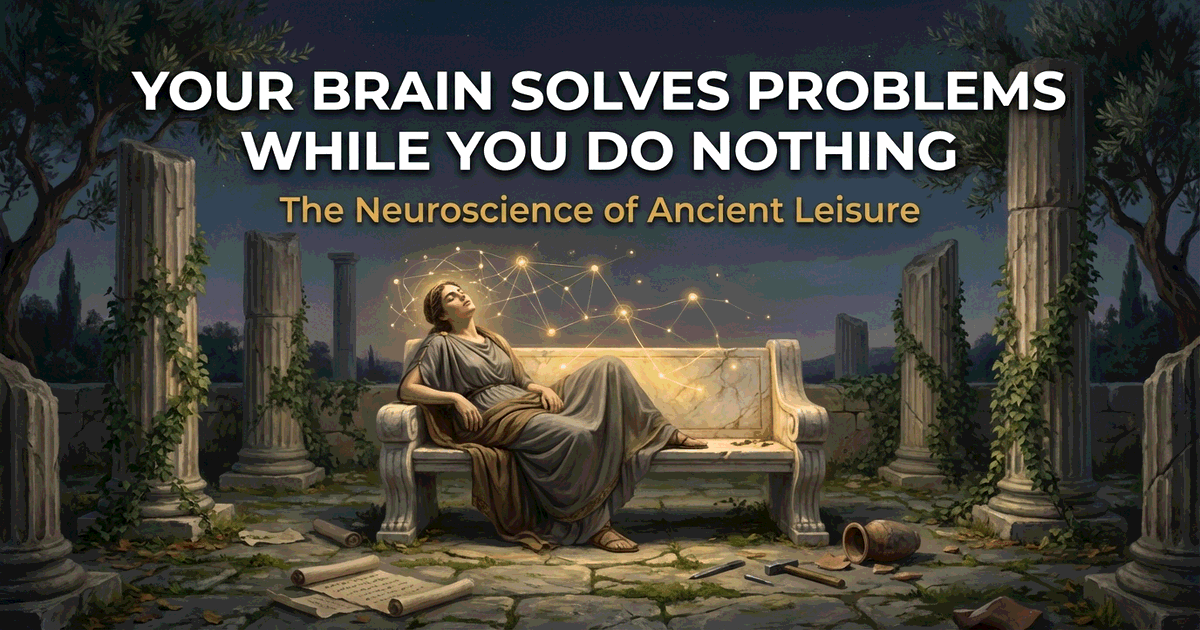
Your Brain Solves Problems While You Do Nothing
By Derek Neighbors on April 7, 2026
You know the feeling. You’ve been grinding on a problem for hours. Staring at it. Rearranging it. Forcing your way through. Nothing lands.
Then you take a shower. Or go for a walk. Or lie down and do absolutely nothing.
And the answer arrives. Fully formed. Almost insulting in its clarity.
This isn’t a happy accident. It’s your brain doing exactly what it was built to do, and it can only do it when you get out of the way.
The Curious Observation
In 2001, neuroscientist Marcus Raichle at Washington University published a finding in the Proceedings of the National Academy of Sciences that changed how we understand the brain. He noticed something strange in imaging data. When research subjects stopped performing tasks and simply rested, their brains didn’t quiet down. Certain regions became more active. Not a little more. Significantly more.
He called this the Default Mode Network, because it represented the brain’s default state. Not the anomaly researchers had assumed it was. The actual baseline.
Your brain, which accounts for roughly 2% of your body weight, burns about 20% of your total energy. And it doesn’t reduce that consumption when you stop focusing. The organ never idles. It shifts into a different gear entirely.
The DMN handles what focused attention cannot. It consolidates memories into long-term storage. It runs simulations of future scenarios. It connects ideas from completely unrelated domains and processes emotional experiences into usable wisdom. This is where phronesis lives, the practical wisdom that integrates experience into judgment.
And it only activates fully when you stop trying.
The Evidence
The research has piled up in the decades since Raichle’s discovery. Studies on creative problem-solving consistently show that breakthrough insights correlate with DMN activation, not with focused concentration. The “aha” moment, that flash of clarity that reorganizes everything, arrives when conscious effort steps aside.
This shouldn’t surprise us. The pattern has been hiding in plain sight for centuries.
Newton wasn’t at his desk when the apple fell. Archimedes wasn’t in a library when he understood displacement. He was in a bath. Darwin structured his entire day around walks. Three of them. Every single day. Not for exercise. For thinking. Einstein played violin between bouts of intense calculation, and he credited those breaks with more than the calculations themselves.
Henri Poincaré, one of the greatest mathematicians who ever lived, described his process explicitly. He would work intensely on a problem, reach an impasse, and deliberately stop. The solution would arrive later, often during a walk or while boarding a bus. He called it “unconscious work,” and he considered it the essential second half of any intellectual process. The first half, the focused effort, loaded the problem. The second half, the rest, solved it.
These weren’t lazy thinkers stealing credit for luck. They were disciplined minds who understood, through practice if not through neuroscience, that their best cognitive work required two distinct phases. And the second phase demanded the courage to stop.
The Hidden Pattern
The ancient Greeks built an entire civilization around this insight.
schole (σχολή) was their word for leisure. And they didn’t mean Netflix and scrolling and killing time. They meant the highest form of human activity. The condition in which real thinking, philosophy, political deliberation, and the cultivation of arete became possible.
The etymology tells you everything. Scholé became the Latin schola, which became our word “school.” The place we send people to develop their minds was named after the Greek practice of doing nothing productive.
Aristotle made the relationship explicit in the Politics: “We work in order to have leisure.” The sentence sounds backwards to modern ears. We assume leisure exists to recharge us for more work. Aristotle argued the opposite. Work existed to create the conditions for scholé, and scholé was where human flourishing, eudaimonia, actually happened.
The Greek citizen’s life was structured around this conviction. Manual labor and commerce were necessary, sometimes unavoidable, but they weren’t the point. The point was creating space for specific activities: philosophical dialogue in the agora, contemplation of ethical questions, participation in civic life, the slow cultivation of character through reflection. Scholé wasn’t passive. It was the active, unrushed pursuit of wisdom and virtue without the pressure of economic necessity.
Modern productivity culture inverted this model completely. We treat rest as the reward for work. The Greeks treated work as the cost of rest. The DMN research didn’t confirm the Greek insight so much as arrive at a parallel conclusion from a different direction. The neuroscience says: the brain needs disengagement to do its deepest processing. The philosophy says: the soul needs leisure to do its proper work. Different languages for the same structural truth, that the most important human capacities require space that constant occupation destroys.
Here is the critical distinction, and it requires real phronesis to navigate: recovery and escape look identical from the outside but produce opposite results.
| Recovery | Escape | |
|---|---|---|
| What it looks like | Sitting quietly, walking, staring at nothing | Scrolling, binge-watching, filling silence with noise |
| What the brain does | DMN activates, processes, connects, integrates | DMN stays suppressed under constant input |
| What it produces | Insight, clarity, creative connections | Numbness, the illusion of rest without cognitive benefit |
| Feels like | Uncomfortable at first, satisfying after | Comfortable during, hollow after |
Recovery is structured disengagement. A walk without your phone. Sitting with a problem and then deliberately stepping away from it. Allowing boredom. Escape is the cognitive equivalent of keeping the engine running in neutral. Motion without going anywhere.
The Implications
I spent years believing that more input meant better output. Read more books, attend more conferences, listen to more podcasts. My brain was so full of other people’s ideas that it never had space to form its own. I’ve written before about working hard on the wrong things, and constant input without integration is the subtlest version of that mistake.
The professional who is “always on” has reduced their brain’s capacity for integration. Constant input prevents the deep processing that creates wisdom. You can accumulate information for a decade and never develop real insight, because you never give the DMN space to connect what you’ve absorbed.
Organizations that celebrate busyness are systematically destroying their capacity for innovation. The person answering emails at midnight gets praised. The person who went home at a reasonable hour and arrived the next morning with the solution that saved the project gets called lucky. The incentive structure actively punishes the cognitive behavior that produces the best results.
This is where scholé separates from laziness, and the distinction matters. Scholé is intentional space for integration and reflection. Laziness is avoidance of challenge. One feeds eudaimonia. The other starves it. I wrote about this distinction from the opposite direction in Your Self-Care Routine Is Making You Weaker, where the argument was that rest without earned exertion breeds fragility. The argument here is the complement: once you’ve earned it, rest is where the real work, both cognitive and philosophical, happens.
The neuroscience explains the mechanism. But the value of rest extends beyond producing better ideas. The Greeks understood something the DMN research cannot capture: that unrushed reflection is where character develops, where you process not only information but experience, where you become the person capable of acting with wisdom rather than reacting from impulse. That is worth protecting for its own sake, not because it makes you more productive. The Greeks had no confusion about this because their concept of leisure carried a moral dimension. You were obligated to use scholé for the cultivation of excellence. Leisure spent on triviality was a failure of character, not a lifestyle choice.
The Application
I’ve experimented with this for the past few years. The practices that work are embarrassingly simple, but they require a kind of discipline that most people underestimate.
Walk without your phone. Darwin didn’t stroll with a podcast. The entire point is reducing input so the brain can process what it already has. I resisted this for months because I felt like I was “wasting” the walk. Then I noticed that every significant business decision I made well came after one of those walks.
Sit with a problem before sleep. Clearly define what you’re stuck on, then stop working on it. Your brain will continue processing it through the night. The solution that arrives at 6am feels like magic. It’s the DMN completing work you consciously started.
Between focused work blocks, step away from all input for even five minutes. The brain needs these boundaries to shift between focused and default modes. Switching from a spreadsheet to Twitter is not a break. It’s a different flavor of the same cognitive load.
Protect disengagement. This is the hardest one. The DMN doesn’t strictly require boredom. It requires freedom from directed attention. But in practice, boredom is how most people encounter that state, and the urge to fill every gap with stimulation is powerful. Every device in your life is designed to exploit it. When you eliminate all unstructured cognitive space, you eliminate the conditions for your deepest thinking.
I should be honest about something: these practices are easier to describe than to access. Not everyone has the luxury of an empty calendar block. The person working two jobs doesn’t lack discipline. They lack margin. But the obligation doesn’t disappear with the margin. Epictetus was a slave and still insisted the mind’s freedom was non-negotiable. The practice scales down. Five minutes of genuine disengagement is available to almost anyone. The question is whether you’ll use those five minutes to scroll or to think.
None of this is indulgence. Doing nothing in a culture that worships constant activity is an act of character. It demands trusting that your brain will work without your conscious supervision, and that trust is itself a form of sophrosyne, the self-mastery to restrain the impulse toward constant doing.
The audit question: when was the last time you were genuinely bored? Not waiting-for-something bored. Sitting-with-nothing bored. If you cannot remember, you have been starving your brain of the single condition it needs to do its most important work.
Frequently Asked Questions
What is the Default Mode Network? The Default Mode Network is a set of brain regions that activate when you stop performing focused tasks. Discovered by Marcus Raichle in 2001, it handles memory consolidation, future planning, connecting unrelated ideas, and processing experience into wisdom. It burns significant energy, roughly 20% of your body’s total, even when you feel like you’re doing nothing.
Why do my best ideas come in the shower or on walks? When you step away from focused work, the DMN activates and begins connecting information your conscious mind couldn’t link. The shower, the walk, the commute where you zone out, these are DMN processing windows. The insight feels sudden, but the brain has been working on it since you stepped away from the problem.
How is productive rest different from laziness? Productive rest (scholé in Greek philosophy) is intentional disengagement that gives the brain space to integrate and connect. Laziness is avoidance of challenge. One builds cognitive capacity and wisdom. The other depletes it. The Greeks considered this distinction a matter of character, not preference.
Final Thoughts
The highest form of productivity is knowing when to stop producing. The Greeks built a civilization that shaped the next 2,500 years of human thought. Many factors contributed, geography, military strength, democratic experimentation, but their insistence that leisure was the foundation of intellectual life, not the roof, created the conditions for philosophy, mathematics, and political theory to flourish. Neuroscience agrees with them. The DMN’s deep processing, connecting unrelated ideas, converting experience into wisdom, only happens when conscious effort stops.
Your brain does its best work without your conscious direction. The question is whether you’ll step back from the controls long enough to let it.
If you’re ready to build the kind of discipline that includes knowing when to stop, MasteryLab.co is where we put these principles into practice.