You Don't Need More Willpower. You Need a Better Sequence.
By Derek Neighbors on February 12, 2026
Every January, the same ritual. The alarm moves to 5am. The gym bag sits by the door. The meal prep containers fill the fridge. The journal appears on the nightstand. The meditation app gets downloaded. The alcohol gets poured down the sink.
By Wednesday, the alarm gets snoozed. By Friday, the gym bag hasn’t moved. By Sunday, takeout replaces the meal prep. The journal has one entry. The meditation app sends notifications to a phone that ignores them.
This isn’t a story about discipline. This is a story about architecture.
The Beginning State
Most people approach transformation like a demolition crew. Tear everything down. Rebuild from scratch. New morning, new diet, new workout, new mindset, new habits, new life. The assumption is that total overhaul requires total effort, applied everywhere, simultaneously.
This approach flatters the ego. It feels ambitious. It photographs well. And it fails with remarkable consistency, not because people lack willpower, but because conscious attention is finite. Whether or not willpower is a depletable resource in the strict psychological sense, anyone who’s tried to maintain ten new behaviors simultaneously knows the experience: each one demands attention, and attention has limits. Twelve simultaneous withdrawals from a single account, regardless of the account’s exact size, is a losing strategy.
The ancient Greeks had a concept for what happens when action becomes stable character: hexis. Aristotle described it as a settled disposition that forms through repeated action. Not through one dramatic gesture. Through consistent repetition of the same action until it stops requiring conscious effort and becomes part of who you are.
Here’s the problem with the overhaul approach: hexis struggles to form when everything is new at once. A disposition requires repetition, and repetition requires sustained focus. You might form two related dispositions simultaneously if they reinforce each other. But spread your attention across ten unrelated behaviors, and none of them get the sustained repetition necessary to become disposition. They remain intentions. And intentions decay faster than most people realize.
The willpower model treats discipline as fuel. But fuel burns. When it’s gone, so is the change, and you’re back to January, one year older, planning the same overhaul with the same confidence and the same inevitable result.
The Progression
The people who actually transform, the ones who look back after two years and barely recognize who they were, don’t do more. They sequence better.
They change one thing. They protect it. And they let that single change do the work of creating conditions for the next one.
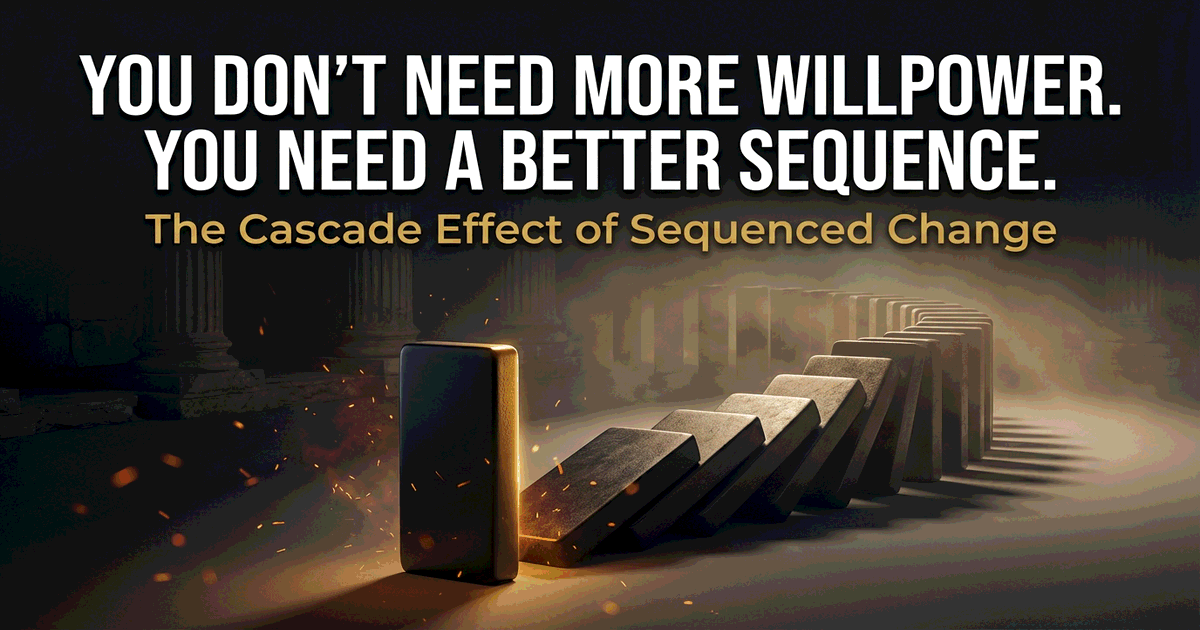
This is the cascade principle. Each change in the right sequence reduces the willpower cost of the next change. The relationship isn’t additive. It’s multiplicative. One right change doesn’t add capability. It multiplies it.
Consider the sobriety cascade. Someone stops drinking. They didn’t set out to overhaul their health. They changed one thing. But watch what happens downstream. Without alcohol in the evening, falling asleep early isn’t a battle. It’s what happens naturally. Better sleep means waking up without the 30-minute fog of dragging yourself vertical. Morning energy makes physical activity possible rather than punishing. Regular movement regulates appetite. Healthier eating stops requiring willpower because the body is actually requesting fuel instead of comfort. One change. Five downstream effects. None of them required a separate decision.
Or consider the morning cascade. Someone starts waking up one hour earlier. Not to do five things. To do one: move. Thirty minutes of walking before the day starts changes the neurological baseline for every decision that follows. Choices made from an activated body are different from choices made from a groggy one. The energy compounds through the day. And by evening, the body is genuinely tired at the right time, which fixes the sleep pattern, which strengthens the morning routine, which compounds again.
Or consider someone working two jobs who starts with one change: walking to the closer job instead of driving. Twenty minutes of movement, no gym membership required, no schedule rearrangement. The walking clears the mental fog between shifts. Clearer thinking means fewer mistakes at job two. Fewer mistakes means less stress carried home. Less stress means falling asleep without the screen that was numbing the anxiety. Better sleep means more capacity the next day. One change. No money spent. No privilege required. The cascade doesn’t care about your tax bracket.
Or the simplest one: someone starts saying no to one category of request. Not everything. Meetings that should have been emails. The freed time creates space they haven’t experienced in years. Space creates clarity about which other commitments are also hollow. The next round of elimination becomes obvious instead of agonizing.
An honest note: cascades can fail. Someone stops drinking and doesn’t sleep better. They get restless, irritable, and the downstream effects never materialize. The sequence was wrong for them, which means the principle isn’t “change one thing and everything fixes itself.” The principle is that the right first change, chosen with genuine self-knowledge, creates conditions for the next. Get the wrong first domino and you get a different cascade, one that leads nowhere or somewhere worse. The sequence demands honesty about which change is actually upstream for you, not which one sounds good in theory.
The Greeks called this phronesis, practical wisdom. Not strategic optimization. Not efficiency hacking. phronesis is the capacity to deliberate about what’s good for a particular person in particular circumstances and act on that deliberation. It’s the judgment to look at your specific life, with your specific friction points, and discern which change would serve as the foundation for the others. Two people with identical goals might need entirely different first dominos. phronesis is what tells you which one is yours.
The mechanism behind the cascade is straightforward: each completed change alters the environment in which the next decision gets made. Stop drinking, and the decision to sleep early happens in a body without a stimulant fighting against rest. Sleep well, and the decision to exercise happens in a body with energy instead of fog. The decisions don’t get easier because your willpower grows. They get easier because the context shifts. You’re choosing from a different starting position.
The Advanced State
Here’s the counterintuitive truth about people who’ve built lives of sustained excellence: many of them needed less willpower than you’d think.
They didn’t develop superhuman discipline. They sequenced their changes so well that each one created gravitational pull toward the next. What looks from the outside like extraordinary self-control is, on the inside, extraordinary order.
The Stoics understood this intuitively. They spoke of living kata phusin, according to nature, which meant aligning action with the natural order rather than forcing outcomes through sheer will. Marcus Aurelius didn’t write about conquering life through force. He wrote about aligning with the way things actually work. In Book Five of the Meditations, he returns again and again to the idea that resistance comes from fighting the sequence rather than following it. The universe operates through ordered causation. So does personal transformation.
The person who reads fifty books a year didn’t start by reading fifty books. They started by replacing one evening habit, probably the one that was consuming two hours of attention every night without producing anything. The reading followed because the space existed.
The leader who runs a disciplined organization didn’t start by overhauling the culture. They started by changing how they showed up to one recurring meeting. They prepared differently. They listened more. They held the room to a standard. Other meetings shifted to match. The ripple spread without a memo or a mandate.
The cascade doesn’t stop at habits. It works the same way with understanding. One genuine insight, fully absorbed, creates the conditions to see the next thing clearly. The person who understands why they avoid conflict can then see why they overcommit. That understanding makes visible why they resent the people closest to them. Intellectual and moral transformation cascades too, each honest reckoning making the next one possible.
There’s a reason ordered change works better than chaos. Order isn’t a productivity hack. It reflects something deeper about how growth actually operates. The Greeks understood that kosmos, the ordered arrangement of things, isn’t imposed on reality. It’s how reality is structured. Working with that order instead of against it isn’t a technique. It’s alignment with how transformation actually works.
The diagnostic question isn’t “what do I need to change?” That question produces a list. Lists produce overwhelm. Overwhelm produces paralysis dressed up as planning.
The right question is: “What’s the one change that would make the next three changes easier?”
That’s your sequence. Everything else can wait.
The Integration
The beginning state, the willpower grind, isn’t wasted time. It produces something essential: the experience of failure that reveals the pattern. Most people try the overhaul approach first, not because it’s a required stage, but because the culture teaches dramatic transformation before it teaches intelligent sequencing. The grind teaches you where your real friction lives.
But staying in the grind is a choice, not a requirement. Once you’ve identified your friction points, the sequence becomes available.
Three steps. Nothing more.
Find your highest-friction habit. What costs you the most conscious effort every day? What drains the willpower account fastest? That’s not where you start. That’s where the sequence leads. Starting at maximum friction is why overhauls collapse.
Identify the upstream change. What single change would reduce the friction on that expensive habit? Not eliminate it. Reduce it. If your highest-friction habit is exercising in the morning, the upstream change might be going to bed earlier. If going to bed earlier is hard, the upstream change might be cutting the screen time that keeps you up. Find the domino that falls into the one you actually want to move.
Protect the sequence. Don’t add a second change until the first one requires zero conscious effort. This is the hardest part, not because it’s difficult, but because it’s slow. The willpower approach feels productive immediately. Five new habits on day one. The sequence approach feels almost negligent. One change. Wait. Let it settle into hexis, stable disposition. Then the next.
This patience isn’t willpower by another name. Willpower fights against what you want to do. Patience is the clarity to recognize that you’re already doing the right thing and the sequence hasn’t finished yet. One is resistance. The other is trust. That distinction matters, because patience doesn’t deplete the same account that willpower drains. It draws from understanding, not force.
This is phronesis in action. The wisdom to trust that the right sequence beats the fast one. That slow and permanent defeats fast and temporary far more often than the overhaul crowd wants to admit. That the person who changed one thing and held it will be unrecognizable in a year, while the person who changed everything at once will be planning the same overhaul twelve months from now.
Final Thoughts
Go back to that January scene. The alarm, the gym bag, the meal prep, the journal, the meditation app. Now picture a different version. Same person. Same desire to change. But this time, they pick one thing. They protect it for sixty days. They let it settle into who they are rather than what they’re currently attempting. Then they let it cascade.
In six months, their life looks unrecognizable. Not because they found more willpower. Because they found a better sequence.
The question worth sitting with tonight: what is the one change that, if you made it and held it, would make the next three changes almost inevitable?
That’s your first move. Not ten moves. Not the whole board. One piece, positioned with phronesis. Everything else follows.
If you’re tired of the annual overhaul that collapses by February, the problem was never your willpower. MasteryLab.co is built for people ready to find the sequence that actually holds.