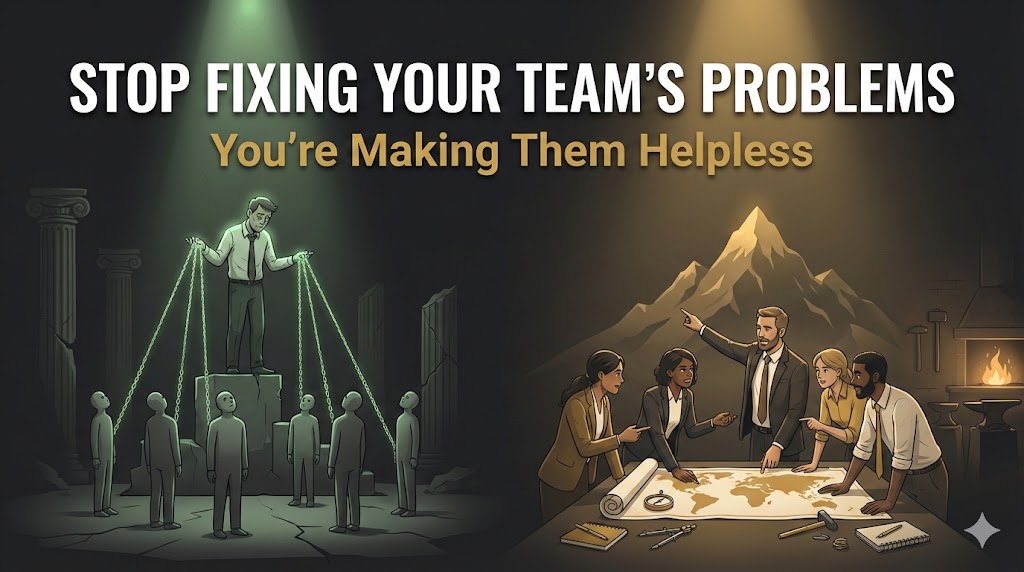
Stop Fixing Your Team's Problems. You're Making Them Helpless.
By Derek Neighbors on January 7, 2026
I used to be the guy who fixed everything.
Early in my career, I wore it like a badge of honor. Problem on the team? I’m on it. Crisis brewing? Hand it over. Someone stuck? Let me show you. I was responsive. Attentive. Problems never lingered because I jumped on everything immediately. My teams hit their numbers. Leadership loved me.
Then I took a two-week vacation and came back to chaos.
Projects had stalled. Decisions had backed up. Problems that should have been routine had become crises. The people who’d seemed so capable under my leadership suddenly couldn’t function without me in the room.
That’s when it hit me: I hadn’t built a capable team. I’d built a team that needed me.
Every problem I’d solved for them was a problem they never learned to solve themselves. Every fire I put out was a fire-fighting skill they never developed. My helpfulness had been a slow poison. I’d been building dependency where I should have been building capability.
The instinct to rescue never disappears. It must be disciplined daily. When PE partners want problems solved yesterday, when pressure mounts to just fix it and move on, the temptation surfaces. But external pressure doesn’t change what’s right. The obligation to develop rather than rescue remains constant whether the timeline is comfortable or crushing. What feels like leadership and looks like leadership is actually the opposite of what builds a team that can perform without you hovering over every decision.
The Two Paths
Two approaches to team leadership look almost identical from the outside. Both involve caring about your people. Both involve being responsive to problems. Both produce results in the short term.
One builds capability. The other destroys it.
The Rescue Path works like this: Problem emerges. Leader steps in. Problem solved. The team brings an issue. The leader provides the solution. The team executes. Crisis hits. Leader takes over. Crisis resolved.
The Coach Path works differently: Problem emerges. Leader asks questions. Team discovers solution. Team brings an issue. Leader explores their thinking. Team builds the approach. Crisis hits. Leader supports from the sidelines. Team learns to handle pressure.
Same problems. Same leader involvement. Radically different outcomes.
The rescue path produces faster visible results today. The coaching path produces capable people over weeks and months. Most leaders choose the path that feels better in the moment. That choice determines what their team becomes.
The Rescue Path
The appeal of rescuing is obvious. You get instant results. The team feels supported. You feel needed and valuable. Problems don’t fester. From the outside, it looks like strong leadership.
It feels like caring. And that’s what makes it so dangerous.
Every rescue comes with hidden costs. The team never develops problem-solving capability because you do it for them. You become the bottleneck for every decision because they’ve learned to wait for you. Their ingenuity atrophies from disuse. They learn helplessness. And you can never step away because the whole thing depends on you.
Here’s what nobody admits: rescuing serves the leader more than the team.
It serves your ego. Feeling indispensable feels good. It serves your anxiety. Controlling outcomes reduces your uncertainty. It serves your short-term metrics. Problems resolved quickly looks great in reports.
What it doesn’t serve is their development. Or the organization’s long-term health. Or anything that matters beyond your own comfort and image.
The self-deception runs deep because the intentions feel noble. You genuinely want to help. You genuinely care about outcomes. The problem is that caring about outcomes and caring about people aren’t the same thing. When you rescue, you’re choosing the outcome over the person’s growth. Then you tell yourself you did it for them. This is why rescuers rarely see themselves as rescuers. The story they tell themselves is “I’m helping.” The story the team experiences is “I’m being managed.”
The ancient Greeks had a concept called autarkeia, self-sufficiency. It represented the ideal of being able to stand on your own, to meet challenges with your own capability rather than depending on external support. Leaders who rescue their teams are actively preventing the development of autarkeia. They’re creating the opposite: chronic dependency dressed up as teamwork.
The Coach Path
The coaching path creates friction. It takes longer in the moment. The team may resist at first because being told what to do is easier than figuring it out. Solutions will be imperfect. You have to tolerate watching people struggle when you could just fix it yourself. The urgency screams at you to step in.
That discomfort is the price of development.
But the returns compound. Each problem the team solves builds capability for the next one. Capability means three things: the skill to execute, the judgment to decide, and the confidence to act without permission. All three must develop together. Skill without judgment creates technicians who can’t think. Judgment without confidence creates analyzers who can’t move. The coaching path develops all three simultaneously because real problems require all three.
Your value multiplies through others instead of being limited to your own bandwidth. The organization becomes resilient. The team can function without you. Eventually, they can excel without you.
This is what actual leadership looks like.
The Greeks called it phronesis, practical wisdom. The kind of judgment that only develops through experience, through wrestling with real problems and discovering what works. You can’t teach phronesis by giving people answers. They have to struggle their way to wisdom.
But not all struggle develops capability. Productive struggle has support structures: clear goals, access to resources, freedom to experiment, and psychological safety to fail. Destructive struggle is drowning: no guidance, no resources, punishment for mistakes. The coach’s job is ensuring the struggle is productive, not eliminating struggle entirely. Calibrating that line is itself an act of phronesis.
The ancient mentorship model understood this. The mentor’s role wasn’t to carry the student or solve their problems for them. The mentor created conditions for growth, asked questions that forced deeper thinking, and provided support that sustained effort without replacing it. The struggle was the teacher. The mentor was the guide.
The Real Difference
The difference between these paths isn’t speed or efficiency. It’s what you’re optimizing for.
Rescue leaders optimize for problems solved. Coach leaders optimize for problem-solvers created. Rescue leaders measure success by how much the team needs them. Coach leaders measure success by how little the team needs them.
The team you “help” the most becomes the team that needs the most help. Your indispensability is their incapability. These are the same thing viewed from different angles.
There’s a simple test. Ask yourself: What happens when I’m gone for a month? Can my team handle a crisis without calling me? Are they more capable now than when I started leading them?
If you’ve been on the rescue path, answer them honestly anyway. The answers reveal what you’ve actually been building.
Rescue leaders leave behind teams that collapse. Coach leaders leave behind teams that thrive. Your legacy isn’t measured by the problems you solved. It’s measured by the problem-solvers you developed.
The Integration
This doesn’t mean you never step in. But the bar is higher than most leaders set. Genuine emergencies mean imminent harm, not merely urgent timelines. Safety issues demand immediate action. Situations where the team literally cannot learn fast enough to avoid serious damage qualify. “This is taking too long” and “I could do it better” do not.
The difference is whether rescue is the exception or the pattern. If you’re rescuing more than once a month, you’re not facing exceptional circumstances. You’re following the rescue path and calling it judgment.
Even when you do step in, you can coach through it. Explain what you’re doing and why. Debrief afterward. Ask how the team could handle this themselves next time. The rescue becomes a teaching moment instead of just another save.
The coaching discipline requires specific practices. Ask questions before giving answers. What have you tried? What do you think? What’s stopping you? Resist the urge to shortcut. Your impatience is their developmental opportunity. Tolerate imperfection. In most business contexts, their good-enough solution that they own beats your optimal solution that they borrowed. The exception is safety-critical work where suboptimal execution causes real harm. But most work isn’t safety-critical. Leaders who claim otherwise are usually rationalizing rescue.
This requires character from you, and character must be developed, not merely decided. The courage to have uncomfortable conversations about capability instead of just fixing things. The patience to watch struggle without swooping in. The wisdom to know when support enables growth versus when it enables dependency. The ego discipline to stop needing to be needed.
Understanding this intellectually isn’t enough. The leader who knows coaching is right but cannot tolerate watching their team struggle hasn’t done the internal work. The anxiety that drives rescue must be examined and mastered. The ego that needs to feel needed must be confronted and released. This is soul work, not behavioral adjustment. You cannot sustain coaching discipline through willpower. You sustain it by becoming the kind of person who doesn’t need to rescue.
Being unnecessary is the goal, not the failure. And reaching that goal transforms the leader as much as the team.
Final Thoughts
Look at your team right now. Not their potential. Their actual current capability.
If they can’t function without you, you haven’t been leading them. You’ve been carrying them. And carrying isn’t sustainable, for you or for them.
The shift is simple to describe and difficult to execute. Stop solving. Start coaching. Stop rescuing. Start developing. Stop being the answer. Start building people who can find their own answers.
Every time you feel the urge to step in and fix something, ask yourself: Am I building capability or dependency right now? Is this rescue serving their growth or my comfort?
The team doesn’t need another problem solved. They need to become problem-solvers.
Your leadership will be measured by what they can do without you. Not by what they couldn’t do without you. The goal isn’t to be the leader everyone runs to. It’s to be the leader who built a team that rarely needs to run to anyone.
That’s the difference between a rescuer and a leader. One creates need. The other creates capability. One stays the same while managing others. The other grows by developing others.
The capable team is the visible result. The virtuous leader is the hidden cause. You cannot build one without becoming the other.
Which one are you building?
Ready to develop the character and discipline to build capable teams instead of dependent ones? MasteryLab provides frameworks and community for leaders who are done rescuing and ready to start developing. Because real leadership multiplies through others.


