The Thing That Saved You Is Now the Thing Destroying You
By Derek Neighbors on April 11, 2026
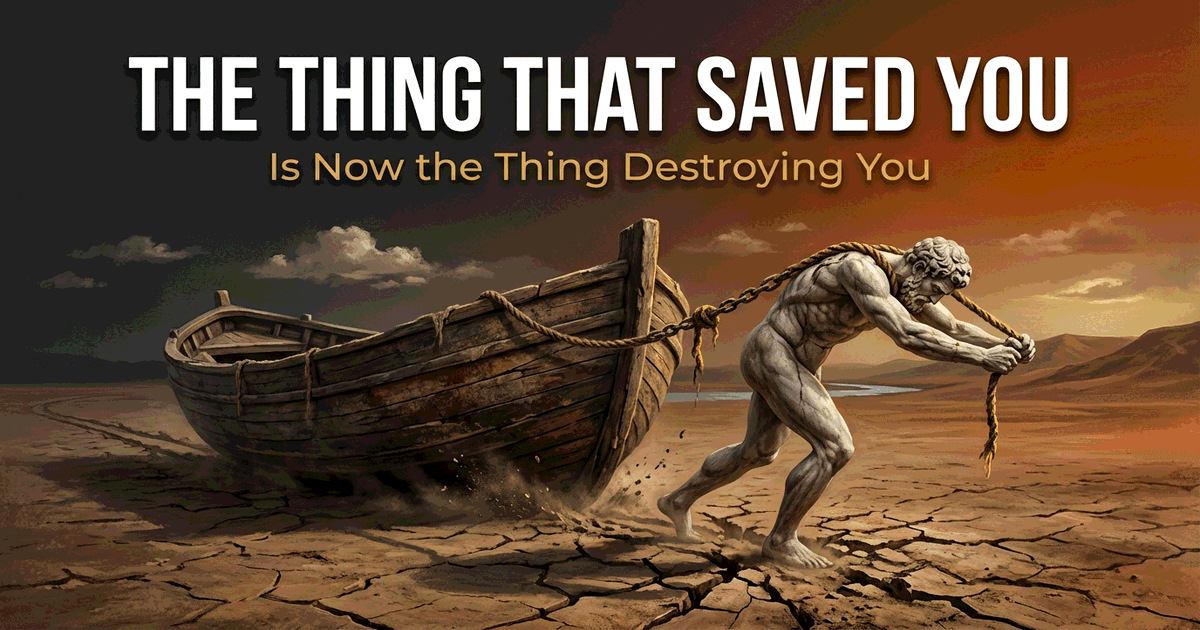
A traveler builds a raft to cross a dangerous river. The current is fast, the water is deep, and without the raft they would drown. It saves their life.
On the other side, they strap it to their back and keep walking.
Miles later, bleeding where the wood digs into their shoulders, exhausted from carrying weight that serves no purpose on dry land, they’re still hauling it. Not because they need it. Because it saved them once. And letting go feels like betraying the survival itself.
This is how most people live. Carrying behaviors, strategies, and identities that were forged in crisis and never examined once the crisis ended. The thing that saved you at twenty-two is the thing suffocating you at forty. The strategy was right for its moment. The moment passed. You kept carrying.
The Hypervigilant Survivor
Picture someone who grew up in chaos. An unpredictable household where the atmosphere could shift without warning. A parent’s mood, a slammed door, the specific weight of a silence that meant trouble was coming.
So they learned to read the room. Every micro-expression cataloged. Every shift in tone decoded. They became an expert at detecting threat before it landed. And that skill kept them safe. It was intelligent. It worked.
Now they’re thirty-five, in a stable relationship with someone who means what they say. Someone whose silence is actually silence, not a prelude to an explosion.
But the radar never turned off. Their partner says “I’m fine” and they spend the next hour scanning for what’s really going on. A neutral expression gets decoded as suppressed anger. A forgotten text becomes evidence of withdrawal. Every interaction runs through a threat-detection system calibrated for a war zone that no longer exists.
Their partner doesn’t understand why every conversation requires reassurance. Why “I’m not upset” never lands. Why love is never quite enough to override the alarm system.
The survival strategy that protected a child is dismantling an adult relationship. The radar was built for a house where danger was real. It’s still running in a home where the danger is the radar itself.
The Self-Made Workhorse
Someone clawed their way out of financial scarcity through relentless work. Fourteen-hour days. No vacations. Sleep deprivation worn like a badge. Everything they have, they built with their hands, and nobody handed them a thing.
That discipline was real. It got them out. It proved something to every person who counted them out.
Now they have resources, stability, options they couldn’t have imagined at twenty. And they still can’t stop. The engine that pulled them out of poverty is now burning through their health, their marriage, their relationship with their kids. They know it intellectually. Their doctor has told them. Their spouse has told them. Their body has told them.
They won’t feel it. The body remembers scarcity even when the bank account doesn’t, but the body doesn’t get the last word. Choice does. Some part of them still believes that the moment they slow down, everything collapses back to zero. Somewhere along the way, the discipline curdled into compulsion. The difference between the two isn’t whether you can stop. It’s whether continuing serves the life you actually have, or the one you escaped.
phronesis, the Greek concept of practical wisdom, would recognize the season changed. But survival programming doesn’t do seasons. It does forever.
The Armored Leader
Someone learned early that vulnerability gets exploited. A workplace betrayal. A partnership where trust became a weapon.
So they built armor. Emotional self-sufficiency became their operating system. Never need anyone. Handle everything alone, especially when things are falling apart.
It worked. They rose. People respected the composure, the capability. The armor got them promoted, got them through crises, got them a reputation as the person who never breaks.
Now they lead a team that needs something they can’t provide. What the people around them need is connection, someone they can follow into uncertainty, someone who shows enough humanity to make the risk feel shared. Instead they get someone standing behind glass, visible but unreachable.
The armor was forged in betrayal. It kept them safe when safety mattered most. Now the composure that earned respect prevents trust. And without trust, authority is performance.
The Inversion
Here’s what makes these patterns so difficult to see: these strategies didn’t fail. They succeeded so completely that the person fused with them. The raft became part of the body. Removing it doesn’t feel like relief. It feels like amputation. That feeling is real. It is also not a reason to keep carrying.
The deeper failure is philosophical. On the river, instinct governed because survival demanded it. On dry land, reason is available. The person dragging the raft hasn’t failed to notice the terrain changed. They’ve refused to let reason take over where instinct once had to rule.
The Buddha told a parable about this exact problem. A man builds a raft to cross a flood. Having reached the far shore safely, he asks himself whether he should continue carrying the raft on his head. The answer is obvious when it’s someone else’s raft. It’s invisible when it’s your own.
There’s a single question that cuts through the fog: Is this still protecting me, or am I now protecting it?
When you start defending the behavior instead of the behavior defending you, the relationship has inverted. The strategy used to serve you. Now you serve the strategy. You arrange your life around it, make excuses for its costs, go after anyone who questions it. You’re serving a ghost. And calling it wisdom.
phronesis is not the wisdom to acquire tools. It’s the wisdom to recognize when a tool’s season has ended. And that recognition demands a kind of grief, because setting down what saved you feels like ingratitude toward the version of you who survived. Too often, people replace that grief with the feeling of growth instead of doing the actual work of release.
Separating Gratitude from Grip
The shift happens when you can honor what the raft did without carrying it into the desert.
Three questions make the invisible visible. A warning: if you’ve been carrying long enough, you may not be able to answer honestly alone. The person inside the pattern is often the last to see it. Ask someone who knows you well to answer with you:
What strategy did you build in your hardest season, and what did it protect you from? Name it specifically. Not “I became strong.” What did you actually do? Withdraw? Overwork? Control? Perform? The vague version lets you keep carrying it. The specific version lets you examine it.
Is the original threat still present? Describe the context you operate in now. Is the chaos still real, or are you running defense against a war that ended years ago? The hypervigilant person living in a safe home. The workhorse sitting on a healthy savings account. The armored leader surrounded by people who have earned trust. If the threat is gone, the strategy is running on memory, not reality. If the threat is still present, keep the raft. The audit isn’t always a path to letting go. Sometimes it confirms the strategy is still earned.
What is the strategy costing you today that it wasn’t costing you then? At twenty-two, hypervigilance cost nothing because the environment demanded it. At thirty-five, it costs intimacy. At twenty-two, relentless work cost nothing because there was nothing else to lose. At forty, it costs a marriage and a relationship with your children. The cost structure changed. The behavior didn’t.
Once you see the gap between the threat that was and the threat that isn’t, there’s nothing left to analyze. The next move is to interrupt the pattern once, in one specific situation, and see what actually happens when the raft isn’t on your back.
The hardest part of that interruption isn’t the action. It’s the fear underneath. Not a void. A fear. Fear of who you might be without the strategy. That fear is the strategy’s last line of defense, the final way it keeps you carrying. If you’re not the hypervigilant one, who are you in relationships? If you’re not the workhorse, what earns your place? If you’re not the armored leader, what protects you?
The answer is the one nobody wants to hear: you do. Not the strategy. You. The version of you that no longer needs the raft. That version has always been there, underneath the wood and the rope and the weight. You’ve been too busy carrying to notice.
Frequently Asked Questions
How do you know when a survival strategy has become destructive?
The clearest signal is when you start defending the behavior more than the behavior defends you. If people close to you keep naming the same pattern, if the cost of maintaining it exceeds what it protects you from, and if you can’t stop even when you want to, the strategy has outlived its purpose. Ask yourself: is this still protecting me, or am I now protecting it?
Why is it so hard to let go of coping mechanisms that once saved you?
Because the strategy fused with your identity. The hypervigilant person isn’t choosing to scan for danger. That scanning is who they believe they are. Letting go requires grieving the version of you that survived, which feels like ingratitude. Honoring what saved you and refusing to let it run your present are compatible, but separating gratitude from grip takes deliberate work.
What is phronesis and how does it relate to letting go of old patterns?
phronesis is Aristotle’s concept of practical wisdom, knowing the right action at the right time in the right measure. Applied to survival strategies, phronesis is the capacity to recognize when a tool’s season has ended. It’s not about acquiring more wisdom or more tools. It’s about knowing when something that once served you has completed its purpose.
Final Thoughts
Every survival strategy forged in extremity has a half-life. The wisdom isn’t in building one. Everyone builds them. The wisdom is in recognizing the expiration.
The Greeks understood this through phronesis, practical wisdom that includes knowing the right action for the right moment. What saved you at twenty-two and suffocates you at forty isn’t a contradiction. It’s a timeline. The strategy was right. The season changed. You didn’t. And the longer you go without noticing, the heavier the raft gets.
The boat-dragging audit isn’t about rejecting your past. It isn’t ingratitude toward the person who survived. It’s the opposite. It’s honoring that survival by refusing to let it make decisions for a present it doesn’t understand.
Set the raft down. You’re on dry land. You have been for a while.
The work of examining what you’re carrying, and building the practical wisdom to set it down, is the kind of work that changes everything downstream. If you’re ready to do that work with structure and accountability, MasteryLab.co is where it happens.