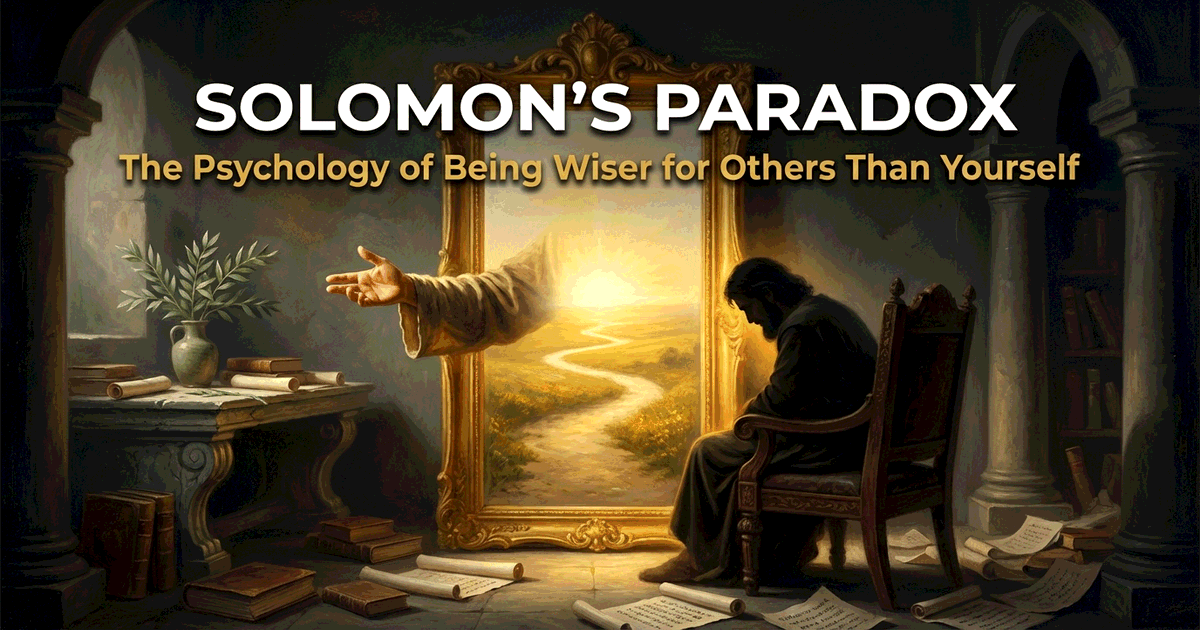
Solomon's Paradox: The Psychology of Being Wiser for Others Than Yourself
By Derek Neighbors on April 5, 2026
Your friend calls with a problem. Maybe it’s a relationship that stopped working two years ago. Maybe it’s a job that’s slowly hollowing them out. Maybe it’s a decision they’ve been circling for months, unable to commit.
You listen for five minutes. You see it. The pattern, the self-deception, the thing they can’t see because they’re inside it. You deliver the insight in thirty seconds. They thank you. They tell you how clear-headed you are.
Then you hang up and face the exact same kind of problem you diagnosed for them. Except now, you can’t see a single step forward.
Psychologists call this Solomon’s Paradox. And if you’ve ever wondered why the person everyone turns to for advice can’t seem to take their own, you already know it from the inside.
The Symptoms
This is a documented cognitive pattern, and it’s nearly universal.
You see other people’s situations with uncomfortable clarity. Their blind spots are obvious. Their rationalizations are transparent. You’ve known what your sister should do about her marriage for months. You’ve known what your colleague should do about his career since last year. The clarity is effortless.
But your own problems? The same categories, relationships, career, money, health, that you can diagnose for others in minutes have been circling your life for years. You preach boundaries to friends while violating your own. You counsel patience while panicking about your own timeline.
The gap between the wisdom you offer and the wisdom you practice has a name. In 2014, psychologist Igor Grossmann at the University of Waterloo published research identifying Solomon’s Paradox, named after the biblical king who dispensed legendary wisdom to his subjects while his own life collapsed under spectacularly poor personal decisions.
Grossmann didn’t leave it at metaphor. He measured it. Across six studies, participants consistently demonstrated wiser reasoning, greater intellectual humility, and more willingness to consider opposing perspectives when evaluating other people’s dilemmas compared to their own. Same person. Same cognitive capacity. Different results depending on whose life was on the line.
The Assessment
The question isn’t whether this gap exists. It does, in almost everyone. The question is why.
Emotional proximity distorts judgment. When it’s your problem, fear is active. Ego is active. Attachment to outcomes, identity investment in past decisions, anxiety about what change requires, all of it floods the reasoning process. When it’s someone else’s problem, none of that noise exists. You can see the board. In your own game, you can only see the piece you’re gripping.
Identity protection creates blind spots. Admitting you’re wrong about your career means admitting you may have been wrong for years. Admitting your relationship isn’t working means confronting the story you’ve told yourself and everyone around you about how well things are going. For other people, truth carries no ego cost. For you, it threatens the narrative you’ve built your stability on.
Stories masquerade as complexity. You’ve constructed elaborate explanations for why your situation is different, more nuanced, more complicated than it appears. These stories feel like sophisticated thinking. They function as insulation. Your friend’s situation seems clear because you haven’t spent three years building justifications for it.
A caveat worth taking seriously: not all self-complexity is rationalization. Sometimes your situation genuinely is more nuanced than it appears from outside, and the friend offering simple advice is the one missing critical information. The diagnostic question is whether your sense of complexity produces new options or only defends the current position. Rationalization disguised as nuance always points toward staying put. Genuine complexity opens doors you haven’t considered.
I’ve watched this play out in myself. I could sit across from a founder and tell them in ten minutes that their co-founder relationship was broken, that the way they avoided conflict was corroding the company from the inside. I could see it with perfect clarity. Meanwhile, I was running the same avoidance pattern in my own business partnerships. The difference wasn’t intelligence. The difference was that my own story had years of emotional investment protecting it from scrutiny.
The Stoics identified this problem two thousand years before Grossmann measured it. They developed a specific practice called prosoche, the disciplined examination of your own judgments, impulses, and reasoning before acting on them. Not reflection in the modern journaling sense. Interrogation. Examining whether your conclusions come from clear thinking or from fear, ego, or habit operating beneath awareness. Epictetus taught it. Marcus Aurelius practiced it nightly. Not because self-awareness came naturally to them. Because it didn’t come naturally to anyone.
The Diagnosis
The root cause is simpler than it feels: you lack distance from yourself.
When you think about your friend’s problem, you automatically adopt an outside perspective. You see the full picture, the patterns, the trajectory. You’re watching a film with the benefit of an aerial shot.
When you think about your own problem, you’re trapped inside the scene. First-person perspective. Your own emotions as the soundtrack. Your own fears as the narrator. Every detail is saturated with personal significance, making it impossible to distinguish signal from noise.
Grossmann’s most important finding was how easily the gap closed. When participants were instructed to reason about their own problems from a third-person perspective, to ask “What would you tell a friend facing this exact situation?”, the wisdom gap vanished. The knowledge was always there. The perspective was missing.
An important distinction: reducing cognitive bias and developing genuine wisdom are related but not identical. Self-distancing clears the interference so you can think straight. But thinking straight is the starting point for phronesis, not the finish line. The Stoics understood that clearing emotional distortion was necessary but not sufficient. You also need the character to act on what you see once the fog lifts.
The ancient Greeks understood this distinction long before anyone measured it in a laboratory. They called the difference doxa and episteme. doxa is opinion shaped by proximity, emotion, and ego. episteme is knowledge earned through examined distance. Your internal monologue about your own problems is doxa, reactive, defensive, distorted by proximity. Your advice to others is closer to episteme, not because you’re smarter about their lives, but because you’re freer.
prosoche is the practice of earning episteme about yourself. Deliberately. Repeatedly. Against the grain of every instinct that wants to keep you comfortable inside your own story.
The Treatment
None of these practices are optional. If you owe honest counsel to a friend, you owe it to yourself first. Epictetus was a slave and still held himself to nightly self-examination. The obligation doesn’t scale with your comfort level.
Four practices that create the distance your brain refuses to provide on its own.
The simplest one first: when facing a decision you can’t resolve, write about it as if you’re advising someone else. Use a friend’s name or invent one. Describe the situation from outside. Include the details you’d normally minimize. Grossmann’s research shows this single technique eliminates the wisdom gap. Not reduces. Eliminates. The knowledge was never missing. The vantage point was.
You can get the same effect with time instead of social distance. Ask yourself: “Looking back on this from five years out, what would I tell myself right now?” The urgency you feel, the fear that this decision will ruin everything, almost never survives a five-year lens. The right answer usually does.
For ongoing practice, try ten minutes daily of examining your own reasoning. Not journaling your feelings. Interrogating your logic. Where is fear making the argument? Where has ego built a fortress around a decision that reality already moved past? Marcus Aurelius wrote the Meditations this way: as letters from his clear-headed self to his compromised self.
And monthly, take your three biggest unresolved problems. For each one, write the advice you would give a friend in the identical situation. Then sit with the gap between what you’d prescribe and what you practice. That gap is the exact measurement of your self-deception, delivered by the part of you that already knows.
The Prevention
prosoche isn’t a one-time insight. It’s a discipline.
Marcus Aurelius didn’t write the Meditations once and put the journal away. He returned to the practice every night for decades because the forces that create the wisdom gap don’t take breaks. New situations generate new stories. New stakes create new emotional proximity. New identity investments build new fortifications around bad decisions.
The human brain processes self-relevant information through different neural pathways than other-relevant information. This is biology, not morality. But the response to it is entirely moral. You can’t choose your cognitive architecture, but you can choose whether to build practices that compensate for its weaknesses. The wiring explains why self-examination is hard. It does not excuse you from doing it. You need structures and practices that counteract the default, not willpower declarations that you’ll “be more honest with yourself.”
This is where most modern advice fails. “Know thyself” assumes the observer is reliable. It isn’t. The observer is compromised by the same proximity that created the problem. You need a method that forces separation between the one examining and the one being examined. The Stoics built prosoche as exactly that method: a structured practice for splitting yourself into the advisor and the advised, then forcing the advisor to speak.
The Stoics understood this with a practicality that modern self-help keeps missing. They didn’t tell people to “trust their gut” or “listen to their inner voice.” They knew the inner voice lies when the stakes are personal. They built prosoche as a systematic counterweight, a practice for forcing the same honest assessment you give freely to others onto the one life where it actually matters.
At its deepest level, prosoche is not a technique you apply but a way of being you develop. The four practices above are entry points. Over time, the distance they create becomes less something you manufacture and more something you inhabit. The Stoics didn’t see self-examination as a tool. They saw it as the defining mark of a philosophically serious life.
Final Thoughts
phronesis, practical wisdom, applied selectively is not wisdom. If your clearest thinking only shows up when someone else’s life is on the line, you haven’t developed a gift for reading people. You’ve developed a habit of avoiding yourself.
Solomon’s Paradox reveals that the gap between the wise counsel you offer and the confused decisions you make isn’t a knowledge problem. You already possess every insight you need. You’ve been distributing it freely to everyone around you.
The missing piece is distance. prosoche is the practice of creating that distance deliberately, turning the clarity you already possess inward, where it costs something, where it threatens a comfortable story, where it actually matters.
The wisdom you need most is the wisdom you gave away last week.
If you’re ready to close the gap between the wisdom you give and the wisdom you live, MasteryLab.co provides the frameworks and community to turn philosophical insight into daily practice.