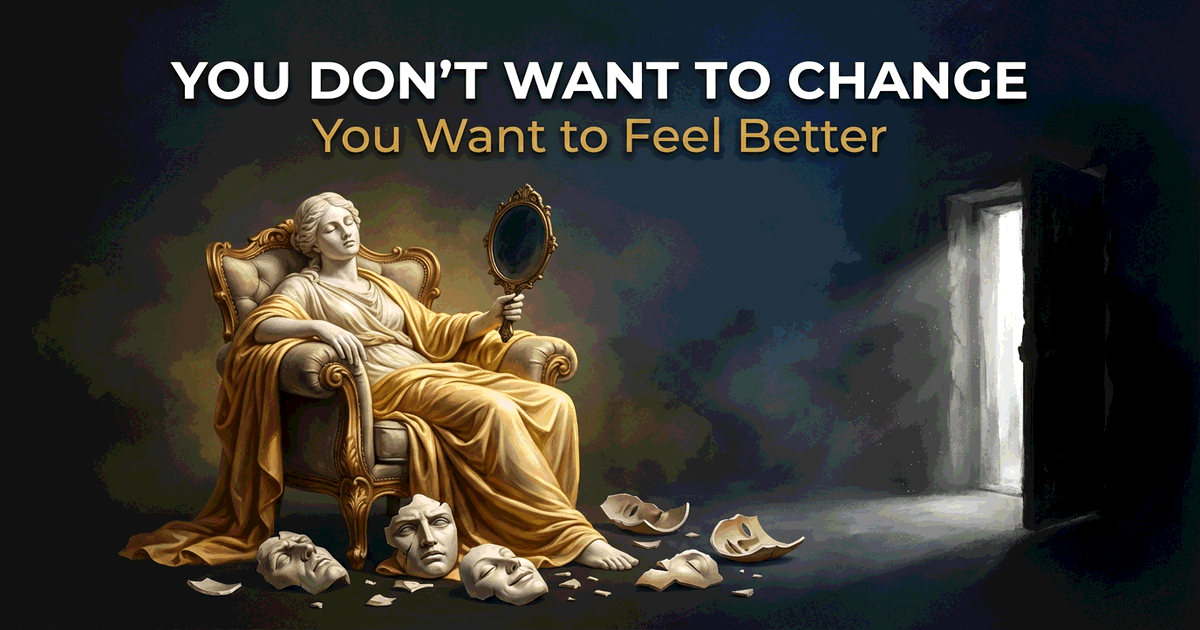
You Don't Want to Change. You Want to Feel Better.
By Derek Neighbors on April 10, 2026
I spent two years doing what I thought was serious personal development work. Journaling every morning. Reading philosophy. Working with a coach. Attending a conference every quarter. I could articulate my patterns with precision. I knew my triggers, my tendencies, my blind spots. The self-awareness was genuine.
Then one afternoon, in the middle of explaining my latest breakthrough to a friend, she said something that stopped me cold.
“You’ve been having the same breakthrough for eighteen months.”
She was right. The language kept getting sharper. The behavior hadn’t moved an inch. Same conflicts at work. Same avoidance in the conversations that mattered. Same patterns playing out on a loop, but now with better narration.
That was the moment I realized: I didn’t want to change. I wanted to feel better about staying the same.
The Relief Industry
Anthony de Mello made a distinction worth sitting with. People don’t want a cure, he argued. They want relief.
Relief and transformation look similar from the outside. Both involve effort and investment. Both produce emotional experiences that feel like progress.
The difference is what survives the process.
Relief preserves who you are by removing discomfort. The anxiety goes down. The vocabulary goes up. The identity stays intact. You walk away from the workshop feeling lighter and more equipped. Nothing structural has changed, but the pressure has been released. That release feels like growth. It isn’t.
Transformation destroys who you are to build who you could be, someone closer to virtue, to honesty, to a life that reflects what you actually value rather than what you’ve settled for. Beliefs you’ve held for decades get demolished. Relationships that depended on the old version of you can’t survive the new one. Comforts you’ve maintained for years become intolerable because maintaining them requires being someone you’re no longer willing to be.
One process adds. The other subtracts. The personal development industry is built almost entirely on the first. But relief-seeking isn’t a consumer problem. It’s a human one. People without access to coaches or workshops run the same pattern in different forms: blaming circumstances, fantasizing about a different life, rehearsing grievances instead of changing behavior. The medium varies. The avoidance is identical.
Four Relief Strategies Disguised as Growth
The sophistication of relief-seeking is what makes it so dangerous. These aren’t lazy behaviors. They require real effort and real money. That’s precisely why they’re so convincing.
The Knowledge Collector
Read every book. Listen to every podcast. Attend every workshop. The knowledge accumulates. The behavior doesn’t.
The Greeks separated mathesis, the act of learning, from askesis, the discipline of training through practice. They understood that knowledge without action is a spectator sport. You can study courage for a decade and still avoid every hard conversation. The studying might even become the mechanism of avoidance, because it feels productive enough to quiet the guilt of inaction.
I know people who can map their attachment patterns on a whiteboard. They can explain, with clinical accuracy, why they avoid intimacy. The explanation has become so refined that it functions as a finished product. Understanding the pattern replaced breaking it.
The Environment Shuffler
New job. New city. New relationship. New morning routine. The external architecture gets redesigned constantly. Seneca identified this pattern two thousand years ago: “It is not that we have a short time to live, but that we waste much of it.” He was even more direct elsewhere. You take yourself with you. Geography doesn’t fix character.
The environment shuffle is relief because it replaces the discomfort of sameness with the stimulation of novelty. The new context provides a temporary reprieve from old patterns. Give it six months. The patterns reassert themselves because they live in you, not in your surroundings.
The Feelings Processor
Endless journaling. Constant emotional excavation. “Sitting with” discomfort as a permanent practice rather than a temporary phase on the way to action.
Aristotle was blunt about this. We become brave by doing brave things. We become generous by practicing generosity. We become honest by telling the truth when it costs us. praxis, action in the world, was the only mechanism the Greeks recognized for building virtue. Understanding bravery doesn’t produce courage. Walking into the situation that scares you does.
Processing has its place. It becomes a problem when it becomes the destination. When “I’m working through it” stretches from weeks into years, the processing has become the avoidance it was supposed to cure.
The Identity Narrator
Public declarations of transformation. Origin stories polished to a shine. “I used to be that person. Now I’m this one.” Vision boards. Affirmation routines. The narrative of change constructed with the care and craft of a screenplay.
The Greeks measured ergon, the actual work and function of a thing. The ergon of a knife is to cut. The ergon of a person is to act with virtue. Not to describe virtue. Not to plan for virtue. To do it, repeatedly, under pressure, when nobody is watching.
Narrating your transformation is not the same as living it. The story can become so compelling that it replaces the need for the experience it describes.
The Destruction Test
Here’s the diagnostic I wish someone had given me during those two years of educated stagnation.
Real transformation is recognizable by what it destroys, not what it adds. Not destruction for its own sake. Destruction that happens because you reoriented toward something truer and the old structures couldn’t survive the shift.
If your identity, your relationships, and your comfort zones all survived your growth period fully intact, you didn’t transform. You upgraded the software on the same machine. The machine is what runs the patterns.
Ask yourself three questions:
What belief did I hold for years that my growth work actually killed? Not refined. Not nuanced. Killed.
What relationship couldn’t survive the person I became? Not because the other person was toxic, but because the old version of me was the one they had a relationship with, and the new version couldn’t honor that contract anymore.
What comfort did I genuinely surrender, not temporarily sacrifice during a retreat weekend, but permanently release because maintaining it required being someone I refused to keep being?
There’s a fourth question that goes deeper than the external ones. Has your relationship to honesty fundamentally changed? Not whether you lost things, but whether you now see yourself and your patterns with a clarity that would have been unbearable before. External losses are indicators. The real shift is internal: a willingness to face what’s true about yourself without the buffer of narrative or rationalization.
If all four answers are thin, the work produced relief. The discomfort went down. The identity stayed the same.
The Fox Problem
There’s a structural problem built into relief-seeking that makes it particularly difficult to escape. The version of you that needs to change is the same version selecting the growth strategy.
Think about what that means. Your current operating system, the one producing the patterns you want to break, is also the operating system evaluating which books to read, which coaches to hire, which workshops to attend. This is why we sabotage what we know is right. It will naturally select interventions that feel challenging enough to satisfy the desire for growth while remaining safe enough to leave the core identity intact.
phronesis, the Greek concept of practical wisdom, includes the capacity to see through your own self-deception. It’s the rarest form of intelligence because it requires turning the analytical lens inward with genuine ruthlessness. Most people deploy their intelligence outward, seeing patterns in others with startling clarity while remaining blind to the identical patterns running in themselves.
The fox is guarding the henhouse. And the fox is very, very smart.
But knowing the fox exists is the first crack in its power. The choice to look honestly at your own patterns, to let someone else’s brutal observation land instead of deflecting it, remains yours. That choice never leaves your control, no matter how sophisticated the self-deception becomes.
Most people who actually break through report the same catalyst: someone they couldn’t manage told them a truth they couldn’t unhear. A crisis made the old identity untenable. Or the pain of staying the same finally exceeded the pain of changing. The fox doesn’t defeat itself. Something from outside the henhouse has to get in.
Frequently Asked Questions
Why doesn’t personal development lead to real change?
Most personal development focuses on relief rather than transformation. Relief removes discomfort while preserving your current identity. Transformation requires destroying parts of who you are to build something new. Reading books, attending workshops, and learning frameworks can all provide the feeling of progress without requiring the behavioral destruction that genuine change demands.
What is the difference between relief and transformation?
Relief adds comfort and removes pain while keeping your identity intact. Transformation subtracts. It requires abandoning beliefs, ending relationships that depend on the old version of you, and surrendering comforts that maintain patterns you claim to want to break. Relief makes the current situation bearable. Transformation makes the current situation impossible to maintain.
How do you know if your personal growth is actually working?
Real growth has a cost beyond money and time. Ask what belief you abandoned, what relationship couldn’t survive the new version of you, what comfort you genuinely surrendered. If your life looks structurally the same after years of growth work, with the same patterns, same conflicts, same avoidance, the work produced relief rather than change.
Final Thoughts
The difference between relief and transformation comes down to a single word: destruction.
Relief adds tools, frameworks, vocabulary, practices, and understanding to your existing identity. Transformation subtracts. It removes beliefs, relationships, comforts, and self-concepts that can only exist if you stay who you currently are.
Stop asking what to add to your growth practice. Start asking what you’re protecting that needs to die.
The answer to that question, and your resistance to answering it honestly, is where the real work begins.
If you’re ready to stop collecting breakthroughs and start building the character that makes them unnecessary, MasteryLab.co is where that work happens.