Concealing Your Intentions Isn't Clever. It's Exhausting.
By Derek Neighbors on February 3, 2026
Power vs. Virtue: The 48 Laws Examined
A year-long examination of Robert Greene's 48 Laws of Power through the lens of ancient virtue ethics. Some laws we affirm, some we reframe, some we reject entirely.
Law 3 of Robert Greene’s The 48 Laws of Power sounds like strategic genius:
Conceal your intentions. Keep people off-balance and in the dark by never revealing the purpose behind your actions. If they have no clue what you are up to, they cannot prepare a defense.”
The logic is seductive. Information is advantage. Surprise creates opportunity. Mystery generates power. It’s one of the most quoted passages from the 48 Laws of Power for a reason.
But there’s something Greene doesn’t calculate: the cost of maintenance.
The Tactical Truth
Let’s be honest about why this law appeals to people.
In competitive situations, information asymmetry creates real advantage. The business acquisition kept secret until announcement prevents competitors from countering. The negotiator who doesn’t reveal their bottom line maintains flexibility. The leader who holds strategic plans close prevents leaks and interference.
In hostile environments, revealing intentions can invite sabotage. Not everyone wishes you well. Not every context rewards transparency.
This isn’t wrong. In zero-sum games, concealment can work tactically.
But “it works” doesn’t mean “it’s wise.” And the behavior of others doesn’t determine what’s right for you to do. Your character isn’t contingent on whether the environment deserves your honesty.
Tactical effectiveness isn’t the only question. The deeper question is what concealment costs, and whether those costs compound faster than the benefits.
The Character Cost
Here’s what Greene doesn’t mention: every concealment requires maintenance.
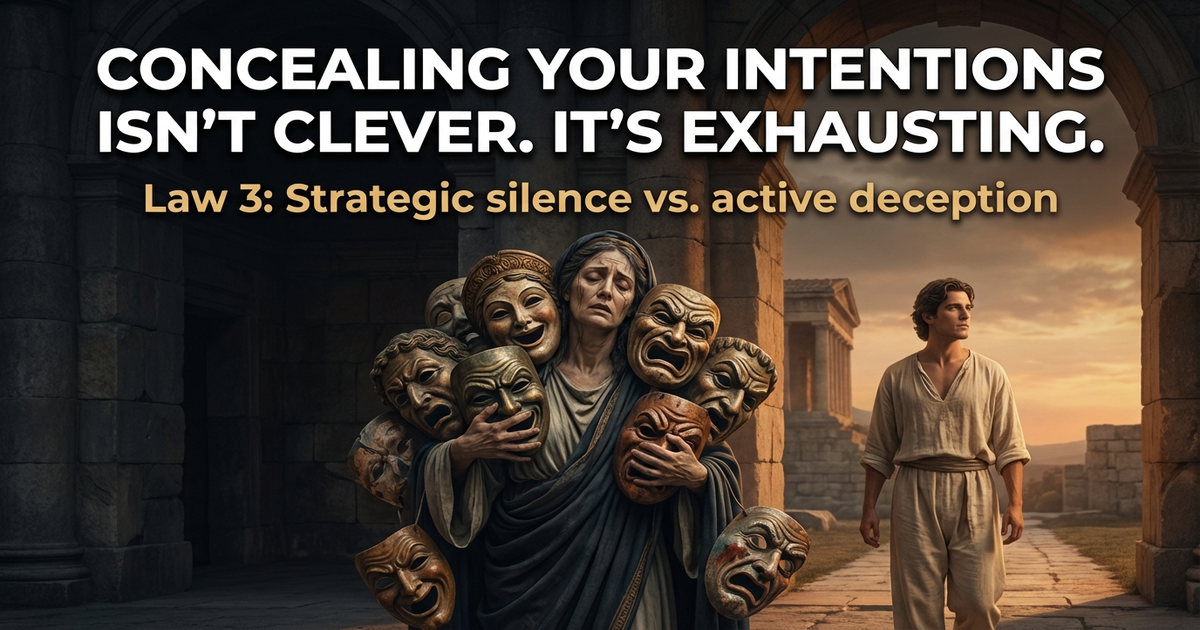
When you tell different stories to different audiences, you have to remember who heard what. When you hide your actual agenda, you have to manage perceptions across every interaction. When you wear masks, you have to track which face you’re showing to whom.
This is work. Constant, draining, never-finished work.
The cognitive load isn’t a one-time cost. It compounds. The more you conceal, the more you have to track. The longer you maintain deceptions, the heavier they become. There’s no point where you’ve done enough concealing and can now relax. The maintenance never ends.
Meanwhile, relationships erode. People sense inauthenticity even when they can’t prove it. Trust, once damaged, rarely fully recovers. Intimacy becomes impossible when concealment is habit. You end up surrounded by people who only know your mask, which means you’re surrounded by people who don’t know you at all.
The deepest cost is identity fragmentation. When you’ve worn enough masks long enough, you start losing track of what you actually want. The authentic self gets buried under layers of performance. Eventually you’re not concealing intentions from others. You’re concealing yourself from yourself.
This is why concealment isn’t clever. It’s exhausting. The energy spent maintaining deceptions could build something real instead.
The ARETE Alternative
The Greeks understood a distinction that Greene ignores: the difference between strategic silence and active deception.
sophrosyne, self-restraint, includes knowing when not to speak. There’s wisdom in timing, in not volunteering information before its moment, in letting actions speak before words explain.
But strategic silence is fundamentally different from active deception.
Silence means not offering information that wasn’t requested. Deception means actively misleading about what is true. The first preserves character. The second erodes it.
But here’s the complication: silence with intent to mislead is still deception. If you stay quiet specifically because you know your silence will create a false impression, you’ve crossed the line. The distinction isn’t about words versus no words. It’s about intent.
Consider the practical difference:
In a negotiation, saying “I’m not ready to share that yet” can be honest, if you genuinely intend to share later or have legitimate reasons to wait. It preserves your position without corrupting your integrity. But the same words spoken with intent to permanently mislead become deception dressed as discretion. The test is your intention, not your phrasing. Providing false information accomplishes the same tactical goal while taxing your character.
In leadership, timing the release of information is phronesis, practical wisdom about when and how to communicate. Lying about your plans is manipulation that will eventually surface and destroy trust.
In relationships, privacy is legitimate. Hidden agendas are corrosive. Keeping your own counsel differs from keeping false counsel.
Note that professional confidentiality is different from self-interested concealment. The doctor who withholds a diagnosis until the right moment, the lawyer who protects client information, the leader who keeps personnel decisions private until announced. These aren’t deceptions but obligations to others. The test is whether concealment serves your advantage or protects someone else’s legitimate interest.
The test requires judgment: “Am I being strategically quiet, or am I actively deceiving?” One is wisdom. The other is a trap.
Ancient Wisdom Connection
The Greeks valued aletheia, a word usually translated as “truth” but meaning something deeper: unconcealment, revelation, the orientation toward reality as it actually is.
This matters beyond practical benefits. Truth isn’t just useful. It’s the proper orientation of a human soul. We’re built to perceive reality, not construct false versions of it. When we deceive, we create a counterfeit world and imprison ourselves within our own fabrication.
Living in concealment isn’t just tactically risky or energetically costly. It’s living against truth itself, against the fundamental human orientation toward what is real. The soul that deceives is a soul turned away from Reality.
Marcus Aurelius advised living as if everything you do will become public. This wasn’t naive idealism. It was practical wisdom about freedom. When you have nothing to hide, you have nothing to manage. When your public face matches your private thinking, you don’t exhaust yourself tracking which version of yourself you’re presenting.
Integrity means wholeness. The word shares a root with “integer,” a complete number. The deceiver is fragmented, maintaining multiple versions of reality across different audiences. The truthful person is whole, the same in all contexts.
That wholeness isn’t just morally superior. It’s energetically efficient. Honesty is low-maintenance. Deception is overhead that never stops compounding.
The Test
Ask yourself these questions:
- How much mental energy do you spend managing what different people think you’re doing? If the answer is “significant,” you’re paying a tax that could fund something better.
- If everything you’ve said this week became public, would you need to explain or apologize? The gap between your answer and “no” is the measure of your concealment load.
- Can you clearly distinguish between times you’re being strategically quiet versus actively deceptive? If the line is blurry, you’ve probably drifted further into deception than you realize.
- Are you building relationships where you can be fully known, or are you surrounded by people who only know your performance? The latter is loneliness with extra steps.
- Is your concealment protecting something worth protecting, or protecting you from accountability you should face? Most concealment, honestly examined, is the second.
Final Thoughts
The 48 Laws of Power treats concealment as a universal advantage. But Law 3 conflates two very different things: the wisdom of timing with the manipulation of deceiving.
Strategic silence, knowing when to speak and when to wait, is genuine phronesis. It’s part of practical wisdom, and the ancients practiced it.
Active deception, misleading others about your actual intentions, is a character tax that compounds until you can’t remember who you were before you started hiding.
The exhaustion isn’t a side effect. It’s a signal. Your energy is finite. Every unit spent maintaining deceptions is a unit not available for building something real. Every relationship damaged by discovered dishonesty is support you could have had.
But here’s what matters most: even if deception weren’t exhausting, it would still corrupt character. The cost isn’t the core problem. The corruption is. Deception would damage the soul even if it were easy to maintain.
Concealment isn’t clever. It’s overhead that disguises itself as strategy. And more than overhead, it’s a turning away from what’s real. Deception isn’t just a practical problem. It’s a metaphysical one. Every lie creates a false world you must then inhabit.
The truly free aren’t the ones with the most secrets. They’re the ones with the least need for them.
If you’re building power that doesn’t require deception, MasteryLab.co is where leaders learn to achieve results through character rather than concealment.