If You've Never Questioned Your Beliefs, You Don't Actually Hold Them
By Derek Neighbors on April 16, 2026
I spent years confusing conviction with clarity.
I could defend every position I held. I had arguments for my worldview, evidence for my strategies, reasons for every choice. And because I could defend them, I assumed my beliefs were examined. Tested. Earned.
They weren’t. I had rehearsed them. There’s a difference most people never discover until something breaks that their certainty promised would hold.
The Discipline That Built Rome’s Greatest Mind
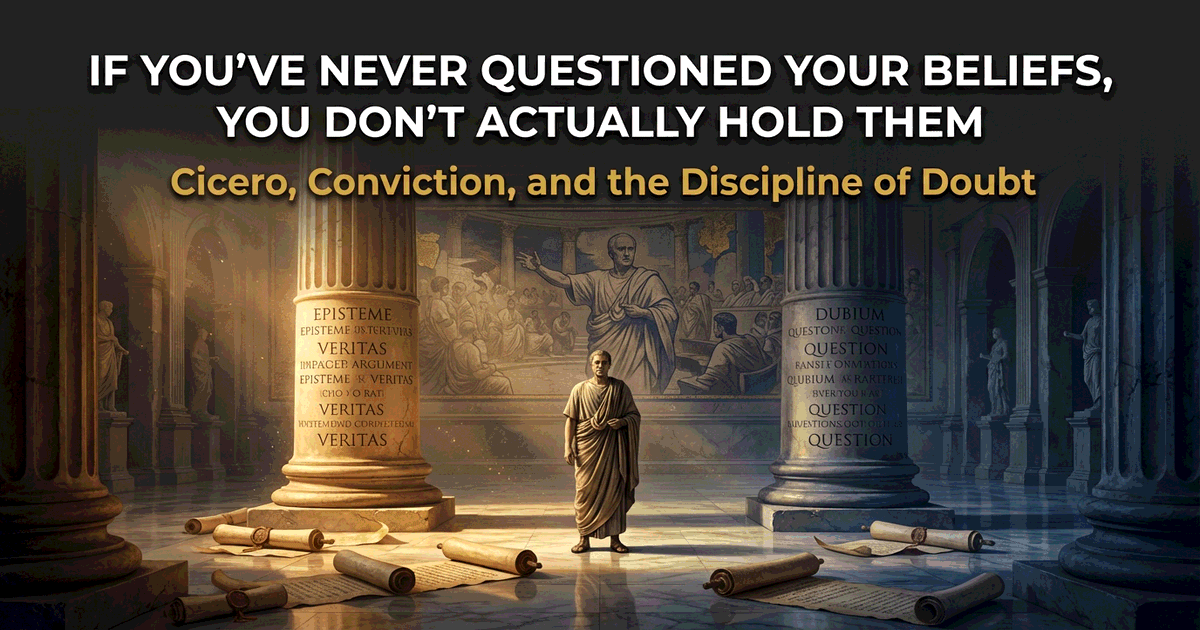
Two thousand years before anyone coined “critical thinking,” Cicero practiced something far more demanding. The Academic Skeptics of the New Academy trained in In Utramque Partem, arguing both sides of every question with equal force. Not as an exercise in relativism. As intellectual combat training.
Epoché, the suspension of judgment, wasn’t weakness. It was the discipline of refusing to commit to a conclusion until you had genuinely tried to destroy it.
This distinction matters. Cicero wasn’t teaching people to believe nothing. He was teaching them to believe things that could survive opposition.
The Stoics, his philosophical rivals, actually agreed on the core principle. Even Zeno and Chrysippus stress-tested their doctrines against counterarguments. The Stoic prosoche (attention) demanded constant vigilance against accepting impressions uncritically. The method differed. The underlying commitment to examination was shared.
Socrates said it first and most simply: wisdom begins with knowing what you don’t know. The Greeks drew a sharp line between doxa (opinion, belief, the things you absorb from your environment) and episteme (genuine knowledge, arrived at through rigorous examination). Most of what people call conviction lives in the doxa category. Inherited. Absorbed. Never stress-tested against serious opposition. That doesn’t mean inherited beliefs are automatically wrong. Some inherited wisdom is genuinely wise. But you can’t know which until you’ve examined it. The person who tests their inherited beliefs and confirms them has earned something the person who simply kept them never did.
Conviction Culture and Its Casualties
Somewhere along the way, certainty became a virtue and doubt became a character flaw.
Social media rewards the person with the strongest take, not the most examined one. Algorithms optimize for positions that generate emotional response, which means the most extreme and unqualified claims get the most distribution. The incentive structure actively punishes nuance.
The personal development industry compounds the problem. “Believe in yourself.” “Trust your vision.” “Stay committed.” These mantras treat doubt as an obstacle to overcome rather than a tool for sharpening what you believe. They sell certainty as a product. Subscribe to this framework, attend this seminar, read this book, and you’ll never have to wrestle with uncertainty again.
The result shows up everywhere.
There’s the leader who built a strategy eighteen months ago and treats any criticism of it as disloyalty. The strategy might be failing. The data might be screaming. But they committed, and commitment means never re-examining, apparently.
There’s the person whose “personal growth” looks suspiciously like doubling down. They read the same category of books, follow the same voices, attend the same events. Each year they’re more certain and less curious. They call it depth. It’s actually a narrowing spiral.
There’s the community that mistakes agreement for alignment. When disagreement disappears, it doesn’t mean the group found truth. It means the dissenters left or went quiet. The remaining consensus feels like strength. It’s fragility waiting for its first real test.
Unexamined conviction produces brittleness. The person who has never seriously entertained the possibility they’re wrong has built their identity on foundations they’ve never inspected. When reality delivers the shock that reality always delivers, they don’t adapt. They shatter. And they rarely shatter alone. The leader operating from unexamined certainty wastes the careers of every person executing that flawed strategy. The parent operating from unexamined beliefs about success damages the child who needed a different kind of support. Unexamined conviction isn’t a personal limitation. It’s a moral failure with collateral damage.
This is why arguing your point is always a losing strategy. The person with unexamined beliefs doesn’t process opposing arguments. They experience them as threats. And when you treat information as a threat, you’ve stopped thinking and started defending. The Greeks called this the difference between a philosopher and a sophist. The philosopher follows the argument wherever it leads. The sophist makes the argument lead wherever they want.
Where Doubt and Conviction Meet
The integration point isn’t choosing between commitment and questioning. It’s understanding that real commitment requires questioning.
Cicero didn’t arrive at provisional conclusions because he lacked the courage for permanent ones. He arrived at provisional conclusions because he understood that permanent positions in a changing world are a liability, not an asset. The word “provisional” doesn’t mean uncertain. It means: I believe this strongly enough to act on it with full commitment, and I remain open to genuinely new evidence that should change my mind. Not open to every passing argument. Open to evidence that actually changes the conditions under which I formed the conclusion.
This is the difference between the scientist and the zealot. Both hold strong positions. The scientist has defined what evidence would change their mind. The zealot has decided in advance that no such evidence exists.
phronesis, practical wisdom, lives at this intersection. The person with phronesis commits fully to a course of action while keeping their eyes open for evidence that the course needs correction. They don’t hedge. They act. But they also watch for the signals that a better move exists.
The strongest strategies don’t need protection from opposition. They survive it. If your conviction requires you to avoid people who disagree, curate your information sources to exclude challenges, or dismiss criticism as “negativity,” your conviction isn’t strong. It’s sheltered.
A belief that can only exist in favorable conditions isn’t a belief. It’s a preference you’ve promoted beyond its competence.
The Ancient Training Protocol
Cicero’s method translates directly into practice.
A necessary warning first: the skill of arguing both sides is morally neutral. The most effective manipulators in history could argue any position convincingly. What separates the philosopher from the sophist isn’t the technique. It’s the intent. Are you arguing the other side to find truth, or to construct better deceptions? The practice only works if the character behind it is honest.
Start by arguing the opposite position. Not the straw man version. The strongest possible version. If you believe remote work is superior, spend thirty minutes building the most compelling case for in-office work. If you believe your product strategy is right, build the case for the alternative your competitor chose. If you can’t make a strong opposing argument, you don’t understand the issue. You’ve memorized one side of it.
Then steel-man before you respond. When someone challenges your position, restate their argument in its strongest form before you address it. Most disagreement isn’t between positions. It’s between one person’s actual argument and another person’s distorted version of it. You’d be stunned how many conflicts dissolve the moment both sides demonstrate they actually understand what the other is saying.
Seek the people who make you uncomfortable. Not hostile people. Thoughtful people who have arrived at different conclusions through their own serious process. The moment you realize that someone capable and well-intentioned holds the opposite view, your certainty should become curiosity, not defensiveness.
This applies far beyond professional strategy. The parent who has never questioned their inherited beliefs about discipline is raising their children on unexamined assumptions. The person who has never questioned their story about what they deserve is making every major life decision from a script someone else wrote. Epictetus practiced this as a slave. He had no product strategy to question, no team to lead. He had his own mind and the obligation to use it honestly. The practice of examining beliefs isn’t a professional skill. It’s the baseline responsibility of anyone with a rational faculty.
And here’s the diagnostic question that ties it all together: if you cannot articulate why smart, good-faith people disagree with you, you do not understand your own position. You understand the talking points. You understand the surface arguments. But you’ve never gone deep enough to see where the genuine tension lives.
Conviction born from examination survives storms because it was tested against them before they arrived. Conviction born from comfort collapses at the first sustained pressure because it was never tested against anything except agreement.
Practical wisdom isn’t knowing the right answer. It’s knowing how to find the right answer when the situation changes. And the only way to build that capacity is through the disciplined practice of questioning what you already believe. Not once. Not as a phase. As the ongoing work of someone who takes their own thinking seriously.
Frequently Asked Questions
What is In Utramque Partem?
In Utramque Partem is the ancient Roman practice of arguing both sides of every question with equal force. Cicero and the Academic Skeptics used it as intellectual combat training, not to promote relativism but to ensure their convictions could survive serious opposition. The practice built the kind of flexible, battle-tested thinking that made Cicero one of the most effective orators and statesmen in Roman history.
What is the difference between doxa and episteme?
In Greek philosophy, doxa means opinion or belief absorbed from your environment and culture. Episteme means genuine knowledge arrived at through rigorous examination. Most of what people call conviction lives in the doxa category: inherited, absorbed, and never tested against opposition. The transition from doxa to episteme requires the willingness to let your beliefs be challenged.
How does questioning beliefs strengthen rather than weaken conviction?
Beliefs that survive rigorous questioning develop deeper roots than beliefs that were never challenged. Like a tree that grows stronger roots in windy conditions, conviction tested against opposition becomes more resilient. The person who has examined their beliefs from every angle and still holds them has earned something the person who simply absorbed their beliefs can never claim: certainty grounded in genuine understanding.
Final Thoughts
Cicero didn’t practice In Utramque Partem to stop believing things. He practiced it so that what he believed was worth believing. The goal was never perpetual questioning. Perpetual questioning is its own form of cowardice, a way to avoid the risk of being wrong by never committing to being right. The goal was arriving at truth that could hold weight, convictions earned through examination rather than absorbed through proximity.
The discipline of doubt isn’t the enemy of commitment. It’s the forge that separates genuine conviction from inherited opinion. The person who has questioned everything they believe and still holds those beliefs has something the person who never questioned can never have: a foundation they chose rather than one they stumbled into.
Unexamined conviction is the most dangerous form of ignorance because it wears the mask of strength. It speaks loudly. It acts decisively. And sometimes it crumbles the moment it encounters something it was never prepared for. But the more common damage is quieter: decades of decisions built on assumptions nobody tested, relationships eroded by beliefs nobody questioned, potential abandoned because inherited stories about capacity were never examined. The dramatic collapse makes for a better narrative. The slow invisible corrosion does more total damage.
The ancient test remains the modern test. Can your beliefs survive the best arguments against them? If yes, they were forged in the right fire. If you’ve never tried, you don’t have convictions. You have habits of thought that no one has bothered to challenge yet.
If you’re ready to examine what you believe and build something worth defending, MasteryLab.co is where people do the real work of turning examined conviction into daily practice.