You Don't Have to Be the Best. You Just Have to Still Be Here.
By Derek Neighbors on May 9, 2026
You probably are not the best at what you do.
Sit with that for a second instead of arguing with it. There is almost certainly someone more naturally talented in your field, someone with a better network, someone who reads faster, sees patterns more easily, or got the early credentialing that makes the rest of the journey easier. The honest professional question, somewhere around year five, is whether that fact is the verdict it feels like.
It isn’t. The verdict is being delivered by an entirely different mechanism, and almost nobody is paying attention to it.
The mechanism is this. Over a long enough horizon, professional competition does not get beaten. It self-eliminates. The people who started at the same time you did, who looked more promising, who had the easier path, are quietly leaving the field on a curve that almost nobody bothers to calculate. By the time the curve finishes its work, the variable that decides outcomes is not talent. It is presence.
You do not have to be the best. You just have to still be here.
The Standard
The people who quietly dominate any serious field over decades are, in most cases, not the most gifted operators who ever entered it. They are the ones who were still doing the work when the more gifted operators stopped.
The litigator who has tried two hundred cases over thirty years carries something a brilliant younger litigator cannot fake. The novelist on book seventeen has access to a craft the debut prodigy will not see for another fifteen years if they ever stay long enough to find it. The operator who has run a business through three full economic cycles can read a downturn in ways no business school prepares anyone to read it.
Mastery in any serious field is the actualized excellence years of returning to the work produce in the practitioner. It is not a residue of mere time. It is the cultivated shape your character takes when you keep showing up at the work and the work keeps reshaping you. The standard is plain and almost impossible: be there, doing the work, when most of the people who started with you are not.
That standard has nothing to do with brilliance. It has everything to do with whether you can build a relationship with the work that survives the parts where the work does not love you back. Presence is necessary. It is not sufficient. What the years of presence produce, when you remain alive to the work rather than drifting through it, is the cultivation that compounds.
The Gap
The honest gap between most ambitious professionals and the small number who become unmistakable in their fields is not effort. It is staying power.
Most professional competition self-eliminates in ordinary ways. People stop because the work runs slower than the dopamine cycle they trained on in their twenties. They stop because their identity got attached to the early wins and the long middle is unflattering. They stop because they read about a faster path. They stop because the work stopped feeling new and they started treating novelty as a synonym for growth. They stop because someone offered them a more comfortable seat and they took it. They stop because they got tired of being misunderstood. They stop because they cannot tell whether they are progressing, and the absence of a scoreboard turned into the absence of motivation.
The Greeks gave a name to the capacity that prevents this. karteria is endurance, but the ordinary kind, the kind that holds across decades rather than the heroic kind summoned in crises and remembered in stories. It is the endurance you exercise on a Tuesday afternoon when nobody is watching and nobody would notice if the work simply did not get done.
Most people can summon a sprint of karteria under crisis. Almost nobody can sustain it across the unremarkable years where the strategy actually pays.
This is the gap. The survivors are not working harder than the people who left. They are continuing to show up after the work has stopped delivering the rewards that originally got them there.
The Path
If staying is the strategy, the path becomes whatever protects your ability to keep returning to the work.
That changes the question you ask. The question is no longer how to optimize today’s output. It becomes what version of this work you could still be doing in fifteen years without negotiating with yourself every morning. The second question is more useful. It also rules out a surprising amount of what passes for professional ambition.
Three shifts make the long version of the work survivable, and together they produce a fourth thing, which is what the strategy is actually for.
First, lower the daily bar to something you can hit on your worst day. The bar is not for your best self. The bar is for the version of you who is sick, exhausted, in a fight with someone, or recovering from a disappointing week. If the bar requires heroics to clear, you will fail it during the months that matter most, which are the months you cannot predict in advance. The bar is the floor that protects continuous engagement, not the ceiling. On any given day, you give the work everything you actually have. The lowered bar exists so that everything you actually have on a hard day still counts, not so that lesser effort becomes the new standard.
Second, build the work into the structure of your day at a place where motivation is not a prerequisite. Motivation is a feeling that has already announced its plans to leave. The middle stretch of any long project is unglamorous. If the system depends on inspiration to move, the system stops moving the day inspiration takes a vacation. The professionals who compound across decades almost all share the same boring trait: they make the work nearly automatic so they do not have to debate it daily.
Third, take recoverable risks instead of glamorous ones. The risks that end careers are usually not the obvious ones. They are the leveraged bets that look brilliant if they work and unsurvivable if they do not. The professionals still doing serious work in their sixties tend to share another boring trait: they declined to take career-ending bets in their thirties. Surviving is not glamorous. It is also the only condition under which any of the other professional virtues compound.
Together, these three shifts produce hexis, the settled disposition the Greeks understood as the durable shape character takes from years of small actions. hexis is what the system is for. Practice repeated long enough stops requiring the daily debate about whether to do the work. The runner with twenty years on the road does not negotiate. The disposition has become the default. The negotiation only burns fuel. The disposition spends none. The cost of one missed day is rarely one day, which is part of why protecting the streak matters more than producing the heroic week. (One slip doesn’t set you back a day covers the asymmetry of that math.)
The Test
The hardest part of running survival as a strategy is that the markers do not look like winning. They look like absence.
Three diagnostics tell you whether you are progressing.
First, are your dramatic restarts decreasing? The professional with twelve restarts in fifteen years has, in effect, twelve careers of about a year each. The professional with two restarts in fifteen years has thirteen years of compound work. Most progress shows up as the disappearance of the cycle of starting over.
Second, can you name a specific capability you have now that you did not have three years ago? If you cannot, the years did not compound. They passed. hexis shows up as named, durable capacity. If your years are not converting into capability you can describe in a sentence, the staying was passive. You were rented to your routine instead of trained by it.
Third, are you using language about the work you did not have five years ago? The people who are actually compounding develop language for what they are seeing. New words appear. Old words get retired. Stuck attendance, as opposed to live attendance, sounds like the same explanation a decade later.
The test of survival is not whether you are still here. It is whether being here is producing different versions of you over time.
The Mastery
What arrives at the end of a long agon, the contest the Greeks understood as something one returns to over and over rather than wins once, is not a prize. It is a position.
By year fifteen or twenty, the field has thinned. The people who left did not lack capacity. Most had more raw talent than the survivors. They had different sequencing problems, different timing problems, different patience problems, all of which look like luck from the outside and were actually compound choices about whether to remain.
The survivor finds, almost embarrassingly, that the room has cleared. I have lived enough of this now to recognize the moment when it shows up. Questions that required strategy and ferocity at year three resolve quietly at year twenty because there are simply fewer people in the contest. Opportunities that would have been impossible to access early flow toward the survivors because the people who would have absorbed them have moved on.
This is the telos, the deeper aim, that the long-game players were optimizing for. Not victory at any single point. Not even position at the end of the road, though that arrives as a consequence. The telos is the character the years have made of you, the hexis you only become through sustained engagement with the work itself. Position is what the world sees once the field thins out. The cultivated disposition is what you have actually built, and it is the only thing you take with you regardless of what the field does next. The agent who stays for the position will not last long enough to receive it. The agent who stays for the work, and lets the work shape who they are becoming, finds that both arrive together.
The deep secret of any serious field is that almost everyone leaves. The work of staying is unfashionable, but it is the most reliable competitive strategy ever discovered, and the deeper claim is more honest still: the strategy is not primarily competitive but formational. The competitive consequences are real, and they are downstream. The actual work is becoming the kind of person who can keep returning to the work. It is also the strategy almost nobody runs. The other half of the equation lives in the productivity systems post, which is really an essay about whether you can still trust your own word over time, and the answer is what makes attendance possible at all.
Final Thoughts
You probably are not the best at what you do. You probably never will be. That fact is far less important than you have been told.
The deepest professional question is not how good you can become. It is how long you can remain. The two are related, but the second is structurally more powerful, because almost nobody runs it.
Survival is the rare strategy in plain sight. It does not require talent you do not have. It does not require permission. Its core mechanism does not depend on luck, even though timing and circumstance still touch every life that runs it. What it requires is the deeply unfashionable willingness to keep showing up at the work after most of your peers have moved on. What you release is the comparison to others. What you do not release is the obligation to give the work in front of you everything you have on any given day. The ones who do that are not always the smartest in the room. They are the only ones still in the room, still actually doing the work. At year twenty, that turns out to be more than enough.
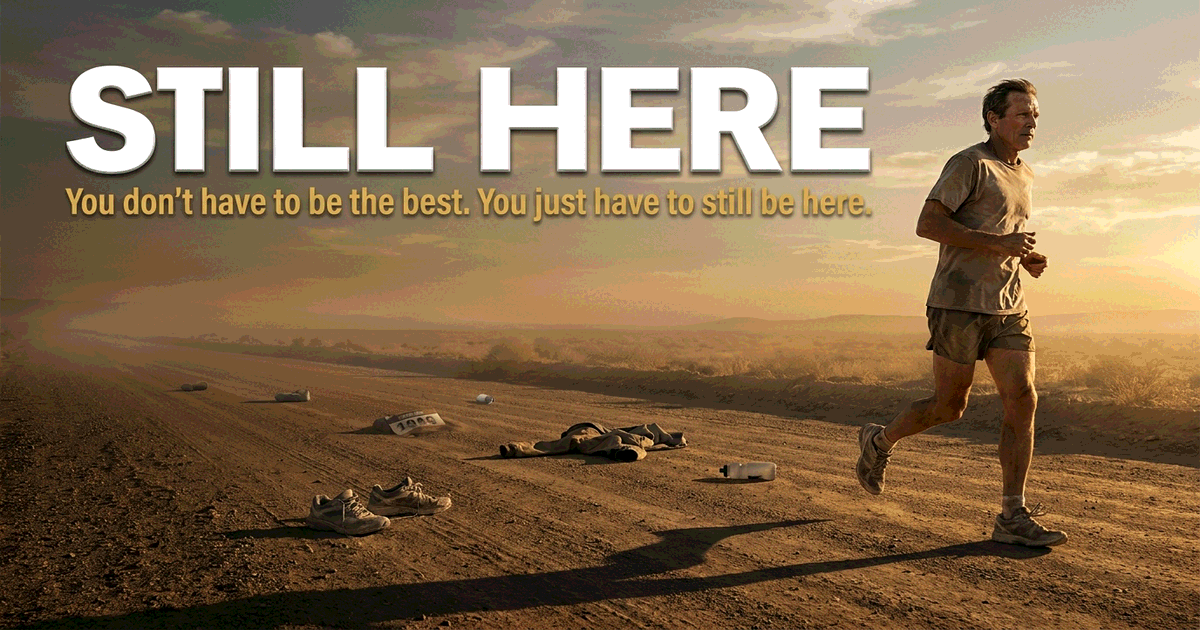
You do not have to be the best. You just have to still be here.
If you are ready to design the long game instead of chasing the next peak, that is the work I do at MasteryLab.co. The disciplines that make survival sustainable across decades are not motivational. They are structural, and they are learnable.