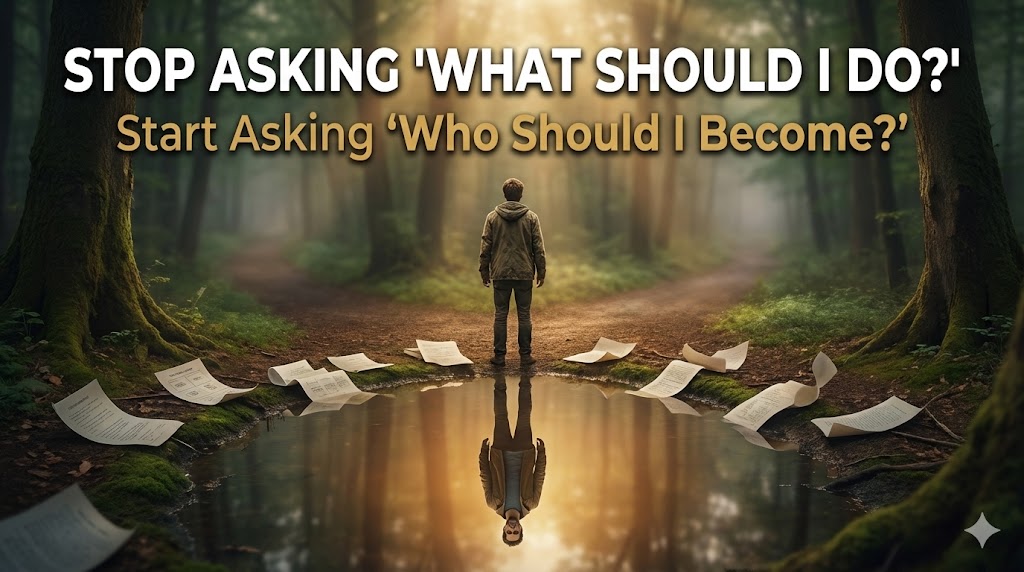
Stop Asking 'What Should I Do?' Start Asking 'Who Should I Become?'
By Derek Neighbors on January 15, 2026
I spent weeks agonizing over which race to sign up for.
Should I do the 17K or push to a 26K? Maybe the 30K makes more sense. But what about the 50K? Is it too hard? Is it long enough to actually challenge me? Will I have enough time to train? What if I pick wrong and either blow up or feel like I sandbagged? I read race reports, studied elevation profiles, calculated training windows, asked other runners what they thought.
Weeks of analysis paralysis for a question that could have been answered in seconds.
The problem wasn’t the complexity of the decision. The problem was I kept asking the wrong question. “What should I do?” has infinite answers. Every distance has tradeoffs. Every race has risks you can’t fully calculate. You can analyze forever and never find certainty.
I was asking which race to run when I should have been asking who I’m becoming.
The Wrong Question Trap
Watch people make decisions. They gather information. They consult experts. They read reviews, compare options, weigh alternatives. They agonize, postpone, and gather more information. Eventually they decide something, often exhausted and still uncertain.
This is the wrong question trap: treating every decision as a unique puzzle requiring fresh analysis.
“What should I do about this job offer?” “What should I do about this relationship?” “What should I do with my morning routine?” “What should I do about this difficult colleague?”
Each question invites endless options. Each option invites endless analysis. The person asking lives in perpetual uncertainty, always one more data point away from confidence that never arrives.
The Greeks had a different approach. They understood that eudaimonia, human flourishing, wasn’t achieved by optimizing individual choices. It was achieved by becoming a certain kind of person. The question wasn’t “what should I do?” but “what kind of person should I become?” Once you answered the second question, the first answered itself.
The Paradox of Identity-First Thinking
Here’s what seems counterintuitive: focusing on identity makes decisions easier, not harder.
The person who knows they’re becoming a leader doesn’t agonize over whether to have the difficult conversation. Having difficult conversations is what leaders do. The decision makes itself.
The person who knows they’re becoming excellent doesn’t debate whether to do the work when they don’t feel like it. Doing the work regardless of feeling is what excellence requires. No analysis needed.
The person who knows they’re becoming trustworthy doesn’t weigh whether to keep the inconvenient promise. Keeping promises is who they are. The calculation is already complete.
phronesis, what the Greeks called practical wisdom, isn’t about making better tactical choices. It’s about developing the kind of character that makes right action natural. When you know who you’re becoming, you don’t need frameworks for every decision. Your identity does the filtering.
This doesn’t eliminate deliberation entirely. Complex situations still require judgment. Two aspects of your identity might conflict. The particulars of a situation might matter. But identity provides the compass that makes deliberation productive rather than paralyzing. You’re not choosing between infinite options. You’re weighing which path better serves who you’re becoming.
This is why most productivity advice fails. It optimizes doing while ignoring becoming. So people wake up earlier, batch their email, time-block their calendars, optimize every hour. And they still feel lost. They’re moving faster but going nowhere. Productive on things that don’t matter. Optimizing their way into a life they never actually chose.
How Identity Shapes Action
Aristotle taught that we become what we repeatedly do. The modern version inverts this: we do what we’ve decided to become.
Every action either reinforces or contradicts your declared identity. When you act in alignment with who you’re becoming, you build hexis, a stable disposition that makes similar actions easier. When you act against it, you erode that disposition.
The person who says they’re becoming a writer but doesn’t write isn’t missing a deadline. They’re proving “writer” is an aspiration, not an identity. Each day without writing makes the next day without writing more likely. They’re teaching themselves that their declared identity is negotiable.
This is why New Year’s resolutions fail. “I want to lose weight” is a goal requiring willpower for every decision. “I’m becoming someone who takes care of their body” is an identity that makes the decision automatic.
ethos, the Greek concept of character, wasn’t something you had. It was something you built through repeated choices that aligned with who you declared yourself to be. Character precedes action because character shapes which actions feel natural.
Here’s the uncomfortable truth: declared identity and actual identity are often different. You can say you’re becoming a leader while acting like a coward. The gap between declared and actual is where self-deception lives. The only honest test is behavior. You’re becoming who your actions reveal, not who you claim. The solution isn’t to declare louder. It’s to act differently.
The Reversal
Most modern self-help operates backwards.
It starts with goals: what do you want to achieve? Then it works to tactics: what should you do to achieve it? Then it adds motivation: how do you keep doing it when you don’t want to?
This sequence guarantees struggle. Goals are external and arbitrary. Tactics are endless and debatable. Motivation is unreliable and exhausting.
The ancient sequence was different.
Start with identity: who are you becoming? Then align your actions: what does that person do? Motivation becomes irrelevant because you’re not forcing yourself toward an external goal. You’re simply being who you declared yourself to be.
The race that paralyzed me for weeks? Once I asked the right question, the answer was obvious. I’m becoming an ultrarunner. Someone who seeks discomfort, who chooses the harder path, who wants to find out what they’re made of. The 50K. Done. Seconds, not weeks.
This principle applies regardless of how many options you have. Epictetus was a slave. His external options were determined by his master. But his identity remained his own. He could choose who he was becoming even when he couldn’t choose what he was doing. Identity-first thinking works whether you have fifty options or one. The question isn’t which path to choose. It’s who you’re becoming on whatever path you’re on.
The Practice
Before any significant decision, stop asking “what should I do?” Ask instead: “Who am I becoming? What would that person do?”
The difficult conversation, the skipped workout, the career crossroads. Same question every time. Same filter. Identity cuts through the noise that tactics can’t.
When Identity Isn’t Clear
What if you don’t know who you’re becoming? More common than most admit. Many people have goals without identity. They know what they want to achieve but not who they want to be.
If that’s you, the identity question reveals your first work: clarify who you’re becoming before trying to decide what to do. Some discover identity through action, trying different ways of being. Others through reflection, examining what they admire and despise. Either way, that clarity is the foundation. Without it, every decision stays hard.
The Questions That Matter
If someone watched your actions for the past month without hearing your words, what identity would they conclude you’re building?
When you face a decision, is your first instinct to analyze options or to consult your declared identity?
Do you have a clear answer to “who am I becoming?” or do you only have goals you’re pursuing?
How often do you make decisions that contradict the identity you claim?
Final Thoughts
Most decisions that paralyze people aren’t actually difficult. They’re only difficult because identity hasn’t been established.
One caution: identity clarity without virtue orientation is dangerous. A criminal has clear identity. A tyrant knows exactly who they’re becoming. The question only serves flourishing when the answer is oriented toward the good. eudaimonia wasn’t just about becoming someone. It was about becoming someone worth being.
Stop asking what to do. Start asking who to become. The rest follows.
If you’re ready to stop optimizing tactics and start building identity, MasteryLab.co is where people committed to becoming gather. Not to plan. To become.