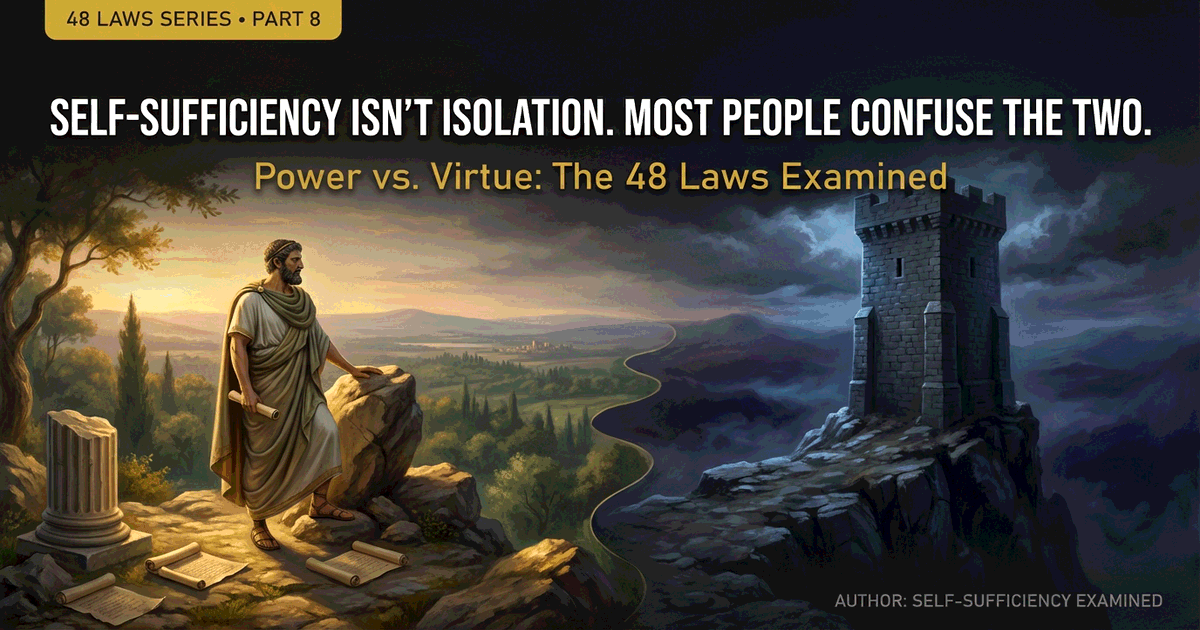
Self-Sufficiency Isn't Isolation. Most People Confuse the Two.
By Derek Neighbors on March 9, 2026
Power vs. Virtue: The 48 Laws Examined
A year-long examination of Robert Greene's 48 Laws of Power through the lens of ancient virtue ethics. Some laws we affirm, some we reframe, some we reject entirely.
Greene’s Law 8 turns self-sufficiency into a weapon and isolation into a strategy. The ancients saw it differently.
Law 8 of Robert Greene’s The 48 Laws of Power:
Make other people come to you. Use bait if necessary. When you force the other person to act, you are the one in control. It is always better to make your opponent come to you, abandoning his own plans in the process. Lure him with fabulous gains, then attack. You hold the cards.
Greene’s core argument: the person who moves first surrenders control. By making others come to you, you dictate the terrain, the timing, and the terms. Napoleon used this repeatedly, drawing enemies into battles they hadn’t planned, on his ground.
The law has a seductive logic. The person who chases always negotiates from weakness. The person who waits negotiates from strength.
The Tactical Truth
Greene identifies something important about positioning. Desperation is a strategy killer. The leader who chases every opportunity, accepts every meeting, responds to every demand broadcasts a signal that experienced operators read instantly: this person needs me more than I need them.
There’s real wisdom in not chasing. The party with more alternatives holds more leverage in any negotiation. The person who builds capability rather than collecting contacts creates actual gravity. And the person comfortable with their own company attracts different people than the one who can’t stand being alone.
Excellence, given enough time and enough consistency, draws the right people toward it. You don’t need to chase when what you’ve built speaks for itself.
But Greene weaponizes this insight. He turns natural attraction into calculated manipulation. “Use bait if necessary” turns attraction into a trap, not positioning. And the distinction between building something worth approaching and setting a lure matters more than Greene acknowledges.
The Character Cost
The danger isn’t in the positioning. It’s in what happens when you start wielding self-sufficiency as a weapon.
Refusing to approach anyone builds a prison that only looks like a castle from the inside. You stop reaching out to mentors, collaborators, and allies because you’ve convinced yourself that real power never moves first. Your network calcifies. The people who would have challenged your thinking never get the chance. Isolation that looks like strength produces stagnation.
This plays out in organizations constantly. The senior leader who won’t walk down the hall to talk to a junior engineer misses the person who sees the flaw in the strategy. The founder who insists on being approached first loses the advisor who would have changed the trajectory of the company, because that advisor had three other founders who picked up the phone. Waiting isn’t free. It costs you the people who refuse to play the game.
“Use bait if necessary” trains you to think in terms of lures and traps rather than actual value exchange. Interactions become chess moves. Relationships become transactions. You lose the ability to engage with people as people because you’ve trained yourself to see them as pieces on a board. Over time, the calculating becomes automatic. You stop noticing you’re doing it, and the people around you stop trusting that anything you do is straightforward.
Making others come to you requires believing you’re always the more important party. That belief hardens. You stop learning from people who won’t make the trip. You lose access to perspectives that could have transformed your thinking, because those people had too much self-respect to chase you.
Some of the best relationships start when someone makes the first move. When someone admits they want to learn, collaborate, or build together. The person who never reaches out first misses all of them.
And there’s a deeper fragility underneath. An identity built on “I never chase” collapses the first time circumstances require you to ask for help. Circumstances always eventually require you to ask for help. The person who has spent years training themselves never to move first finds that when they finally need to, they’ve lost the capacity. The muscle has atrophied. They don’t know how to ask, and the people they might have asked have long since stopped waiting.
The ARETE Alternative: Self-Sufficiency Without Isolation
There’s a difference between real self-sufficiency and performed unavailability.
What the Greeks called autarkeia means your inner ground doesn’t depend on external validation. You can stand alone. That capacity makes every relationship you enter a choice rather than a need. You approach people because you want to, not because you’ll collapse without them.
Performed unavailability means constructing an elaborate game to make yourself seem important by being inaccessible. The underlying driver is the same as desperation, inverted: both define your worth by other people’s behavior toward you.
Build something worth approaching. Not as bait. As your actual work. When the work is excellent, the right people notice. This is the part of Greene’s law that holds up. But it doesn’t require manipulation. It requires excellence.
Reach out when reaching out serves the mission. Leaders who refuse to make the first move aren’t disciplined. They’re insecure. The person confident in their worth can approach anyone because their identity isn’t threatened by the act of approaching. This is the part Greene gets wrong. Initiative from a stable center looks nothing like desperation, and experienced people can tell the difference.
And learn to distinguish between desperation and initiative. A desperate person chases because they need something from you. A person with initiative reaches out because they see a real possibility. The energy is completely different, and so is the response it generates.
The strongest position isn’t “come to me.” It’s “I’m complete either way, and I see value in connecting.”
Ancient Wisdom Connection
The Stoic concept of autarkeia anchors this reframe. Epictetus, who spent his early life enslaved before building a school that shaped Roman thought for centuries, taught that true freedom comes from depending only on what is within your control. Your judgments, your choices, your character. External things, including other people’s decisions to approach you or not, are adiaphora: indifferent things that don’t determine your worth.
But autarkeia was never meant to be isolation. The Stoics were deeply social. Marcus Aurelius governed an empire. Seneca advised emperors. Epictetus ran a school full of students. They engaged with the world constantly. Their self-sufficiency wasn’t withdrawal. It was a foundation that made engagement voluntary rather than desperate.
This is the distinction Greene misses entirely. The Stoics would have agreed that desperation is weakness. But they would have rejected the idea that making others come to you is strength. Strength is engaging fully with the world while your inner stability remains unshaken regardless of the response.
Seneca wrote hundreds of letters to friends and students. Not because he needed their validation, but because the exchange of ideas was itself valuable. He could have sat in his villa and waited for the world to come to him. He had the wealth and status to pull it off. Instead he reached out constantly, because his self-sufficiency freed him to connect rather than giving him a reason to withdraw. That’s what autarkeia looks like in practice. Not silence. Not distance. Voluntary engagement from a stable center.
phronesis (practical wisdom) tells you when to wait and when to move. Sometimes the wise action is patience. Sometimes it’s initiative. The person who has only one mode, whether that’s constant chasing or constant waiting, lacks phronesis. Wisdom reads the situation and responds accordingly, without ego dictating the response.
The Test
When you refuse to reach out first, is it wisdom or pride making that decision?
Could you ask someone for help tomorrow without it threatening your identity?
Are people drawn to you because of what you’ve built, or because you’ve made yourself strategically scarce?
When was the last time you made the first move toward someone you admired, without calculating whether it made you look weak?
Final Thoughts
Greene says make other people come to you. The ancients say build a foundation so solid that your worth doesn’t depend on who approaches whom. One is a tactic for controlling interactions. The other is a character trait that transforms every interaction you enter.
Self-sufficiency means you can stand alone. It doesn’t mean you should. The person who has real autarkeia can reach out to anyone because the act of reaching out costs them nothing. Their stability isn’t shaken by initiative. Their identity isn’t threatened by admitting they want to connect.
The person who refuses to move first isn’t powerful. They’re protecting a fragile sense of importance that can’t survive the act of approaching someone else. Real strength goes wherever the mission requires, talks to whoever needs talking to, and asks for help when help is needed. Not because it’s desperate. Because it’s free.
Ready to build the kind of self-sufficiency that makes genuine connection possible? MasteryLab.co is where people who are done performing strength learn to build the real thing.