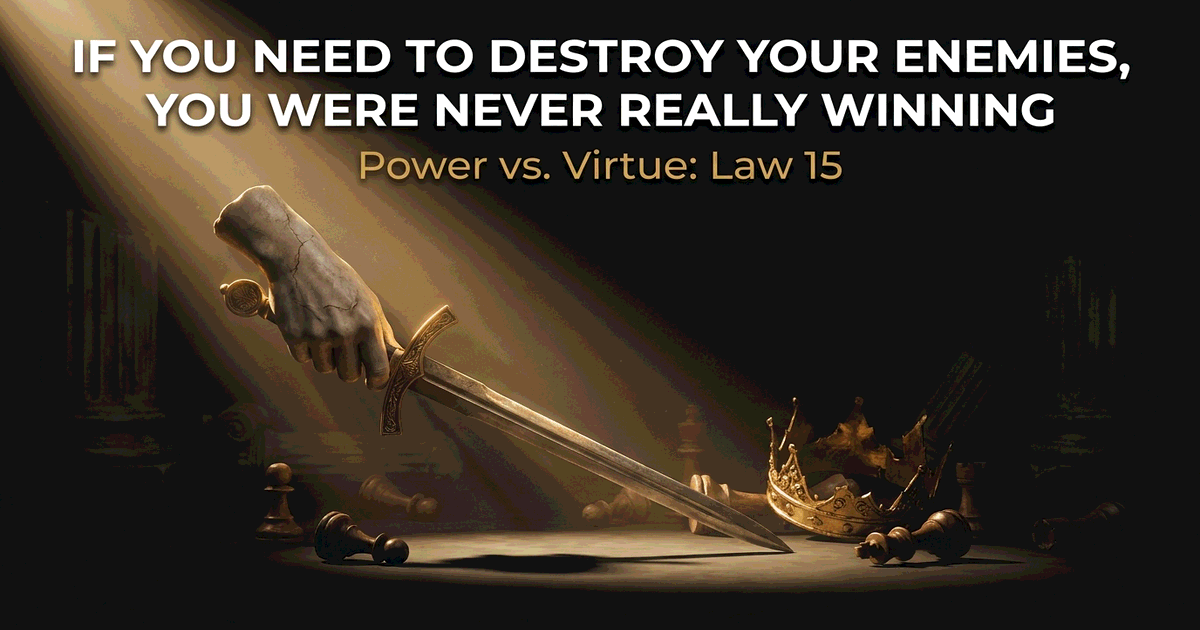
If You Need to Destroy Your Enemies, You Were Never Really Winning
By Derek Neighbors on April 22, 2026
Power vs. Virtue: The 48 Laws Examined
A year-long examination of Robert Greene's 48 Laws of Power through the lens of ancient virtue ethics. Some laws we affirm, some we reframe, some we reject entirely.
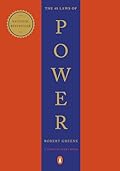
Law 15 of Robert Greene’s The 48 Laws of Power:
All great leaders since Moses have known that a feared enemy must be crushed completely. If one ember is left alight, no matter how dimly it smolders, a fire will eventually break out. More is lost through stopping halfway than through total annihilation: The enemy will recover, and will seek revenge. Crush him, not only in body but in spirit.
Greene’s examples are dramatic: Napoleon returns from Elba, a partially defeated rival nurses decades of resentment, the merciful victor dies at the hands of someone they spared. The logic is clean. Leave nothing to chance. Leave nothing alive. Leave nothing that could one day turn around and finish you.
This is the law that reveals Greene’s framework most honestly. Strip the sophistication, and Law 15 says: kill or be killed. No middle ground, no measured response, no possibility that your former opponent might become something other than a threat.
The Tactical Truth
Half-measures do create real problems. Napoleon’s exile to Elba gave him time, resources, and the perception of survival that fueled his return. The Hundred Days cost hundreds of thousands of lives. History offers no shortage of partially defeated enemies who regrouped, adapted, and struck with greater precision the second time.
In business, this operates on smaller scales with comparable dynamics. The competitor you wounded with a price war but didn’t outcompete on product will study your playbook and build something better. The executive you demoted but didn’t remove retains institutional knowledge and relationships that can be weaponized. The startup you acquired but failed to fully integrate keeps its culture alive as a resistance movement inside your organization.
The observation is valid: incomplete victories carry risk. The person or organization that survives your attempt to defeat them learns from the experience in ways that make them more dangerous, not less. They’ve now seen your strategy, felt your pressure, and mapped your limitations. Next time, they won’t make the same mistakes.
But observing that half-measures fail doesn’t prove that total annihilation is the answer. The diagnostic is accurate. The prescription is poison.
The Character Cost
The first cost operates invisibly, inside the person executing the law. To crush someone totally, they must occupy significant mental and emotional territory in your life. You have to track them, anticipate them, plan for their elimination, and sustain the intensity required to ensure nothing survives. Your enemy has to matter to you. They have to matter enough that their destruction becomes a project you resource, schedule, and measure progress against.
This is where the law consumes its practitioner. Your telos, your purpose, becomes defined by opposition. You are no longer building toward something. You are building against someone. The energy flowing into destruction is energy diverted from creation. And the target of your annihilation campaign has achieved something remarkable without lifting a finger: they have become the organizing principle of your life.
I have watched executives spend months engineering the removal of a rival who, in the grand scheme of the organization’s future, was a minor obstacle. The rival eventually left. The executive had lost a year of creative output, strained relationships with everyone who witnessed the campaign, and trained their own team to see political destruction as the primary skill their leader valued. They won the battle and hollowed out their own capacity to lead.
The second cost lands on relationships. A reputation for total destruction is a reputation for danger. Allies hedge their commitments because they have seen what happens when you turn. Opponents fight with desperation because surrender offers no safety. You’ve eliminated the off-ramp. When people know there’s no middle ground, every conflict escalates to maximum intensity immediately, because moderation has no payoff against someone who only accepts unconditional destruction.
The Greeks identified this pattern and called it hubris: the overreach that converts victory into the seed of future defeat. hubris doesn’t mean arrogance in the modern sense. It means the specific blindness that comes from believing your power has no natural limits. The person practicing Law 15 believes they can destroy without cost, that the act of annihilation moves in one direction only. It never does. nemesis, the corrective force the Greeks associated with excess, doesn’t arrive as punishment from the gods. It arrives as the predictable consequence of actions that assumed consequences didn’t apply.
The third cost is the escalation trap. Crush one enemy totally, and the next one studies your methods. They strike harder, faster, with less warning, because they’ve seen what happens to those who give you time. Each “total victory” raises the stakes for the next conflict. The leader known for annihilation attracts opponents who match that intensity. The arms race has no natural stopping point.
These are the pragmatic costs. But even if none of them applied, even if total destruction worked perfectly every time and produced no strategic blowback, the character problem remains. The person who organizes their life around another person’s annihilation has made a choice about what occupies the center of their soul. That choice corrodes whether the campaign succeeds or fails. Winning the destruction game doesn’t fix what playing it does to you.
The ARETE Alternative
Aristotle described megalopsychia, greatness of soul, as the condition of someone who has earned the right to think greatly of themselves through actual achievement, and whose sense of purpose is so secure that petty conflicts cannot reach them. The person with megalopsychia isn’t weak. They’re so thoroughly grounded in their own telos that the existence of opposition doesn’t reorganize their priorities. They can afford magnanimity because their identity was never at stake. More precisely: magnanimity isn’t something they can afford. It’s something they owe. The obligation to refuse obsessive destruction applies whether you’re winning or losing, powerful or vulnerable.
This is not pacifism. The false dilemma Greene constructs is between half-measures and total annihilation, as if those are the only options. They aren’t. The middle ground is decisive action: compete hard, set firm boundaries, remove threats when removal is necessary, then redirect your attention to what you’re building. Decisive action ends a conflict. Obsessive annihilation becomes the conflict. One is phronesis, practical wisdom applied to confrontation. The other is obsession with a strategic alibi.
The practical alternative: build something so valuable that former enemies want to join rather than fight. Convert defeated opponents into allies who bring the one thing no intelligence report can provide: intimate knowledge of how you can be beaten, now deployed in your defense. The leader who can extend real trust after conflict demonstrates more power than the one who can only destroy, because extension of trust after conflict is something most people find impossible. It signals a level of security that annihilation never can.
Stop calling your anger righteous. It’s still controlling you. The same principle applies to the desire for total destruction. The feeling of righteous certainty that your enemy deserves annihilation is the feeling of being controlled by someone else’s existence. Seneca called anger temporary madness. The campaign of total destruction is anger given a project plan and a timeline.
Ancient Wisdom Connection
When Avidius Cassius declared himself Emperor and raised legions against Marcus Aurelius, Marcus’s advisors counseled swift and total destruction. Marcus planned instead to pardon him. He intended to demonstrate that the Empire’s strength did not depend on the annihilation of every challenger, that Roman authority rested on something more durable than the capacity for violence. Cassius was killed by his own soldiers before Marcus could carry out the pardon, but the intention tells us everything about Marcus’s understanding of power.
Marcus wrote in his Meditations: “The best revenge is not to be like your enemy.” Read that as soft advice and you’ll miss the strategy underneath. Becoming the person who crushes enemies totally means becoming indistinguishable from the enemies you crush. Both organize their lives around the domination of the other, and domination as a purpose produces the same character regardless of which side you’re on. The methods converge. The character converges. The only difference is who won the last round.
The obvious counterargument: Napoleon. Mercy failed. Elba failed. Thousands died because the Allies didn’t finish the job. History has cases where showing mercy produced exactly the catastrophe Greene warns about. The distinction is between mercy from weakness, which does backfire, and magnanimity from secure purpose, which doesn’t. The Allies exiled Napoleon not out of strength but out of political convenience. They didn’t pardon him from a position of secure purpose. They compromised because full resolution was expensive. That’s a half-measure, not magnanimity. The question is never “should I show mercy?” It’s “am I acting from purpose or from avoidance?”
praotes, the Greek concept of gentleness, was not a soft word in the ancient world. It described the controlled strength of a trained horse: full capacity for force, deliberately restrained. The person practicing praotes can destroy but chooses not to, and that choice communicates more authority than any act of annihilation.
Forgiveness isn’t about them. It’s the most selfish thing you can do. The refusal to be consumed by an enemy’s existence is ultimately an act of self-preservation. The person who releases the campaign of destruction recovers the mental and emotional territory their enemy had been occupying. That territory, redirected toward creation rather than destruction, is where every significant achievement in a career actually originates.
The Test
Four questions that reveal whether Law 15 has shaped your operating system:
- When you think about someone who wronged you, does the fantasy end with their destruction, or with your own indifference to their existence?
- Could you clearly describe what you are building, or can you only articulate what you are fighting against?
- If your primary adversary disappeared tomorrow, would you feel relief, or would you feel the loss of purpose?
- In your last significant conflict, were you seeking resolution or unconditional surrender?
If the destruction fantasy is more vivid than the building vision, your enemy is already winning. Not in the external contest, but in the one that matters: the contest for what occupies the center of your life.
Final Thoughts
Greene says crush your enemy because the partially defeated always return. The deeper question is what you become while crushing them. Both the destroyer and the destroyed participate in the same error: treating material dominance as the highest good. The person who devotes their life to annihilation has oriented their entire soul toward winning, losing, and dominating rather than toward virtue. That orientation degrades whether you win or lose. The campaign of total annihilation requires you to organize your life around another person’s destruction. It demands that their elimination become your purpose, your metric, your definition of success. You win, and then you have to find another enemy to destroy, because you have trained yourself for nothing else.
megalopsychia offers the alternative: a sense of purpose so large that no single opponent can define it. The person with greatness of soul does not spare enemies out of weakness. They spare them because destruction was never the point. Creation was. The empire, the organization, the life worth building always required more attention than any rival deserved.
Greene says crush them totally. arete says become someone who doesn’t need to.
Ready to build leadership grounded in purpose rather than opposition? MasteryLab provides frameworks and community for leaders who understand that what you build outlasts what you destroy.