Sophrosyne (σωφροσύνη): Meaning, Definition & Modern Application
soh-froh-SOO-nay
Self-mastery and moderation. The discipline to regulate yourself internally when nothing external compels you to continue.
Etymology
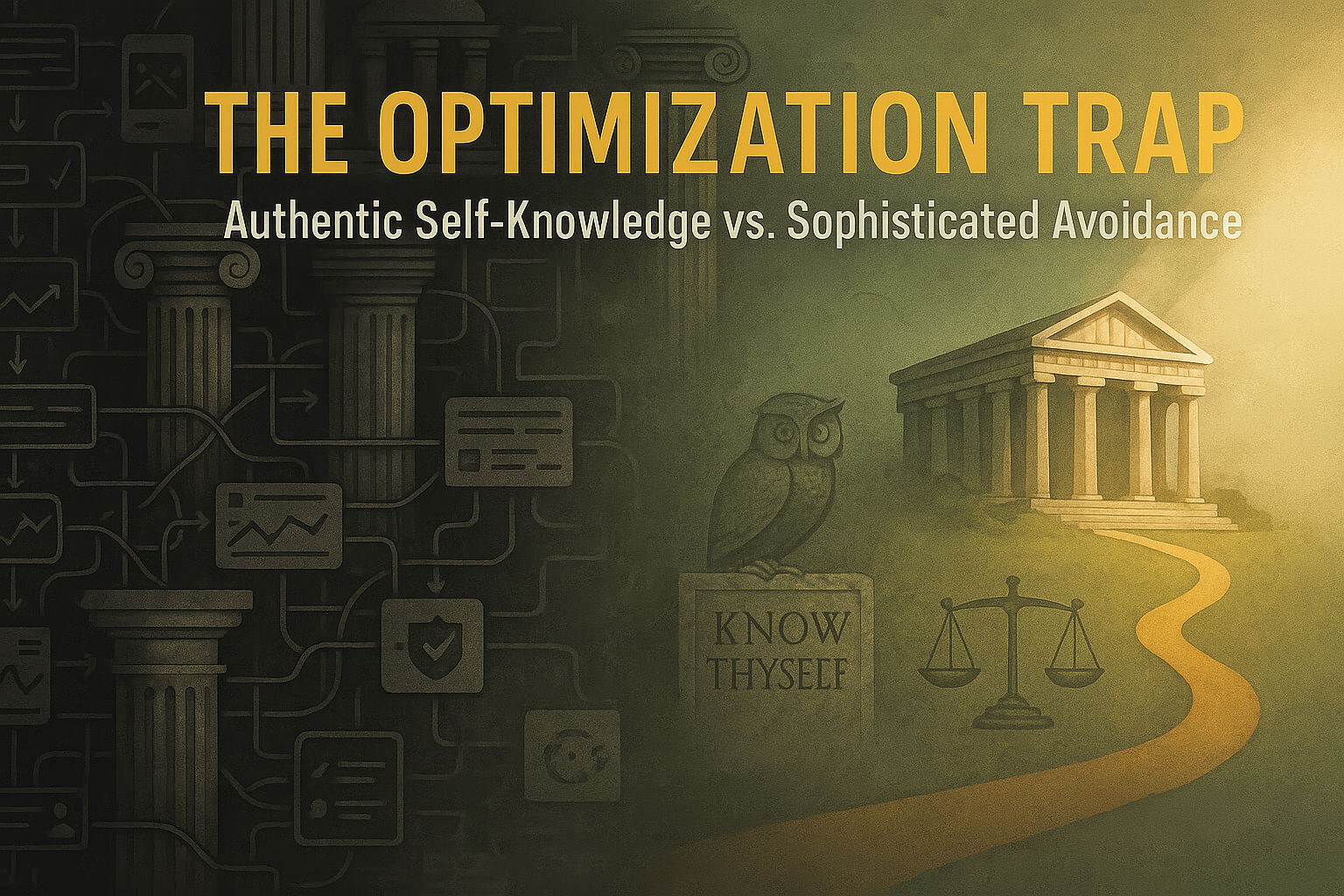
From sos (safe, sound) and phren (mind), literally meaning “soundness of mind” or “safe-thinking.” The Delphic Oracle inscribed “nothing in excess” (meden agan) as a companion to “know thyself,” and sophrosyne embodied both commands. For Plato, it was the virtue that harmonized the soul’s parts. The concept carried strong associations with self-knowledge and the temperance that flows from understanding your own limits.
Deep Analysis
Sophrosyne is composed of sos (safe, sound) and phren (mind, diaphragm, seat of consciousness). The literal meaning, “soundness of mind,” suggests wholeness and integration rather than the mere restraint that modern translations like “temperance” or “moderation” imply. A person with sophrosyne is not someone who constantly fights their desires. They are someone whose desires, reason, and actions are in harmony. The internal conflict between what you want and what you know is right, which most people experience as a permanent condition, is the absence of sophrosyne. Its presence is the state in which desire and reason point in the same direction.
Plato’s Charmides is devoted entirely to the attempt to define sophrosyne, and its repeated failures are instructive. The dialogue proposes and rejects multiple definitions: doing things quietly, modesty, doing one’s own work, knowing what you know and what you do not know. None of these captures the concept adequately, and the dialogue ends without resolution (aporetically). The failure reveals that sophrosyne is a concept that resists simple definition because it describes a quality of the whole person rather than a specific behavior or capacity. You cannot reduce it to a rule because it is not a rule. It is a state of being.
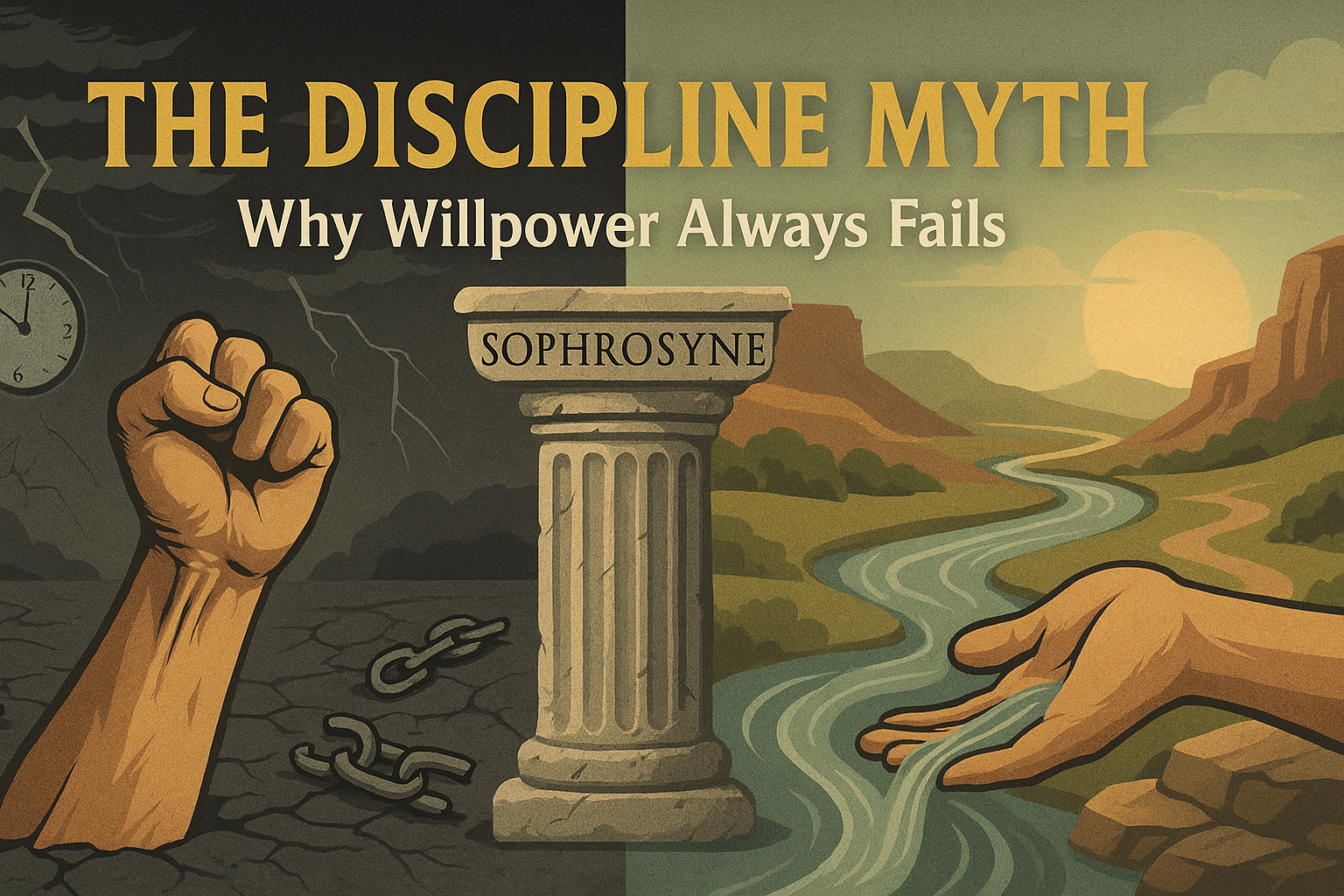
The distinction between sophrosyne and enkrateia (self-control) is the most important clarification for modern readers. Enkrateia is the condition of someone who has strong desires for the wrong things but manages to overpower those desires through willpower. The person with enkrateia wants the extra drink, the illicit affair, or the dishonest shortcut, and resists through sheer force of will. Sophrosyne is the condition where the desire itself has been transformed. The person with sophrosyne does not want the drink, the affair, or the shortcut. Their desires have been educated to align with their understanding of the good. This is why Aristotle argued that the truly virtuous person enjoys doing what is right. Virtue is not a struggle against desire. It is the alignment of desire with reason.
Sophrosyne as one of the four cardinal virtues, alongside phronesis (practical wisdom), andreia (courage), and justice, places it at the foundation of Greek moral thought. Each of the cardinal virtues is necessary, and none is sufficient without the others. Courage without sophrosyne becomes recklessness. Justice without sophrosyne becomes rigidity. Phronesis without sophrosyne cannot operate because the mind overwhelmed by desire cannot perceive clearly what the situation requires. Sophrosyne creates the internal order that allows all the other virtues to function.
Arete (excellence) requires sophrosyne because sustained excellence requires sustained self-governance. The person who pursues excellence in bursts but is regularly undone by unchecked desire, who trains intensely for a month and then abandons the practice, who leads with integrity under normal conditions and cuts corners under pressure, lacks the internal stability that sophrosyne provides. The genius who destroys their career through unchecked impulse, a familiar pattern in every domain of human achievement, has ability without sophrosyne.
The connection between sophrosyne and phronesis is particularly intimate. Phronesis is practical wisdom, the capacity to perceive what a situation requires and act accordingly. This perception requires a mind that is not distorted by excessive desire, fear, or anger. The person in the grip of strong emotion does not see clearly. Their perception is filtered through the emotion, and the judgment that follows is corrupted at the source. Sophrosyne, by maintaining the internal order that keeps emotions proportionate and manageable, provides the conditions under which phronesis can operate. Without sophrosyne, even the wisest person will make poor decisions in moments of emotional turbulence.
Modern Application
Sophrosyne is the unsexy virtue that prevents self-destruction. It's resisting the urge to overcomplicate, stopping yourself from reacting emotionally, and maintaining your standard when no one is watching. Most failure is self-inflicted, and sophrosyne is how you stop inflicting it.
Historical Examples
Socrates, in Plato’s dialogues, embodies sophrosyne in ways that his interlocutors consistently fail to match. In the Symposium, Alcibiades describes Socrates’s extraordinary self-control: unmoved by cold, fatigue, alcohol, or sexual temptation. But Plato is careful to show that Socrates’s sophrosyne is not repression. Socrates is not fighting desire. He has achieved a state where his desires are aligned with his pursuit of wisdom. At the famous drinking party, Socrates can drink all night without becoming intoxicated, not because he is fighting the effects of wine, but because his internal order is so stable that external agents cannot disrupt it.
Cato the Younger, the Roman senator who lived from 95 to 46 BCE, was renowned in antiquity for his sophrosyne. Plutarch describes Cato as incorruptible in an age of rampant corruption, modest in an age of ostentation, and principled in an age of expedience. Cato’s famous walk through the streets of Rome without shoes or tunic was not asceticism for its own sake. It was a demonstration that a person whose desires are governed by reason does not need the trappings that convention demands. His suicide at Utica in 46 BCE, rather than live under Caesar’s tyranny, was described by Seneca as the ultimate act of a person whose commitment to his principles was stronger than his desire for survival.
The Japanese aesthetic concept of wabi-sabi, which values simplicity, impermanence, and imperfection, represents a cultural expression of sophrosyne. Developed within the tea ceremony tradition by Sen no Rikyu in the sixteenth century, wabi-sabi rejects excess, ostentation, and the pursuit of perfection in favor of austere beauty and acceptance of natural processes. The tea ceremony itself is a practice of sophrosyne: every movement is deliberate, every element is purposeful, and the entire experience is designed to cultivate the internal harmony that the Greeks would have recognized as soundness of mind.
How to Practice Sophrosyne
Choose one area of excess in your life and impose a deliberate constraint for thirty days. This could mean capping work hours, limiting social media to specific windows, or setting a firm boundary on commitments. Track what happens to your output quality when you impose limits. Practice the “pause protocol”: when you feel a strong emotional reaction, wait two full breaths before responding. Log the triggers that most frequently overwhelm your self-regulation and design specific countermeasures for each. At the end of each week, identify the moment where your self-control was tested most severely and write down what you did, what you wish you had done, and what you will do differently next time. Build physical practices that reinforce mental discipline: regular sleep schedules, consistent exercise, and deliberate rest. The Greeks understood that a sound mind requires a regulated life. Mastery over yourself is the prerequisite for mastery over anything else.
Application Examples
A startup founder receives an acquisition offer at a valuation that exceeds her most optimistic projections. The offer is flattering, the money is life-changing, and every advisor is urging her to accept. She takes forty-eight hours to examine whether her excitement is aligned with what the company needs at this stage and what she genuinely wants for her life. She declines the offer, not out of greed for a higher price, but because her analysis of the company’s trajectory and her own purpose leads her to a different conclusion.
Sophrosyne in business decisions means maintaining clarity when circumstances are designed to overwhelm it. The acquisition offer triggers excitement, social pressure, and financial desire simultaneously. The founder’s ability to pause, examine her own motivations, and make a decision based on genuine assessment rather than emotional reaction demonstrates the internal order that sophrosyne provides.
A person with a history of impulsive spending receives a bonus and feels the immediate pull to upgrade their car. Instead of either spending impulsively or suppressing the desire through willpower, they sit with the desire long enough to understand what it represents. They discover that the desire for a new car is really a desire for the feeling of success. They find a more aligned way to acknowledge their achievement.
Sophrosyne is not about suppressing desire but understanding it. The person who examines the desire discovers that the surface want (a new car) conceals a deeper want (acknowledgment of achievement). Addressing the deeper want directly is more satisfying and more aligned than either indulging or repressing the surface desire.
A CEO receives a scathing public critique from a competitor. Her first impulse is to fire back with equal force. She has the platform, the resources, and the justification. Instead, she waits twenty-four hours. The waiting is not suppression. It is the practice of allowing the initial emotional charge to dissipate so that a measured response, one that serves the company’s interests rather than her ego, can emerge.
The interval between impulse and action is where sophrosyne operates. The CEO’s ability to wait is not weakness or indecision. It is the strength of a mind that governs its reactions rather than being governed by them. The response that emerges after twenty-four hours of reflection will be superior to whatever the initial impulse would have produced.
A marathon runner reaches mile twenty and feels strong. The temptation to accelerate is powerful because the body feels capable and the competitive instinct says push harder. The runner with sophrosyne maintains the planned pace because they understand that the feeling of strength at mile twenty does not reliably predict capacity at mile twenty-four. Discipline holds the pace. Impulse would have broken it.
Athletic sophrosyne means governing your effort by understanding rather than by feeling. The runner who accelerates because they feel strong at mile twenty will learn at mile twenty-four why the plan existed. The runner who maintains pace despite feeling capable demonstrates the alignment of desire and reason that sophrosyne produces.
A startup receives an offer of venture capital that would triple their funding but require a growth trajectory that the founders believe is unsustainable. The money is tempting. The validation is flattering. The founders decline because they recognize that the growth trajectory would require compromises in product quality and team culture that conflict with their definition of excellence.
Sophrosyne in business means the capacity to say no to attractive opportunities that conflict with your principles. The founders’ refusal is not caution or risk-aversion. It is the expression of internal harmony: their desires (for growth) are governed by their understanding (of what sustainable excellence requires). The venture capital was not wrong for every company. It was wrong for this company, and the founders had the self-knowledge to recognize it.
Common Misconceptions
“Moderation in all things,” frequently attributed to the Greeks, actually distorts what sophrosyne means. Aristotle’s doctrine of the mean does not counsel moderate amounts of everything. It counsels the right amount, at the right time, toward the right person, for the right reason. Sometimes the right amount is extreme: the appropriate response to injustice is not moderate outrage but full commitment to correction. Sophrosyne governs the response to ensure it is proportionate and well-directed, not that it is moderate in intensity. Another common error equates sophrosyne with emotional suppression. The Stoics themselves were clear that the goal is not to eliminate emotions but to ensure they are appropriate to the situation. Grief at the loss of a loved one is entirely compatible with sophrosyne. Panic at a minor inconvenience is not. The distinction is between emotions that are proportionate and rational and emotions that are disproportionate and ungoverned.
Self-mastery was a concept I misunderstood for most of my life. I thought it meant winning the war against your own desires, forcing yourself to do what is right through sheer willpower. This produced a pattern of intense discipline followed by spectacular collapse, because willpower is a finite resource and the desires I was fighting were not going anywhere.
The shift happened when I encountered the Greek distinction between enkrateia and sophrosyne. I realized that I had been practicing enkrateia, overpowering my desires through force, when the goal should have been sophrosyne, aligning my desires with my understanding of what genuinely matters. The difference is not subtle. White-knuckling your way through a diet is enkrateia. Genuinely losing the desire for food that harms you because you have internalized what nourishment means is sophrosyne.
The transition from enkrateia to sophrosyne has been the longest project of my adult life, and it remains incomplete. But in the domains where it has succeeded, the experience is qualitatively different from anything willpower could produce. When you no longer want the thing you used to resist through force, the energy that was consumed by the internal battle becomes available for other purposes. The cognitive load of constant self-regulation drops. The decisions that used to require discipline become natural.
The domains where I still struggle are instructive. They reveal where my desires and my understanding are still misaligned, where I know what is right but still want something different. Those gaps are the frontier of ongoing work, and I have learned to treat them with curiosity rather than shame. Sophrosyne is not a destination you reach. It is a direction you travel. The distance covered matters more than the distance remaining.
Frequently Asked Questions
What is sophrosyne in Greek philosophy?
Sophrosyne is the Greek virtue of self-mastery, moderation, and soundness of mind. Plato considered it essential for harmonizing the different parts of the soul. It represents the discipline to regulate your impulses and maintain balance without external enforcement. The Delphic Oracle's inscription "nothing in excess" expressed the spirit of sophrosyne, and the Greeks regarded it as one of the four cardinal virtues alongside courage, wisdom, and justice.
What does sophrosyne mean?
Sophrosyne literally means "soundness of mind" or "safe-thinking," from sos (safe, sound) and phren (mind). It describes the temperate, self-controlled disposition that keeps a person from excess in any direction. The word carried strong associations with self-knowledge, reflecting the Greek insight that true moderation flows naturally from understanding your own limits and tendencies.
How do you practice sophrosyne?
You practice sophrosyne by imposing deliberate constraints on areas of excess, pausing before emotional reactions, and maintaining your standards when no one holds you accountable. It grows through daily acts of self-regulation and honest recognition of your own limits. Choose one area of habitual excess this week, whether in spending, eating, working, or consuming media, and impose a specific constraint that forces you to practice moderation.
What is the difference between sophrosyne and enkrateia?
Sophrosyne is the settled disposition of moderation where self-control feels natural and effortless. Enkrateia is the active struggle of willpower against temptation, where you feel the pull of desire but override it through conscious effort. Sophrosyne is the destination; enkrateia is the journey toward it. Aristotle placed the person with sophrosyne higher on the moral scale because their moderation has become second nature, while the enkratic person still battles internal resistance.