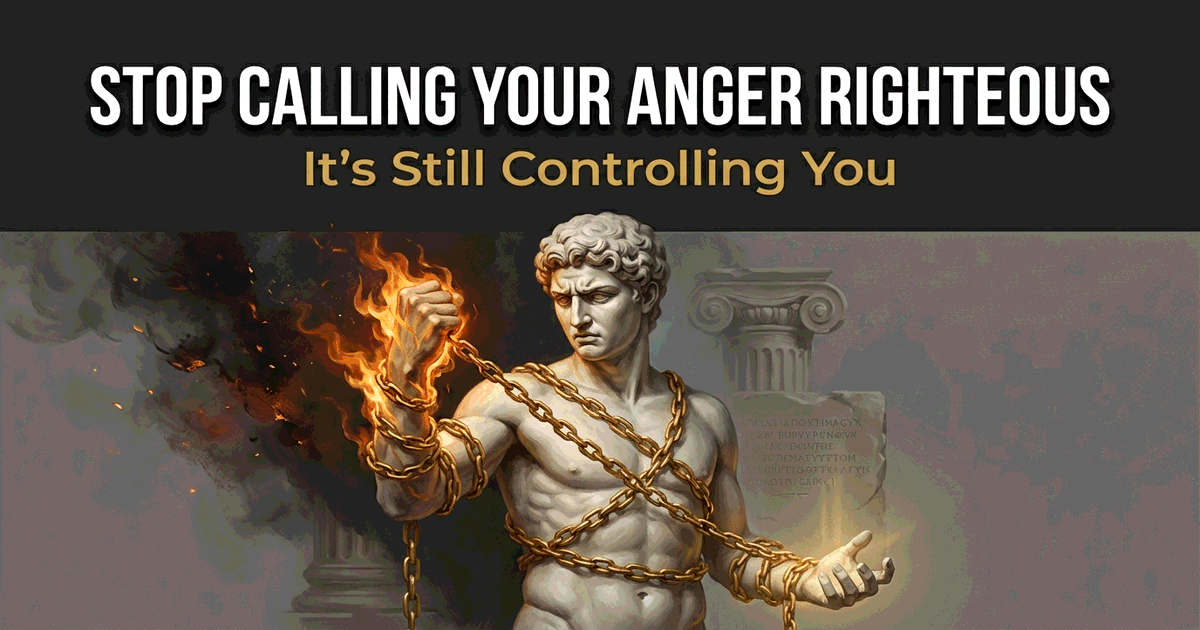
Stop Calling Your Anger Righteous. It's Still Controlling You.
By Derek Neighbors on April 12, 2026
You’ve heard it a thousand times. “If you’re not angry, you’re not paying attention.” The implication is clear: anger proves moral seriousness. The righteous person burns with fury at injustice. The morally weak person shrugs.
It sounds correct. It feels correct. And it has been selling you a lie about what strength looks like for your entire life.
The idea that “righteous anger” represents moral superiority is one of the most seductive beliefs in modern culture. We celebrate it and perform it on social media, mistaking intensity for depth and heat for conviction. When someone responds to injustice with measured calm, we question their commitment. When someone erupts with fury, we call it passion.
The ancient Greeks watched this same pattern two thousand years ago. Plato identified anger as thymos, the spirited element of the soul, whose proper function is to serve reason as an ally, not to replace it. When thymos operates without rational governance, it becomes what the Stoics called a pathos, a suffering of the soul. A symptom of being controlled by what you claim to control.
The Reality Check
Here is what the brain actually does when you get angry, regardless of whether the cause is noble or petty.
The amygdala fires and cortisol floods. Executive function narrows. Your capacity for nuance and strategic thinking drops off a cliff. The neurochemistry of anger doesn’t check whether your cause is worthy before it hijacks your cognition. It fires the same way whether someone cuts you off in traffic or a government policy threatens your values.
Marcus Aurelius spent years observing this pattern. “How much more grievous are the consequences of anger than the causes of it.” He wasn’t dismissing injustice. He was pointing out that the anger itself compounds the damage.
Seneca wrote an entire treatise on anger, De Ira, making a single argument across three volumes: anger promises justice and delivers excess. Every person who has “lost it” in the name of something righteous can identify the exact moment the anger went past the cause and became its own force.
The critical distinction most people miss: assertive behavior and angry feelings are different things. You can confront injustice with force and clarity. You can hold people accountable and fight for what matters without the chemical cocktail of rage running the operation. The confusion between confrontation and combustion is what keeps righteous anger alive as a concept.
The Hidden Cost
The cost of righteous anger hides behind the nobility of the cause. Because the cause is worth fighting for, we never examine what the anger itself does to the fight.
It narrows perception. Anger turns every complex situation into a binary. Good versus evil. Us versus them. Right versus wrong. Real situations rarely divide that cleanly. The leader who responds to a team failure with righteous fury misses the systemic issues that created the failure. The parent who erupts at a child’s behavior misses the fear or confusion driving it. The intensity of the anger becomes an obstacle to understanding the very thing that triggered it.
This holds when the stakes are existential, not just inconvenient. Epictetus, who endured slavery, held himself to this standard. The person facing genuine oppression who responds with disciplined force rather than reactive fury is not less committed to justice. They are more dangerous to the oppressor, because their clarity cannot be baited or exhausted.
It destroys credibility. Watch someone deliver an argument with quiet conviction. Then watch someone deliver the same argument while visibly shaking with anger. The angry version might feel more passionate, but it lands differently. The audience spends half its cognitive energy managing the speaker’s emotional state instead of processing the argument. Your anger becomes the story. Your point disappears into the performance.
Here is the part that should unsettle you: kindness in the face of injustice requires more andreia (courage) than fury does. Marcus Aurelius argued this repeatedly. Being furious requires no discipline and no developed character. It is the default mammalian response to perceived threat. Responding with measured force while maintaining your composure, your clarity, and your humanity demands something most people never build.
The Truth
The Stoics classified anger as a pathos, a passion that happens to you rather than something you choose. This is where the modern notion of “channeling” anger collapses.
“I channel my anger productively.” You hear this constantly. But examine what it actually means. If the anger is driving the bus, you are still a passenger. Being a productive passenger doesn’t make you the driver. The anger chose the destination. The anger set the pace. You are performing efficiency in service of something you didn’t consciously select.
sophrosyne, the Greek virtue of self-mastery and temperance, demands something different. This is the same discipline behind knowing when silence is more powerful than speech. Not passivity or the suppression of conviction. The capacity to respond with the full force of your values without being hijacked by the emotion of the moment.
Aristotle approached this differently than the Stoics, and the tension is worth naming. He believed appropriate anger was itself a virtue. His concept of praotes (gentleness or mildness) placed the virtuous response between the extremes of rage and apathy. The virtuous person feels anger at the right things, toward the right people, in the right way, at the right time, and for the right duration. This article takes the Stoic position, that the reactive emotional state of anger is always a liability. But even by Aristotle’s more permissive standard, notice how much discernment his criteria require. Blind fury fails every single one of them. What most people call “righteous anger” does not meet Aristotle’s bar for virtuous anger any more than it meets the Stoic bar for no anger at all.
The Stoics went further. They practiced prosoche (self-attention), the discipline of watching your own mental processes in real time. When an event occurs, there is a brief gap before your response. The Stoics called the initial impression a phantasia, and the decision to assent to it synkatathesis. In that gap between impression and assent lives the entire domain of human freedom. You do not have to agree with the anger. You do not have to let it set the terms.
What works instead is conviction rooted in phronesis (practical wisdom). The person operating from phronesis can confront injustice with more sustained intensity than the angry person, because their energy comes from a renewable source. Anger burns hot and exhausts itself. Conviction rooted in character burns steady and outlasts the crisis.
The Shift
Here is the practice.
A distinction matters first. This argument targets the reactive emotional state, the surge that hijacks cognition and narrows perception. Sustained moral commitment to justice is a different phenomenon. The abolitionist who worked for decades operated from conviction, not from a permanent state of cortisol elevation. The reactive anger may have ignited the commitment, but it was phronesis that sustained it.
When you feel that reactive anger rising, notice it before it narrates. Before it tells you that this situation is different, that this time the fury is earned. All anger feels earned, whether the cause is worthy or petty. That identical feeling is exactly why it fails as a guide. The anger cannot tell you whether it is serving justice or serving itself.
Ask yourself one question: Can I respond to this situation with the same intensity and clarity, but without the anger?
If the answer is yes, then the conviction is real and the anger is unnecessary. Act from the conviction. The response will be sharper and more durable than anything the anger could produce.
If the answer is no, then the anger owns the response. You are not fighting for a cause. You are serving an emotion that has co-opted the cause as its justification.
This is the Stoic provocation that still lands after two thousand years: your anger is not evidence of your virtue. It is evidence that something external still has the power to control your internal state. The person who responds to injustice with fierce calm is not less committed than the person who responds with fury. They are more free. Their response comes from conviction rather than reaction, from phronesis rather than pathos, from the part of them that chooses rather than the part that gets hijacked.
Frequently Asked Questions
Is righteous anger ever justified?
The feeling of anger is a natural response to injustice, but the Stoics argued it is never a useful one. You can confront injustice with force, clarity, and assertive action without the emotional hijacking that anger produces. The cause may be justified. The anger itself is still a liability.
How did the Stoics recommend dealing with anger?
The Stoics practiced prosoche (self-attention), watching their own mental processes in real time. They identified a gap between the initial impression (phantasia) and the decision to assent to it (synkatathesis). By training yourself to notice anger before it narrates, you can choose a response rooted in conviction rather than reaction.
What is the difference between anger and assertiveness?
Assertiveness is a deliberate behavior choice driven by values and practical wisdom. Anger is an emotional state that hijacks cognition and narrows perception. You can be forceful, direct, and hold people accountable without the neurochemical cascade of rage. Confusing the two is what keeps the myth of righteous anger alive.
Final Thoughts
Righteous anger is seductive because it lets you feel virtuous while being out of control. It wraps reactivity in the language of principle and calls it strength.
The Stoics saw through this twenty centuries ago. Anger, regardless of its trigger, is a surrender of the faculty that makes you human: your capacity to choose your response. The more “righteous” the anger feels, the more dangerous it becomes, because the nobility of the cause prevents you from questioning the method.
Stop calling it righteous. Start asking whether it’s necessary. The answer is that your cause deserves better than what anger can deliver.
If you’re ready to build the kind of character that responds from conviction rather than reaction, MasteryLab.co is where that work begins.