Sophia (σοφία): Meaning, Definition & Modern Application
soh-FEE-ah
Theoretical wisdom. The ability to see clearly, cutting through noise to identify what's actually true and understanding the deeper principles beneath surface patterns.
Etymology
From an ancient root meaning “skilled” or “clever,” sophia originally described expertise in any craft, from carpentry to poetry. The pre-Socratic philosophers claimed the word for a higher purpose: understanding the fundamental nature of reality. Pythagoras reportedly coined philosophia (love of wisdom) because he considered sophia too lofty for mortals to possess. Aristotle placed sophia as the highest intellectual virtue, the knowledge of first causes and principles.
Deep Analysis
Aristotle’s definition of sophia in Nicomachean Ethics Book VI is precise: sophia is the combination of nous (intuitive reason, the capacity to grasp first principles) and episteme (demonstrative knowledge, the capacity to derive conclusions from principles). Sophia is not one capacity but two working together. Nous grasps the starting points. Episteme builds from those starting points through rigorous demonstration. Together, they constitute the highest form of knowledge about the highest objects: the principles and causes of things that are necessary and unchanging.
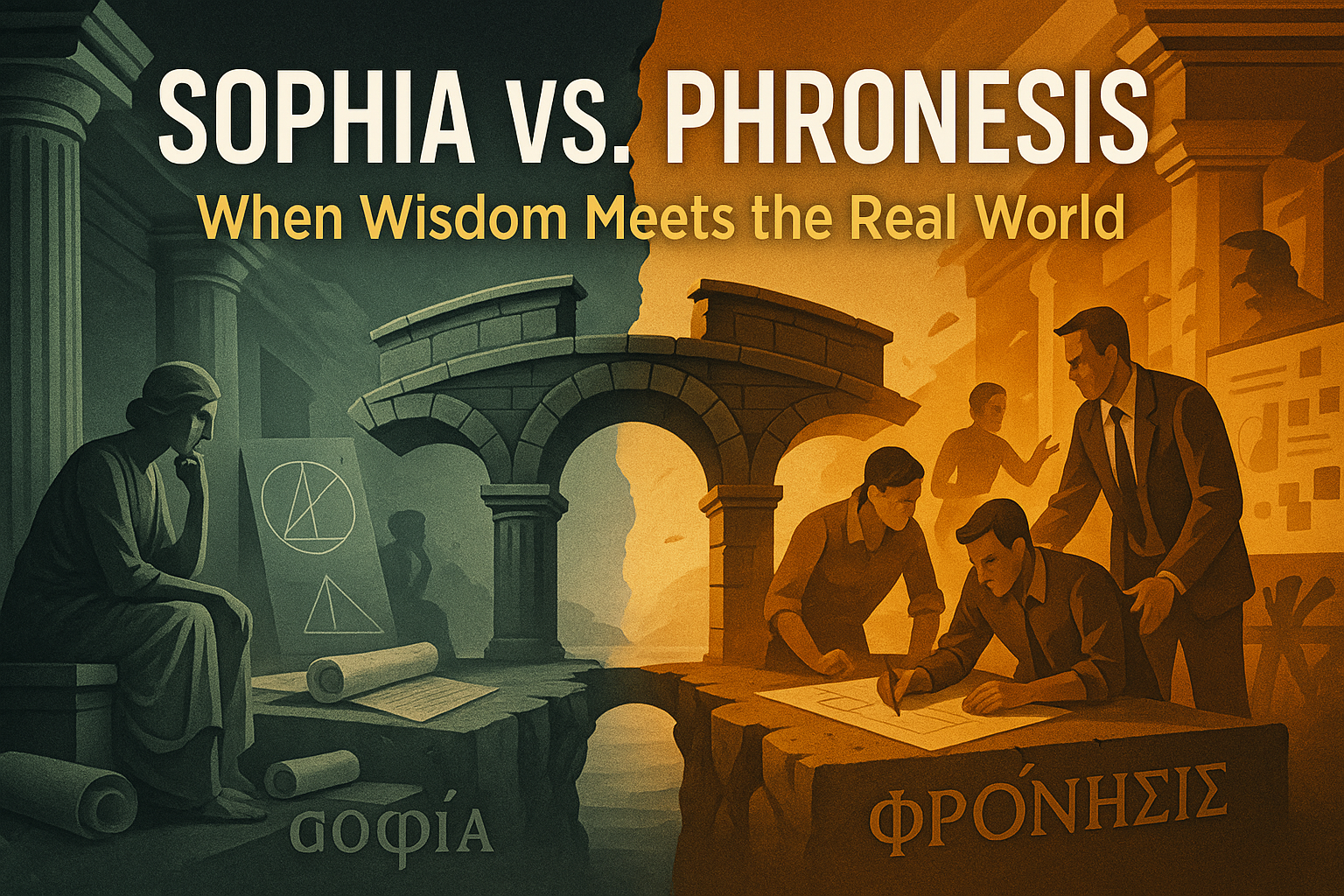
The critical distinction between sophia and phronesis (practical wisdom) is the most important conceptual boundary in Aristotle’s intellectual framework. Sophia deals with universals that do not change: mathematical truths, metaphysical principles, the nature of the cosmos. Phronesis deals with particulars that are always changing: this person, this situation, this moment, this decision. The objects of sophia are eternal. The objects of phronesis are contingent. The methods of sophia are demonstrative. The methods of phronesis are deliberative. Both are intellectual virtues, but they operate in fundamentally different domains.
Aristotle’s controversial ranking places sophia above phronesis as the higher intellectual virtue. His argument is that the objects of sophia are “more exalted” than the objects of phronesis. Sophia contemplates the eternal and necessary; phronesis navigates the temporal and contingent. The contemplative life directed by sophia is, for Aristotle, the highest form of human activity because it most closely approximates the activity of the divine. This ranking has been contested for millennia, and it creates a genuine tension in Aristotle’s ethics: if sophia is higher than phronesis, and phronesis is the virtue that guides ethical action, does Aristotle value theoretical contemplation above ethical life?
Socrates’s paradox of wisdom in the Apology complicates the concept from a different direction. When the Delphic oracle declared Socrates the wisest person in Athens, Socrates interpreted this to mean that he was wise only in knowing that he did not know. He questioned politicians, poets, and craftsmen, and found that each group possessed expertise in their domain but mistakenly believed they also possessed wisdom about things they did not understand. The craftsman who knows how to build a ship believes this entitles them to opinions about how to govern a city. The politician who knows how to win elections believes this entitles them to opinions about the nature of justice. Socrates’s wisdom consisted in recognizing the boundaries of his knowledge, a form of sophia that begins with acknowledging what you do not know.
The relationship between sophia and eudaimonia (flourishing) is the capstone of Aristotle’s ethical project. If eudaimonia is “activity of the soul in accordance with the best and most complete arete,” and if sophia is the best intellectual virtue, then the life of contemplation is the most eudaimon life. Aristotle acknowledges that this contemplative ideal is difficult to achieve because human beings also have bodily needs, social obligations, and practical concerns that require phronesis. The fully flourishing life, therefore, likely involves both sophia and phronesis, both contemplation of eternal truths and wise navigation of practical circumstances. The priority of sophia does not eliminate the necessity of phronesis.
Arete (excellence) in the intellectual domain divides along the sophia-phronesis line. Theoretical excellence means understanding why things are the way they are: why mathematical truths hold, why natural processes operate as they do, why certain principles are necessary rather than contingent. Practical excellence means knowing what to do in specific situations. Both are forms of arete, and both are necessary for the complete human life. The person who possesses only sophia is wise in their understanding but may be helpless in practical affairs. The person who possesses only phronesis navigates daily life skillfully but lacks the deeper understanding that would make their practical choices coherent.
Modern Application
Sophia reveals itself through simplicity, not complexity. When you truly understand something, you can explain it plainly. The person who grasps the structure beneath the surface sees which parts are essential and which are decoration. True wisdom distinguishes what matters from what merely seems to.
Historical Examples
Aristotle himself represents the most comprehensive attempt to combine sophia and phronesis in a single life. His theoretical work spans physics, metaphysics, biology, logic, and cosmology. His practical work includes the Nicomachean Ethics, the Politics, and the Rhetoric. He was Alexander the Great’s tutor, a role that required practical wisdom of the highest order, and the founder of the Lyceum, a theoretical institution dedicated to the pursuit of knowledge for its own sake. The breadth of his achievement demonstrates what becomes possible when theoretical and practical wisdom operate together.
Hypatia of Alexandria, the fifth-century CE mathematician, philosopher, and astronomer, embodied sophia in a context that was hostile to it. She taught mathematics and Neoplatonic philosophy in Alexandria, wrote commentaries on Apollonius and Diophantus, and was consulted by political leaders for her judgment. According to the historical record, including accounts by Socrates Scholasticus, she was murdered by a Christian mob in 415 CE. Her death, which both contemporaries and historians have attributed to political and religious conflict, illustrates the vulnerability of the life of theoretical wisdom in a world governed by factional violence.
Albert Einstein’s development of the theory of relativity exemplifies sophia as the grasp of principles that explain previously disconnected phenomena. Einstein’s special relativity (1905) and general relativity (1915) did not emerge from new experimental data. They emerged from deep theoretical reasoning about the nature of space, time, and gravity. Einstein perceived that the existing theoretical framework was inadequate and constructed a new one from first principles. His work demonstrates the sophia capacity at its most productive: the combination of intuitive insight (nous) and rigorous demonstration (episteme) producing understanding that transforms the entire field.
How to Practice Sophia
Choose one domain you think you understand well and attempt to explain its core principles to someone with no background in it. Where your explanation stumbles, your understanding has gaps. Read primary sources rather than summaries. Spend thirty minutes daily with material that challenges your existing mental models rather than confirming them. Practice asking “why” five times in succession about any conclusion you reach. The discipline of tracing effects back to causes, and causes back to first principles, builds the kind of deep seeing that sophia demands. Maintain a list of questions you cannot yet answer and revisit them monthly. Study across disciplines to develop the pattern recognition that reveals universal principles operating beneath surface differences. When you encounter a new idea, ask how it connects to what you already know at the deepest level. Sophia grows not through accumulating information but through integrating understanding into a coherent view of how things fundamentally work.
Application Examples
A data scientist has mastered the statistical techniques required for their role. They can build models, run analyses, and produce accurate predictions. When asked why a particular model works, they cannot explain the mathematical principles underlying it. They have episteme (knowledge that the technique works) without full sophia (understanding why it works).
Technical competence without theoretical understanding creates fragile expertise. The data scientist who understands why their models work can adapt them to novel situations. The data scientist who only knows that they work is dependent on conditions remaining familiar. Sophia provides the depth that makes expertise transferable and resilient.
A person who has read extensively about moral philosophy faces a genuine ethical dilemma in their personal life. Their theoretical knowledge is extensive, but they realize that understanding justice in the abstract does not tell them what justice requires in this specific situation with these specific people and these specific competing obligations.
Sophia illuminates principles. It does not resolve particular cases. The person who understands moral philosophy deeply has a crucial advantage over the person who does not, but the advantage is in the clarity of their reasoning, not in the specificity of their conclusions. Applying abstract principles to concrete situations requires phronesis, the practical wisdom that sophia alone cannot provide.
A university president who is a distinguished physicist is asked to lead the institution through a complex governance restructuring. Her scientific understanding is profound. Her understanding of organizational politics, human motivation, and institutional dynamics is minimal. She attempts to apply the same analytical rigor to governance that works in physics and discovers that human institutions do not behave like physical systems.
Sophia in one domain does not transfer to other domains. The brilliant scientist who assumes their theoretical intelligence applies universally is making the error Socrates identified: believing that expertise in one area constitutes wisdom in all areas. The university president needs phronesis for governance, which her sophia in physics cannot supply.
A philosophy professor knows the history of Western thought with extraordinary depth. Students report that his lectures are brilliant but his advice is useless because he cannot connect abstract principles to the concrete problems they face. He understands Aristotle’s ethics perfectly and cannot help a student navigate an ethical dilemma.
The gap between theoretical understanding and practical application is the gap between sophia and phronesis. Both are intellectual virtues, but they serve different functions. The professor who can explicate Aristotle’s framework without applying it to a student’s lived experience demonstrates that sophia, however valuable, is incomplete without the practical judgment to deploy it.
A doctoral student discovers that their thesis advisor’s foundational assumption, which has shaped an entire research program, is contradicted by data from an adjacent field. The advisor is unaware of the adjacent field’s findings. The student faces a choice between protecting the advisor’s research program and pursuing the truth wherever it leads. They choose truth and spend an additional two years rebuilding the theoretical framework from corrected foundations.
Sophia requires the willingness to follow understanding wherever it leads, even when it leads away from the comfortable and the familiar. The doctoral student’s commitment to correcting the foundational assumption, at significant personal cost, demonstrates that sophia is not merely an intellectual capacity. It is a character trait: the love of truth strong enough to override the desire for convenience.
A machine learning engineer builds models that produce accurate predictions but cannot explain why the models work. A colleague with a stronger theoretical background examines the models and identifies that they are exploiting a spurious correlation in the training data. The models will fail when deployed in an environment where the correlation does not hold. The theoretical understanding that detected the flaw is sophia applied to a practical domain.
Technical competence that produces correct outputs without understanding why they are correct is vulnerable to silent failure. The engineer with sophia, theoretical understanding of the domain, can identify fragile patterns that the engineer without sophia cannot. In domains where failures are costly, sophia is not a luxury. It is a safeguard.
Common Misconceptions
Confusing sophia with intelligence or cleverness misses what makes it distinctive. Intelligence is a general cognitive capacity. Sophia is a specific intellectual virtue: the understanding of first principles and their necessary consequences. A highly intelligent person who has never reflected on fundamental questions lacks sophia. A person of modest intelligence who has spent decades studying the principles underlying their domain may possess genuine sophia within that domain. Another misconception treats sophia as impractical, useful only for philosophers in ivory towers. Aristotle’s own career refutes this: his theoretical wisdom informed his practical teaching and political advice. The person with sophia understands why things work the way they do, which provides a foundation for practical judgment that experience alone cannot supply.
I discovered, painfully, that my practical competence had no theoretical foundations, and that I had been mistaking pattern recognition for wisdom. I could navigate complex organizational situations effectively. I could make good decisions under pressure. But when someone asked me why my approach worked, I could not explain it beyond “experience” and “intuition.”
The limitation became apparent when I tried to teach what I knew. Practical wisdom that cannot be articulated cannot be transmitted. I could show people how I made decisions, but I could not explain the principles behind those decisions in a way that would allow others to make similar decisions in different circumstances. My knowledge was tacit, embedded in pattern recognition rather than in explicit understanding.
The corrective was deliberate study. I went back to primary sources, not management books but the philosophical traditions that attempt to explain why human beings cooperate, conflict, lead, and follow. Aristotle, the Stoics, Confucius, and others gave me the theoretical framework that my practical experience lacked. The combination transformed my effectiveness: I could now see why certain approaches worked and others did not, which made my practical judgment more precise and more transferable.
What I learned is that sophia and phronesis are genuinely complementary. Neither is sufficient alone. The theorist who cannot act and the practitioner who cannot explain are both incomplete. The most valuable people I have worked with are those who possess both: deep understanding of principles and the practical judgment to apply them in the irreducible complexity of real situations.
Frequently Asked Questions
What is sophia in Greek philosophy?
Sophia is Aristotle's concept of theoretical wisdom, the highest intellectual virtue. It involves understanding first principles and the fundamental nature of reality. Unlike practical wisdom (phronesis), sophia concerns itself with universal truths that do not change with circumstances. Aristotle placed sophia at the summit of intellectual virtues because it grasps the deepest causes and principles that govern existence itself.
What does sophia mean?
Sophia means wisdom or theoretical knowledge. Originally it described skilled expertise in any craft, but Greek philosophers elevated it to mean deep understanding of reality's fundamental principles and causes. It is the root of the word philosophy, literally "love of wisdom." Pythagoras reportedly coined that term because he believed true sophia was too exalted for any mortal to claim to possess, only to love and pursue.
How do you practice sophia?
You develop sophia by studying primary sources, questioning assumptions, tracing conclusions back to first principles, and seeking to understand why things are the way they are rather than merely what they are. It requires sustained intellectual discipline and genuine curiosity about the nature of reality. Test your understanding by attempting to teach complex ideas simply, because genuine comprehension reveals itself in the ability to distill complexity into clarity.
What is the difference between sophia and phronesis?
Sophia is theoretical wisdom about universal truths and first principles. Phronesis is practical wisdom about particular situations and right action. Sophia asks "what is true?" while phronesis asks "what should I do here?" Both are essential, but they operate in different domains of human understanding. Aristotle noted that young people can become mathematical geniuses (a form of sophia) but cannot possess phronesis, which requires the lived experience that only time provides.