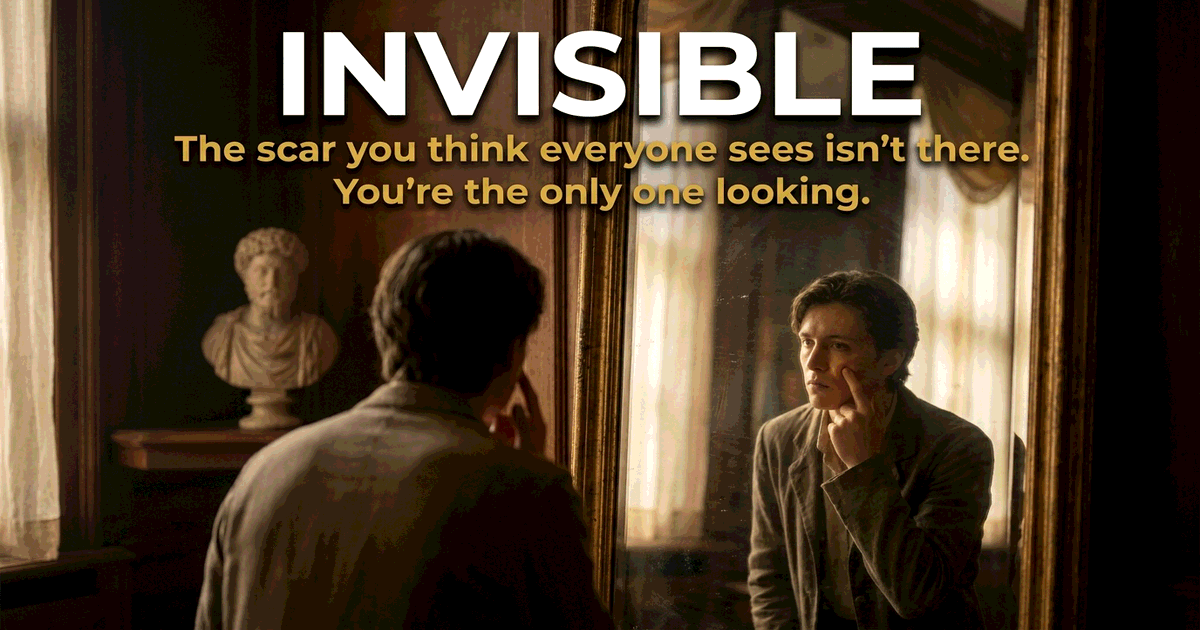
The Scar You Think Everyone Sees Isn't There. You're the Only One Looking.
By Derek Neighbors on May 10, 2026
Your experience of how others treat you is mostly not data. It is the output of a filter you have been running for years without auditing.
Someone seemed cold. The room got quiet when you walked in. The interviewer’s smile dropped half a second after the handshake. The colleague avoided your eye in the hallway. Each moment gets filed as evidence of something you already suspect about yourself: that your flaw, your wound, your scar, the thing you have been quietly carrying, is showing.
The assumption underneath this filing system is that perception is mostly accurate. That when you feel rejected, rejection is usually happening. That when you feel judged, judgment is usually present. That the room is responding to something real about you, and your job is to figure out what.
It is one of the most expensive assumptions a person can carry, and almost everyone carries it. The writer of this article carried it for decades.
The Experiment Almost No One Talks About
In 1980, the Dartmouth psychologist Robert Kleck and his colleague Angelo Strenta ran a study that should have permanently changed how we think about social perception. It did not, because the result is uncomfortable enough that most people prefer to keep not knowing it.
The setup was simple. Female participants were told they would have a brief conversation with another person about a topic of mild interest. Before the conversation, a makeup artist applied a realistic facial scar to each participant’s cheek. The participants were shown the scar in a mirror and confirmed that it looked striking and visible. Then, just before the conversation began, the experimenter said the scar needed one more dab of moisturizing makeup so it would not crack on camera.
What the experimenter actually did was wipe the scar off entirely.
The participants then walked into their conversations believing they had a visible facial disfigurement. The conversation partners saw nothing unusual at all. The encounters were recorded.
Afterward, the participants were asked how they had been treated. They reported, with conviction and in detail, that the conversation partners had been less friendly, more tense, more avoidant of eye contact, more uncomfortable. They believed they had experienced discrimination based on their appearance.
There was no scar. There was no discrimination. There was a belief, and the belief produced an entire perceived reality that did not match what neutral observers later confirmed in the recorded interactions.
The participants were not lying. They were doing what brains tend to do when given a strong prior expectation, and the broader research literature on social perception has continued to confirm the pattern across many populations and contexts since. They were filtering the conversation through the belief that they were being judged, and the hexis of that belief manufactured the data the belief required.
The Mechanism Is Universal
The Dartmouth result is shocking because the scar was so concrete, so easy to disprove. The mechanism it exposes is anything but limited to scars.
Most of us are walking around with invisible scars we are convinced are visible. The man who failed once at thirty-two now reads every conference room at fifty as an audience aware of that failure. The woman who was overlooked in her family of origin now reads every team meeting as confirmation that she is being overlooked again. The professional who got fired in a public way reads every quiet client as the prelude to being dismissed.
In each case, the original wound is not the question the discipline asks. Whether the wound was real, imagined, exaggerated, or earned changes nothing about the audit that is now owed. What is producing the present-tense suffering is rarely the original wound. It is the belief that the wound is still being seen, still being responded to, still defining the encounter. That belief is producing exactly the data it predicts. Decades of work in social psychology and cognitive science point in the same direction: human perception is shaped at least as much by prior expectation as by present evidence.
The most painful possibility is the one almost no one wants to entertain. A substantial portion of the rejection, judgment, and dismissal you have catalogued as the consequence of your wound was never actually present in the rooms you remember. You generated it. You felt it. You responded to it. You made decisions because of it. And it was, in some meaningful percentage, a phantom you carried into the room and projected onto faces that were doing nothing of the sort.
I know this because I have been forced, over the last several years, to face the same arithmetic in my own life.
The Stoics Named This Two Thousand Years Ago
The Stoics, two millennia before any psychology lab existed, named exactly this problem. They called the raw mental image that arises from any encounter a phantasia. The face you read as cold. The silence you read as judgment. The pause you read as rejection. Each of these arrives not as a fact, but as an impression, a phantasia, a felt interpretation that announces itself with the urgency of truth.
The Stoic insight is that phantasiai are not optional. They will arrive, and they will arrive feeling certain, regardless of whether they are accurate. The shape they take is not random. Each impression is colored by hexis, the settled disposition of past assents that has hardened, over years, into the default lens. What gets called “the filter” in everyday language is exactly this: the hexis of unaudited impressions accumulated across a life.
What is optional is what the Stoics called sunkatathesis, the act of assent, the moment in which you agree that the impression is true and grant it authority over your behavior.
Epictetus, repeated across the Discourses, instructed his students to insert a deliberate pause before assent. He told them to greet every harsh impression by saying, in effect, you are an impression and not at all the thing you claim to be. Test it. Question it. Withhold agreement until the impression has earned it.
This is not the cold detachment that gets bolted onto Stoicism in pop accounts. It is prosoche, attention, the disciplined practice of watching impressions as they arise and refusing to be governed by the ones that have not been audited.
It is the only discipline I know that addresses the Dartmouth problem directly. Without it, your perceived reality will be whatever your strongest prior beliefs predict it should be. With it, perceived reality slowly starts to resemble actual reality, and a quantity of suffering you assumed was inevitable turns out to be optional.
Auditing Your Scars
The practical work is auditing your own catalog of invisible scars and asking which of them are still doing the work the Stoics warned us about.
Start with one room. Pick a recent encounter where you walked away convinced you had been judged, dismissed, or rejected. Write down what you remember the other person doing. Now interrogate it the way a careful witness interrogates the testimony of someone with a strong motive. What did the other person actually do, in physical, observable terms? Did they look away, or did you feel their gaze drift in a way you read as looking away? Did they shorten the conversation, or did you cut it short because the early signals were already feeling familiar?
When I do this exercise with people I work with, the recovered evidence is almost always significantly thinner than the conviction. The person remembered being dismissed, but the actual sequence was three neutral exchanges and an early goodbye that may or may not have been about anything at all. The scar produced the story. The story produced the data. The data confirmed the scar. The loop closed before reality got a vote.
The audit is not a clean instrument. The same faculties used to interrogate an impression are themselves shaped by hexis. What the audit gains is not access to a perfect view. It gains a second pass, run with deliberate attention, on material the first pass treated as fact. That is enough. Two passes are more reliable than one, and the deliberate one is more reliable than the automatic one. The Stoics never claimed the audit produced certainty. They claimed it produced freedom from automatic assent, which is a different and more useful gain.
This is not an exercise in pretending you have no wounds. The wounds are usually real, and they were usually formed by something that did, at some point, happen to you. The exercise is in noticing how much present-tense suffering you are still generating from the original wound through perceptual filtering rather than from current events. The work of prohairesis, the Stoic faculty of choice, is in deciding which impressions to assent to and which to interrogate. You cannot stop the impressions from arriving. You can stop them from running your life.
I have done this exercise enough times now to know what it produces. A surprising portion of the rejection I had filed as confirmed was, on careful examination, never quite confirmed. It was assumed, predicted, expected, and then found exactly because I was looking for it. The scar I thought everyone was seeing was, often, only being seen by me. The proper response to that finding is not embarrassment. It is the resumption of the audit.
Final Thoughts
The hardest thing about the Dartmouth study is that it implicates everyone. There is no one who reads it carefully and emerges exempt. The filter runs whether we want it to or not, and a non-trivial portion of the reality we end up suffering from is being generated by us, on the way into the room.
The relief is that this same fact is also where freedom lives. If a meaningful portion of your suffering is being produced by the filter, the filter is the place to do the work. The original wound is out of reach. The past is a closed file. The present-tense impression, the phantasia that arrives with the urgency of truth and demands assent before you have looked at it, is the only ground actually available to you.
The Stoics called this work the only discipline that mattered, because every other discipline depends on it. You cannot govern your life if your perceived reality is being run by impressions you have never audited. You can begin to govern it the moment you start.
The scar you think everyone sees is, in most cases, not the thing they are responding to. You are the one still looking for it. The work is to stop looking, audit the impression, and let the actual room be the actual room.
The discipline holds even when the room is, in fact, judging you correctly about a real failing. Plato understood this more deeply than the social-perception version of the argument lets on. The Stoic audit is not, ultimately, a tool for getting the room right. It is the work of freeing the soul from dependence on the room’s verdict in either direction. If the room is wrong, you are no longer suffering an event that did not happen. If the room is right, you are no longer governed by an opinion you did not yourself examine. Either way, the soul is restored to its own ground.
The room is usually neutral. When it is not neutral, it is still not the place where your character is being decided.
If you are ready to audit the impressions running your life and build the discipline that ancient wisdom calls the foundation of every other virtue, that is the work I do at MasteryLab.co. The practice of examining what you perceive before assenting to it is not optional for a life of clarity. It is the entire game.