Hats, Haircuts, and Tattoos: Why You're Making Every Decision at the Wrong Speed
By Derek Neighbors on February 5, 2026
Someone is sitting in a restaurant right now, staring at a menu for fifteen minutes, paralyzed between the salmon and the chicken.
That same person signed a thirty-year mortgage last month after a twenty-minute conversation with a loan officer.
The salmon versus chicken question received more deliberation than three decades of financial commitment. And nobody in that person’s life told them this was backwards, because everyone around them does the same thing.
This isn’t an indecision problem. It’s a calibration problem. And the cost compounds quietly, every single day.
The Decision Speed Problem Nobody Talks About
The conventional wisdom on decision-making is useless because it treats all decisions as the same species. “Trust your gut.” “Sleep on it.” “Gather more data.” “Move fast and break things.”
None of this advice works because none of it accounts for the single most important variable: how permanent is this decision?
The Greeks understood something we’ve forgotten. phronesis, practical wisdom, is the ability to discern the right action in particular circumstances. One expression of that discernment: knowing how much deliberation a question deserves. Aristotle didn’t argue that the wise person deliberates more. He argued that the wise person deliberates correctly, applying the right amount of thought to the right kind of problem. This distinction between theoretical wisdom and practical wisdom is central to understanding why brilliant people still make terrible decisions.
Most people apply uniform deliberation to every choice. They give the same cognitive weight to choosing a lunch spot as they do to choosing a business partner. The result is exhaustion on trivia and impulsiveness on what matters.
There’s a better system.
The Three Categories
Every decision you’ll ever make falls into one of three categories. The framework is simple. The discipline of applying it is where character reveals itself.
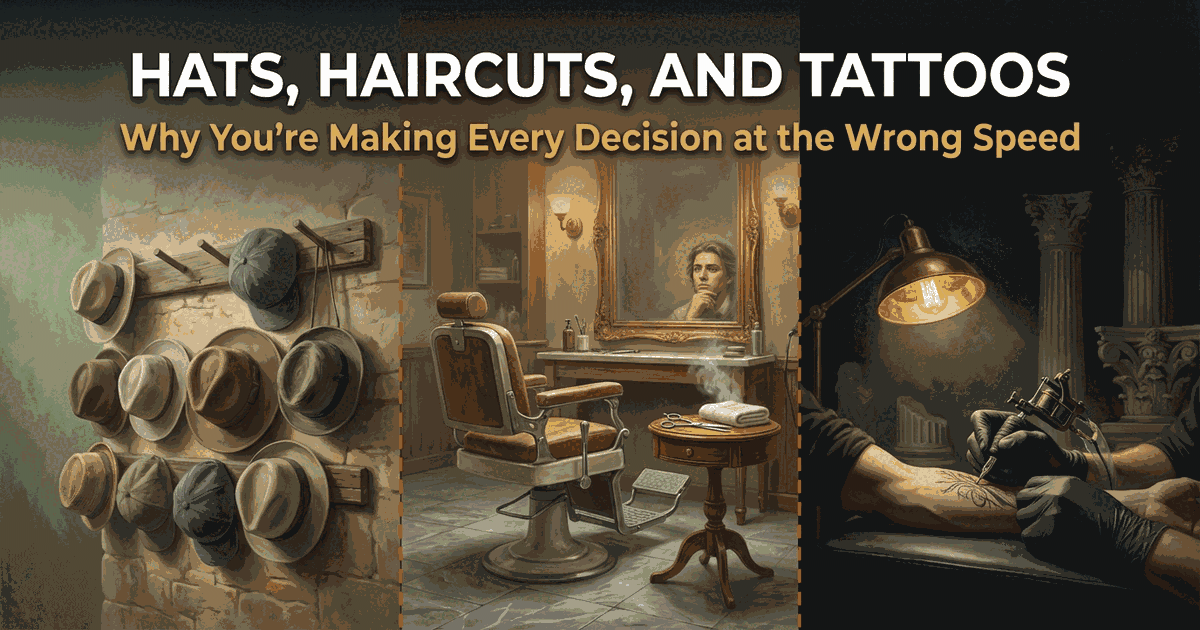
Hats
Put it on. Take it off. Trivial consequence.
What to eat for dinner. Which route to drive to work. What podcast to listen to. Which shirt to wear. What movie to watch.
These decisions are fully reversible at no cost. The wrong hat comes off in two seconds. The right answer to a hat decision is whichever one you pick first, because the cost of deliberating exceeds the cost of being wrong.
The guideline: about sixty seconds or less. The exact number matters less than the principle. If you catch yourself spending real cognitive energy on a hat decision, stop. Pick one. Move. The ancient Stoics practiced prosoche, attentive awareness of how they spent their mental resources. The real competitive advantage belongs to people who manage their attention rather than their hours. The Stoics would have looked at someone agonizing over a Netflix queue and seen a person leaking wisdom through a hole they didn’t know existed.
One caution: speed on hats shouldn’t become speed on everything. The discipline is categorizing first, then matching tempo. If you skip the categorization step and default to fast on all decisions, you’ve traded one failure mode for another.
Haircuts
A bad one is uncomfortable. It grows back.
Which project to prioritize this quarter. Hiring a contractor. Trying a new exercise program. Switching software tools. Accepting a speaking invitation. Signing a one-year lease.
These decisions carry real stakes but are fundamentally reversible. A bad haircut is embarrassing for six weeks. A bad quarterly project wastes time but teaches you something. A wrong hire can be corrected. The discomfort is real, the damage is temporary.
The guideline: set a deadline and honor it. Twenty-four to seventy-two hours of focused deliberation, depending on the stakes. Research enough to be informed, consult someone whose judgment you trust, then commit. sophrosyne, self-restraint, means knowing when you have enough information to act, not waiting for certainty that will never arrive.
The trap with haircuts is treating them like tattoos. People who agonize for months over which gym to join, which CRM to adopt, or whether to attend a conference are burning tattoo-level energy on haircut-level decisions. The time spent deliberating often exceeds the time it would take to try, fail, and try again.
Tattoos
Laser removal exists. It’s painful, expensive, incomplete, and leaves scars.
Marriage. Business partnerships. Having children. Public positions that define your reputation. Major financial commitments. Leaving a career. Severing a key relationship. Anything that reshapes the trajectory of your life and cannot be cleanly undone.
The guideline: slow down. Deliberately. Give yourself at least seventy-two hours between impulse and action, more if the stakes warrant it. Write down your reasoning. Examine your motives with the kind of honesty that makes you uncomfortable. Consult people who will tell you what you don’t want to hear, not the people who validate what you’ve already decided.
phronesis exists for these moments. The full weight of practical wisdom, the kind that Aristotle spent entire books exploring, belongs here. Not on the salmon-versus-chicken question.
| Hats | Haircuts | Tattoos | |
|---|---|---|---|
| Reversibility | Fully reversible, trivial cost | Reversible, but takes time | Permanent or extremely costly to reverse |
| Examples | What to eat, what to wear, which route to drive | Which project to prioritize, hiring a contractor, signing a lease | Marriage, business partnerships, having children |
| Time Guideline | ~60 seconds | 24-72 hours | 72+ hours of deliberation |
| Key Principle | Pick one and move | Set a deadline, then commit | Slow down, write it down, consult honestly |
Where the System Breaks
The reason this framework matters isn’t that people don’t understand it. Most people nod at the logic and continue treating hats like tattoos. The breakdown happens in three predictable places.
Decision fatigue creates miscalibration. When you’ve spent all morning making hat decisions with haircut-level energy, you arrive at actual tattoo decisions with nothing left. The person who agonized over font choices for a presentation and then impulsively accepted a partnership offer didn’t lack judgment. They spent their judgment on the wrong things. The gap between high performers and everyone else isn’t talent, it’s focus, and that includes focus on which decisions deserve your best thinking.
Ego disguises hats as tattoos. Some people deliberate endlessly on trivial choices because deliberation feels like care, thoroughness, intelligence. This is the same instinct that makes smart people overcomplicate everything. The person who researches laptop models for three weeks isn’t making a better decision. They’re performing the identity of someone who makes careful decisions. Meanwhile, the choices that would actually benefit from that rigor go unexamined.
Fear disguises tattoos as hats. The inverse is equally destructive. Rushing through permanent decisions because slowing down forces you to confront the stakes. The couple who gets engaged after three months isn’t spontaneous. They’re avoiding the honest conversation that deliberation would require. Speed becomes a way to outrun doubt.
Haircuts become tattoos without warning. Categories aren’t always stable. A one-year lease becomes a decade of living somewhere. A “quick” business collaboration becomes a defining partnership. The boundary between haircut and tattoo is where the most consequential misjudgments happen. Part of wisdom is noticing when a decision is shifting categories, when something you treated as reversible starts becoming permanent. If you catch that shift early, you can slow down before the cost of reversal becomes unbearable. And when you miscategorize entirely, when something you treated as trivial turns out to be permanent, the response is the same as any other error in judgment: acknowledge it, learn what you missed, and let the mistake sharpen your discernment for next time. The framework won’t be right every time. The discipline is in getting better at the categorization itself.
The Leverage Point
Here’s where small change creates disproportionate impact.
Before engaging with any decision, spend five seconds on one question: “Is this a hat, a haircut, or a tattoo?”
That’s it. Five seconds of categorization before you begin deliberating.
This one practice eliminates the majority of decision fatigue, because it prevents you from applying the wrong level of energy to the wrong level of stakes. Most daily decisions are hats. When you treat them as hats, you preserve your capacity for judgment where it actually matters.
kairos, the Greek concept of right timing, isn’t about moving fast. It isn’t about moving slow. It’s about matching your tempo to the demands of the moment. The same person who should spend sixty seconds choosing lunch should spend six months evaluating a business partner. Both are correct speeds. The wisdom is in the calibration, not the clock.
The Audit That Changes Everything
Track your decisions for one week. Every choice, from what to eat to how to respond to a difficult email, gets one label: hat, haircut, or tattoo.
At the end of the week, look at how you distributed your energy.
Most people discover a pattern that explains their exhaustion: eighty percent of deliberation energy poured into hats and haircuts. Almost nothing reserved for the tattoo decisions that actually define the trajectory of their lives.
The reallocation is where transformation begins. Build defaults for your hats. Same breakfast. Same morning routine. Same default answer to low-stakes requests. This is the elimination discipline applied to your decision-making: cutting the good choices to make room for the great ones. Reclaim that energy and redirect it toward the permanent decisions that deserve your sharpest thinking.
The wisest people across every circumstance share this pattern. They don’t deliberate more than everyone else. They deliberate on fewer things, because they’ve built defaults for the trivial and preserved their judgment for the permanent. This is true whether you’re running a company or running a household on a tight budget. The scale of decisions changes. The principle of calibration doesn’t.
Final Thoughts
phronesis isn’t about making every decision perfectly. It’s about knowing which decisions demand perfection and which demand speed. The person who deliberates deeply on a tattoo and instantly on a hat isn’t indecisive. They’re calibrated. And calibration, the ability to match effort to stakes, is one of the clearest expressions of practical wisdom.
This matters for more than efficiency. Every time you apply the right weight of judgment to the right kind of problem, you train the faculty of discernment itself. Character forms in these moments. The person who practices calibrated judgment doesn’t become faster or more productive. They become wiser. The capacity to distinguish what matters from what doesn’t isn’t a technique. It’s a virtue, developed through repetition, deepened through error, and expressed in how you meet each decision that life puts in front of you.
Here’s a test. Name one decision you’re currently treating like a tattoo that’s actually a hat. Now make it. Right now. Don’t read another paragraph. Decide.
That’s judgment recovered. Yours to spend on something that deserves it.
Now name one decision you’ve been treating like a hat that’s actually a tattoo. That one deserves your attention. Give it the deliberation it requires. Sit with it. Write it down. Talk to someone honest.
The framework is three words. The discipline of living it separates the wise from the merely busy.
If the gap between knowing what to do and actually doing it sounds familiar, that’s the space where MasteryLab.co lives. Frameworks without follow-through are philosophy. Frameworks with practice are transformation.