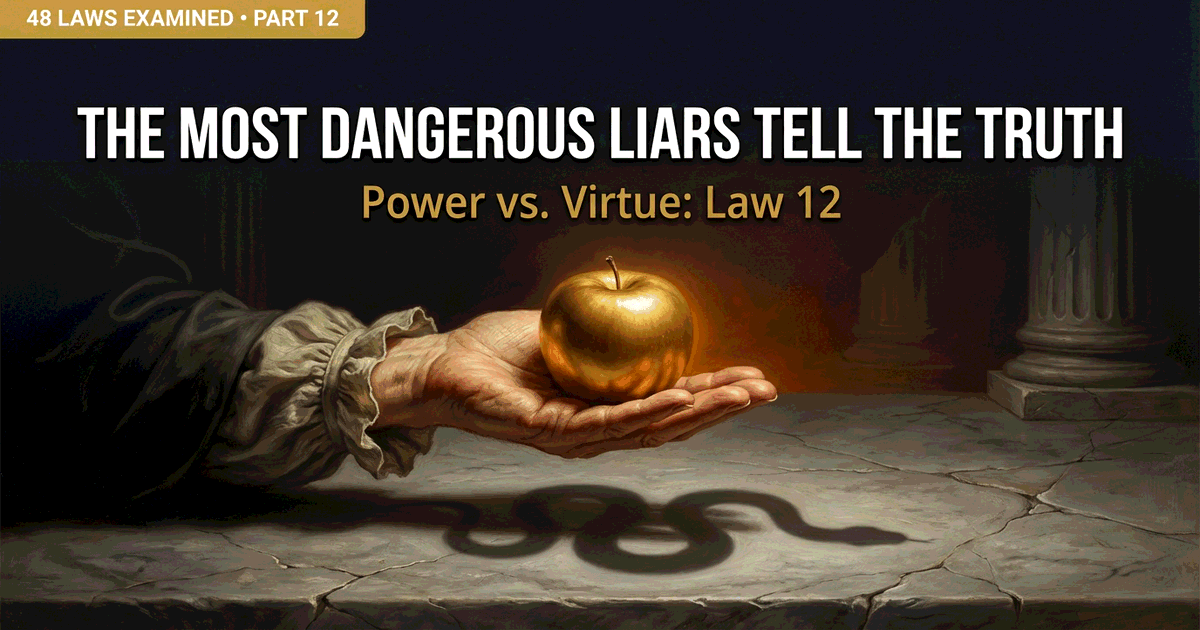
The Most Dangerous Liars Tell the Truth
By Derek Neighbors on April 3, 2026
Power vs. Virtue: The 48 Laws Examined
A year-long examination of Robert Greene's 48 Laws of Power through the lens of ancient virtue ethics. Some laws we affirm, some we reframe, some we reject entirely.
Law 12 of Robert Greene’s The 48 Laws of Power:
One sincere and honest move will cover over dozens of dishonest ones. Open-hearted gestures of honesty and generosity bring down the guard of even the most suspicious people. Once your selective honesty opens a hole in their armor, you can deceive and manipulate them at will.
Greene’s favorite example: con artist Victor Lustig borrows $50,000 from Al Capone, promising to double it. Weeks later, Lustig returns every dollar and admits the venture fell through. Capone, disarmed by the honesty, hands Lustig $5,000 out of respect. That $5,000 was the real target from the beginning. The honest return of $50,000 was the con.
Greene wants you to treat truth like a lockpick. Use it to open doors that lies can’t.
The Tactical Truth
This works because of how the human brain processes trust signals. When someone tells you something honest that appears to cost them, your threat assessment drops. A confession of failure, a transparent disclosure of bad news, these register as proof of character. The brain shortcuts from “this person told me one true thing” to “this person tells true things.”
Psychologists at Harvard call it paltering: using truthful statements to deliberately mislead. Their research found that over half of business executives admit to deploying it in negotiations. It is more common than outright lying because it feels less dishonest to the person doing it and is harder for the target to confront. Every statement passes a fact-check. The overall picture fails a truth-check.
The generosity angle operates on the same circuitry. Robert Cialdini’s research on reciprocity shows that gifts create obligation below conscious awareness. A favor done creates a debt felt. The strategic gift-giver creates a ledger the recipient never agreed to, then draws on it when the moment is right. Most people can’t name why they feel inclined to say yes. They describe it as “I owe them one” without recognizing the precision of that instinct.
Acknowledge this plainly: the person who confesses a small weakness to conceal a large agenda has real tactical advantage. The person who gives generously before asking operates in a space most targets don’t realize exists. The most effective con artists in history didn’t lie constantly. They told the truth relentlessly and selectively, building a foundation of credibility they could spend at exactly the right moment.
The Character Cost
The first thing that breaks is your own instrument. Once honesty becomes ammunition, you lose the ability to deploy it any other way. Every true statement you make passes through a filter: “How does this serve me?” The filter runs whether you want it to or not. Over months, the line between authentic disclosure and strategic disclosure dissolves. You stop knowing which one you’re doing. A carpenter who uses a precision tool as a hammer eventually ruins the tool for precision work. The person who uses truth as a tactic eventually ruins their own capacity for genuine honesty.
The second cost lands on everyone around you. When people discover they’ve been manipulated through truth, and they discover it because patterns repeat and humans are pattern-recognition machines, you haven’t discredited yourself. You’ve discredited honesty. Now every person in your orbit second-guesses genuine vulnerability. Real generosity gets examined for angles. Authentic disclosure gets met with suspicion. The manipulator who weaponizes truth doesn’t damage one relationship. They damage the entire environment’s capacity for trust. The colleague who confesses a real mistake after you gets treated with the same suspicion you earned. Your strategy has collateral damage that extends far beyond your targets.
The third cost is a prison you build without noticing. If honesty is a weapon in your hands, you’ll assume it’s a weapon in everyone else’s. Someone admits a failure and your first calculation is what they’re positioning for. Someone does something generous and you estimate their timeline for calling in the debt. You’ve constructed a world where sincerity cannot exist because you eliminated it from your own behavior and projected that elimination onto everyone else. The strategist who manipulates through truth lives in a world without truth. Not because truth disappeared, but because they lost the ability to recognize it.
The ARETE Alternative
The Greeks had parrhesia: fearless speech that comes from character rather than calculation. The parrhesiastes, the truth-speaker, risks something by being honest. That risk is the signature of genuine honesty. Strategic honesty carries no risk because it’s designed to profit the speaker. parrhesia carries real cost, which is precisely what makes it trustworthy.
The alternative to Law 12 is not naivete. It’s phronesis applied to truth-telling.
Be honest because it’s who you are, not because of what it earns you. Be generous without maintaining a ledger. The moment you start tracking what your generosity produces, it ceases to be generosity and becomes an investment with undisclosed terms. When you confess a weakness, do it because transparency serves the relationship, not because vulnerability lowers defenses.
This looks like a competitive disadvantage against people practicing Law 12. Over a single interaction, it is. Over a career, it’s the only sustainable advantage. The person who practices parrhesia builds a reputation that compounds across decades because people learn to trust their honesty precisely when it’s inconvenient and precisely when it would be easier to stay quiet or spin the story.
I’ve watched both approaches play out across organizations. The strategic truth-teller rises fast and peaks early. People figure out the pattern. They compare notes. The influence built on calculated disclosure erodes the moment two people in the same room realize they received the same “vulnerable confession” deployed for different purposes. The person who speaks truth from character, who practices the ancient discipline of saying what needs to be said regardless of personal cost, builds something that survives scrutiny because there is nothing to find behind it.
Ancient Wisdom Connection
aletheia in Greek philosophy means unconcealment, the removal of what hides the real. For the Greeks, truth wasn’t information management. It was a state of being where nothing is concealed. The person living in aletheia doesn’t select which truths to reveal based on tactical advantage. They live openly because concealment, even strategic concealment, corrodes something internal that no external success can restore.
Aristotle in the Nicomachean Ethics treats truthfulness as a virtue situated between two vices: boastfulness and self-deprecation. The truthful person presents themselves accurately. Not inflated, not deflated. Not because accuracy serves a purpose but because misrepresentation corrupts character regardless of whether anyone notices. The damage is internal before it is external.
Greene’s Law 12 sits squarely in what Aristotle would call dolos, cunning or craft deployed for advantage. The Greeks recognized cunning’s effectiveness. Odysseus was celebrated for it. But they also tracked its cost. Odysseus spent ten years trying to get home, partly because his clever deceptions generated consequences that compounded faster than he could navigate them. The tactical advantage purchased on credit always comes due.
The distinction matters for anyone in leadership. Concealing your intentions creates exhaustion and isolation. Using honesty as a tool creates something worse: an environment where nobody can trust the most basic unit of human communication. A leader practicing Law 12 doesn’t build a team. They build an audience of people performing trust while privately maintaining defenses.
The Test
Four questions worth asking yourself:
- When you share something honest about yourself, are you tracking the other person’s reaction for strategic value?
- When you do something generous, does a part of you file it as a future leverage point?
- If your honesty never produced a single strategic benefit, would you still practice it at the same level?
- Can you receive someone else’s vulnerability without your first thought being “what are they really after?”
If the answers reveal calculation where honesty lives, the law has already shaped you whether you intended it to or not.
Final Thoughts
Greene says deploy honesty as a disarming tool. The Greeks say honesty is a practice that shapes who you become. When truth is a tactic, it stops functioning as truth and becomes the most dangerous form of deception: a lie built entirely from accurate information.
The real defense against Law 12 is not more suspicion. It’s building the kind of character where your own honesty requires no strategy. parrhesia demands speaking truth that costs you something and giving without a ledger. Costly honesty without a ledger is strength that manipulation, no matter how sophisticated, cannot reach and cannot fake.
The most dangerous liars do tell the truth. And the most trustworthy people tell it too. The difference is invisible in a single conversation. Over time, it becomes the only thing that matters.
Ready to build the kind of leadership where honesty needs no strategy? MasteryLab provides frameworks and community for leaders who understand that trust compounds when it costs something.