The Plumber Will Outlast the Programmer. History Already Proved It.
By Derek Neighbors on March 6, 2026
Last year in Tennessee I watched a plumber solve a problem that would have taken an engineering firm a week of analysis. A hundred-year-old house. Cast iron pipes spliced with PVC by a previous owner who clearly learned plumbing from YouTube. Water pooling under the foundation in a spot nobody could see without crawling through a gap that barely fit human shoulders.
He diagnosed it in twenty minutes. He’d seen this pattern before, not in a textbook, but in two decades of crawling under houses where nothing followed code and every job was a puzzle with missing pieces.
No AI on earth could have done what he did that day. The problem required physical presence in an unpredictable environment, pattern recognition from thousands of non-repeatable situations, and a homeowner who trusted him enough to let him tear open a wall based on his word alone. Try tokenizing that.
That combination of skills is about to become the most valuable thing in the economy.
The Pattern Nobody Wants to See
Every major technological revolution in the last 250 years has followed the same script. The technology arrives. Capability spikes. The old guard panics. Adoption moves slower than anyone predicted. Entire industries get destroyed. New ones emerge from the wreckage, eventually. And the people most certain they were protected turn out to be standing directly in the path.
The Industrial Revolution didn’t happen overnight. Steam power emerged in the 1760s. The handloom weavers weren’t fully displaced until the 1840s. That’s eighty years of slow-motion disruption. The Luddites weren’t anti-technology zealots. They were skilled craftsmen watching their expertise become worthless in real time. History proved them right about the destruction even as it proved them wrong about the long-term trajectory.
Electrification followed the same curve. Edison built the first commercial power plant in 1882. But factories didn’t see meaningful productivity gains for another thirty years. Why? Because you couldn’t take a factory designed around a central steam shaft and simply bolt in electric motors. The entire architecture of production had to be reimagined from the ground up. The technology was ready. Organizations weren’t.
Robert Solow won a Nobel Prize partly for observing this pattern in computing: “You can see the computer age everywhere but in the productivity statistics.” Computers arrived in the 1950s. The productivity boom didn’t materialize until the late 1990s. Forty years of organizational learning, infrastructure building, and institutional transformation separated the technology from its impact.
AI is following this script right now.
The Four Brakes
Four forces are slowing AI’s economic impact, buying time that most people are wasting.
Companies cannot restructure faster than their culture allows. The technology to automate half of a company’s knowledge work exists today. The organizational willingness to do it doesn’t. Middle managers protect their headcount. Legal departments flag liability. IT teams worry about integration. The brakes are human, not technical.
Then there’s the liability question. When the AI writes the contract, who’s responsible for the error? When the model recommends the treatment plan, who gets sued? These aren’t hypothetical. They’re the reason adoption in high-stakes domains will take decades, not years.
Integration is expensive and dangerous. Most enterprises run on software built in layers over decades. Replacing it with AI-native workflows means risking the operations that pay the bills right now. The rational move is often to keep the old system running and bolt AI onto the edges.
And every general-purpose technology needs an ecosystem to deliver its full impact. Steam needed railroads and factories. Electricity needed redesigned buildings and consumer appliances. AI needs data infrastructure, sensor networks, robotics, and institutional trust that don’t exist at scale yet.
These brakes don’t stop the revolution. They control its speed. The direction is unmistakable. The timeline is measured in decades.
The Cruel Twist
Here’s where this revolution breaks from the pattern.
Steam displaced physical laborers. Electrification displaced craft workers tied to old production methods. Computing displaced clerical workers and typists. Each revolution climbed the skill ladder, but it always stopped at the same floor. The people doing the work got replaced. The people orchestrating the work stayed.
AI reaches that floor and keeps climbing. For the first time, the technology automates execution-level knowledge work. Writing reports, analyzing data, summarizing research, building presentations, coordinating projects, drafting proposals. This is precisely what large language models do well. These are the tasks that fill the days of millions of white-collar workers who believed their degrees made them safe.
The numbers are already visible. Research published this week measured AI’s actual labor market penetration against its theoretical capability across every occupational category.
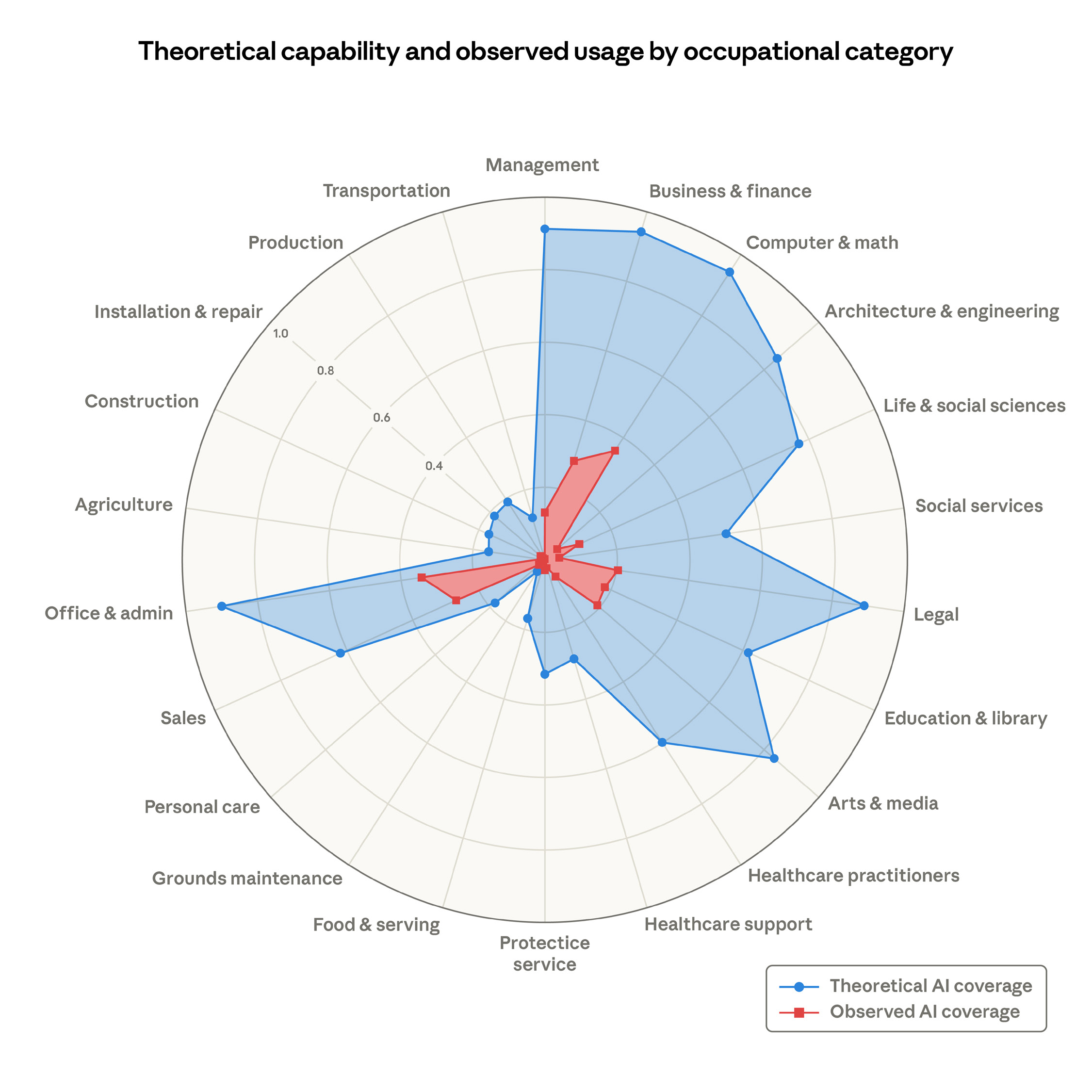
Look at the gap between the blue and red. The blue shows what AI could theoretically automate. The red shows what it actually has. Computer programmers are 75% covered, the highest of any occupation. Computer and math roles are 94% theoretically exposed. Construction, installation and repair, grounds maintenance? Near zero. Meanwhile, 30% of all workers show zero AI exposure. That list reads like a trades directory: motorcycle mechanics, cooks, construction workers. The most exposed workers earn 47% more and hold more degrees than the unexposed. The credentials weren’t armor. They were a target.
The managers still survive, because management requires phronesis, practical wisdom. Someone still has to navigate ambiguity, read the politics in a room, and make the call when the data is incomplete. I wrote about why this kind of wisdom has become a lost art months ago, before the current wave of layoffs made the argument for me. AI can generate the analysis. It can’t decide what to do when the analysis is inconclusive and three stakeholders disagree.
The scarce resource in the economy keeps shifting. Before industrialization, it was muscle. During industrialization, it was energy. In the information age, it was the ability to process data. Now it’s shifting again, toward judgment, taste, trust, and the practical wisdom the Greeks called phronesis.
Think about the “Excel and PowerPoint economy.” The vast middle layer of knowledge work where people spend their days moving information between systems, formatting it, summarizing it, presenting it. That layer sits directly in the path.
The Hands Economy
Before the Industrial Revolution, most people worked with their hands. Farming, building, making. The shift to knowledge work was a product of specific economic conditions: information processing became the bottleneck, and the people who could do it commanded a premium.
That bottleneck held for roughly seventy years.
AI removes it. And something counterintuitive is emerging.
The trades never needed the information-processing bottleneck to justify their value. A plumber’s work requires physical presence in unpredictable environments and techne, genuine craft skill that only comes from years of hands-on practice. Every job involves judgment calls no training dataset can fully capture.
No two houses are the same. The pipe run is always a puzzle. And the customer has to trust you enough to let you tear open a wall.
AI handles none of this. The problem space doesn’t reduce to information processing. You can’t pipe a bathroom remotely. You can’t automate the judgment call about whether to repair or replace a corroded fitting buried inside a wall. And you can’t build the trust required to let a stranger into your home through a chatbot.
The obvious rebuttal: what about robots? Tesla started mass-producing its Optimus humanoid this January. Musk projects a million units by late 2026. But he also acknowledged that the current robots are “primarily for learning, not productive tasks.” Optimus can fold laundry in a lab and sort batteries on a factory floor. It cannot crawl under a hundred-year-old house, diagnose a spliced pipe run that violates three decades of code changes, and convince a skeptical homeowner to authorize a wall tear-out. Robotics will eventually reach unstructured environments. Matching a master plumber’s judgment in a space that barely fits human shoulders will take decades, not product cycles.
The plumber in 2045 may command a premium that today’s corporate analyst would find incomprehensible. Plumbing didn’t get more complex. The analyst’s value proposition collapsed when AI ate the bottleneck that justified it.
What This Means
If your work primarily involves moving information between systems, formatting it for consumption, summarizing it for decision-makers, or coordinating through email, understand what’s happening. The bottleneck that made that work valuable is dissolving. It won’t happen all at once. But the direction is clear and the timeline is decades, not centuries. I’ve written before about how AI is making life easier and why that comfort should worry you. This is the structural reason why.
The people who thrive through this transition will invest in phronesis over credentials. Practical wisdom, the ability to make sound judgments in ambiguous, high-stakes situations, is the skill that increases in value as AI handles everything else. Credentials proved you could process information. Wisdom proves you can decide what to do when the information isn’t enough.
Build techne, real craft skill. Not “prompt engineering” or “AI literacy,” though those have short-term value. Build the kind of skill that requires physical presence, human trust, and irreplaceable judgment. The kind of work that can’t be tokenized.
This requires metanoia, a fundamental transformation of how you think about what makes work valuable. A weekend course won’t cut it. This is a genuine reorientation of what you’re building toward.
Final Thoughts
The pattern is clear if you’re willing to see it. Four technological revolutions in 250 years, and every one of them followed the same arc: capability spike, slow adoption, organizational destruction, new industries born from the wreckage, and the people who thought they were protected getting hit hardest.
AI follows this arc exactly, with one difference that changes everything. This time, the technology doesn’t displace the people who work with their hands. It displaces the people who assumed they’d never have to.
The plumber who crawled under that house last month isn’t worried about AI. He knows something the knowledge economy hasn’t figured out yet: the work that requires showing up, making the call, and earning trust face to face was never a fallback position. It was always the real thing. The rest of us are about to find out he was right.
If you’re ready to build the kind of practical wisdom that AI can’t replicate, MasteryLab is where people who refuse to be displaced do the work that matters.