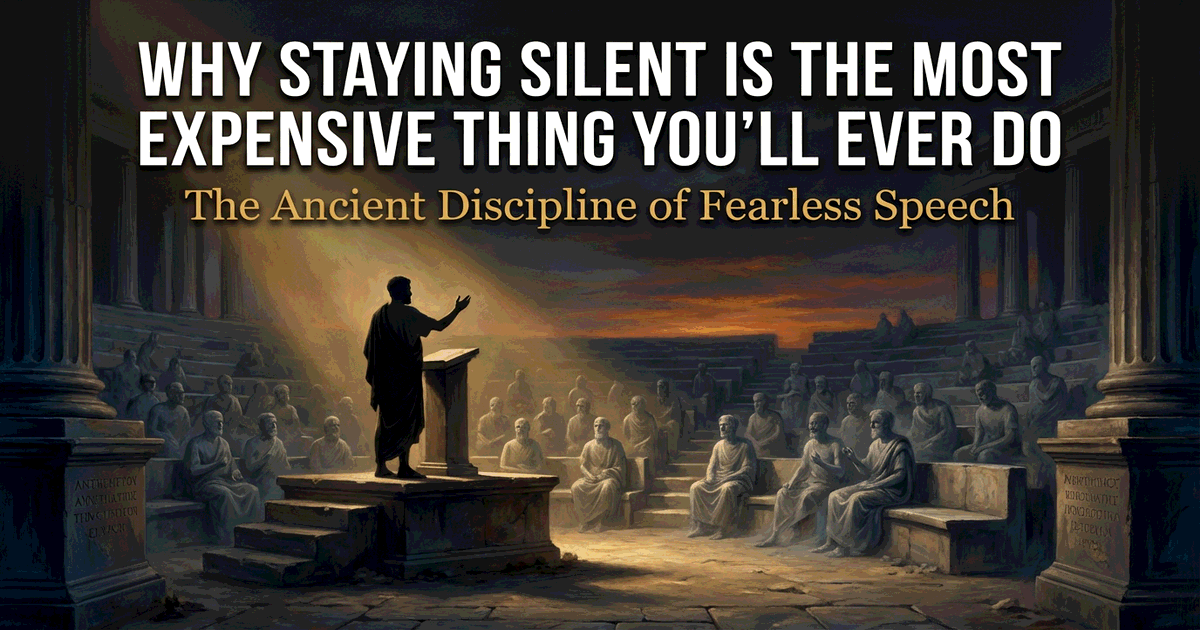
Why Staying Silent Is the Most Expensive Thing You'll Ever Do
By Derek Neighbors on February 10, 2026
Fifteen people in a conference room. A plan on the screen that everyone knows won’t work. The timeline is unrealistic. The assumptions are wrong. The client expectations are built on conversations that never happened.
Fifteen people. Not one says a word.
The plan moves forward. It fails. Three months and a quarter-million dollars later, in hallways and parking lots and Slack DMs, the truth comes out. Everyone knew. They all saw it. And they sat there, nodding along, performing agreement because that’s what the room seemed to require.
The cost of that silence wasn’t the failed plan. Plans fail all the time. And it wasn’t the quarter-million dollars, though someone will fixate on that number. The real cost was fifteen people who practiced being less than they are. The failed project was a symptom. The disease was fifteen people who trained themselves, one more time, that the safe move is to swallow what they know and let someone else deal with the consequences.
The Greeks had a word for what that room was missing. They called it parrhesia.
The Eternal Question
Why do intelligent, capable people go silent at exactly the moments that matter most?
Not because they lack opinions. Not because they lack the words. They go silent because somewhere along the way, they learned that truth-telling has a price and silence appears free.
That calculation is wrong. Silence is one of the most corrosive habits a person can develop, precisely because it doesn’t feel like a habit at all. It costs more than any awkward conversation, any political fallout, any moment of discomfort ever could. But the invoice arrives slowly, over years, in a currency most people don’t track until it’s too late.
The ancients understood this. parrhesia, literally “to say everything,” wasn’t a personality trait in Athens. It was a civic obligation. Not because truth-telling is admirable, but because it’s constitutive of arete, excellence. You cannot pursue human flourishing while systematically abandoning what you know to be true. The relationship between the soul and truth isn’t optional equipment. It’s the engine. Citizens were expected to speak truth to the assembly, especially when that truth was uncomfortable, especially when there was risk in saying it.
That last part is the key. If there’s no risk, it’s not parrhesia. It’s opinion. Flattery is easy. Agreement is free. parrhesia costs something. That’s how you know it’s real.
The Ancient View
Socrates was the archetypal parrhesiastes, the truth-teller. He described himself as a gadfly on the flank of a noble but rather sluggish horse. His role was to sting Athens into wakefulness, to ask the questions no one wanted to hear, to force people to examine beliefs they’d rather leave unexamined.
It wasn’t safe. Athens eventually killed him for it. But consider what the city lost by silencing him. The greatest teacher in Western history, eliminated because the truth he spoke made powerful people uncomfortable. The Athenians didn’t execute a criminal. They revealed their own inability to tolerate parrhesia. And they paid for it in the quality of their discourse for generations.
Foucault, who studied parrhesia extensively in his 1983 Berkeley lectures, identified three conditions that separate fearless speech from everything that pretends to be it. First, you must believe what you say is true. Second, there must be genuine risk in saying it. Third, you must say it anyway. Remove any one of those three and it becomes something else. Opinion. Performance. Manipulation.
The Stoics integrated parrhesia with andreia, courage. Epictetus, himself a former slave who understood freedom at its most visceral level, taught that the only real prison is the one where you know what’s right and refuse to say it. Not the chains on your body. The ones on your speech.
The Modern Problem
We’ve replaced parrhesia with strategic silence. “Pick your battles.” “Read the room.” “Not the right time.” These phrases sound like phronesis, practical wisdom. They function as permission to disappear.
Corporate culture has made it worse. The entire feedback industry, the sandwich methods, the non-violent communication scripts, the “radical candor” trainings, these tools can serve fearless speech, but they cannot replace it. Without the underlying courage to speak truth, they become sophisticated instruments for avoiding it. When every truth needs to be padded with affirmation and scheduled into a one-on-one, the message is clear: honesty is dangerous, so dress it up or keep it to yourself.
Here’s what silence actually costs.
Every time you swallow a truth, you train yourself to swallow the next one faster. The first time feels like discretion. The tenth time feels like personality. The hundredth time, you’ve lost track of what you actually think. Aristotle called this hexis, the process by which repeated actions consolidate into stable character. Your internal compass doesn’t break all at once. It drifts, one silent vote at a time. And by the time you notice, you’re miles from where you meant to stand.
ethos, character, erodes in silence. Aristotle argued in the Nicomachean Ethics that character isn’t what you believe. It’s what you repeatedly do. Each action either strengthens or weakens the disposition beneath it. Choosing not to speak when speaking matters is an action. It’s a vote cast for the version of yourself that prioritizes comfort over conviction. Cast that vote enough times and it becomes your platform.
The organizational cost is equally devastating. Teams where parrhesia is absent don’t fail loudly. They fail quietly, slowly, and expensively. Bad strategies survive because no one challenges them. Talented people leave because the culture punishes honesty. Innovation dies in the gap between what people see and what people say. This is the Abilene Paradox in action, where entire teams march toward outcomes nobody wants because nobody spoke up.
And then there’s the personal cost, the one nobody tracks on a balance sheet. The person who practices silence becomes a stranger to themselves. The gap between what they think and what they express widens until they’ve constructed an entire public identity that has nothing to do with who they actually are. They become a performance of a person rather than a person.
The Integration
Let me be clear about what parrhesia isn’t. It isn’t “brutal honesty” as a personality brand. It isn’t saying whatever crosses your mind without regard for context, timing, or impact. The person who uses truth as a weapon isn’t practicing parrhesia. They’re practicing cruelty and calling it courage.
phronesis, practical wisdom, governs how and when truth gets spoken. The parrhesiastes doesn’t blurt. They choose the moment. They choose the words. And they accept the cost. Fearless speech isn’t careless speech. The discipline is in the integration: courage to speak, wisdom in how you speak, and integrity in why you speak.
There’s also a difference between parrhesia and performance. If your “truth-telling” only happens when it earns applause, it’s a brand, not a practice. Social media is full of people who say provocative things to rooms that already agree with them. That’s not risk. That’s marketing. Real parrhesia means saying the uncomfortable thing to the person or group that doesn’t want to hear it, when you have something to lose by saying it.
And there’s a third impostor: self-righteousness. The person who mistakes their opinions for truth and imposes them on others isn’t practicing parrhesia. They’re practicing dogmatism. The genuine parrhesiastes speaks with conviction AND remains open to being wrong. Fearless speech includes the willingness to hear a fearless response. Without that openness, you’re not pursuing truth. You’re defending territory.
The deepest level of parrhesia isn’t speaking truth to your peers or even speaking truth to power. It’s speaking truth to yourself. Admitting that the story you’ve been telling, about your career, your relationships, your choices, doesn’t match the evidence. Most people will speak up in a meeting before they’ll speak up in their own mind.
The Practice
If you recognize any of this, here’s where to start. But start with a warning: parrhesia requires not only the courage to speak but the wisdom to know what’s true. Before you speak, examine. Sit with the thought. Test it against your own biases. Fearless speech without self-examination produces noise, not truth.
The 24-Hour Truth Audit. For one day, notice every moment you edit, soften, or swallow something you actually believe. Don’t change anything yet. Count them. Most people are shocked by the number. The gap between what they think and what they say is wider than they’ve ever acknowledged.
The One Conversation. Identify one truth you’ve been holding back. One conversation you’ve been avoiding. Not the biggest one. The one that’s been sitting in your chest the longest. Have it this week. Not perfectly. Not with a script. With honesty. The point isn’t to be eloquent. The point is to practice being real.
The parrhesia Question. Before every meeting, every significant conversation, ask yourself: “What do I believe that I’m not saying?” If the answer is “nothing,” you’re either in full alignment or deep in self-deception. Be honest about which one it is.
andreia, courage, is a muscle. Every time you speak a truth that costs something, the next truth becomes slightly easier. Every time you stay silent, the silence gets heavier. You’re always training in one direction or the other. There’s no neutral.
Will it cost you? Sometimes, yes. Epictetus lost everything and still spoke. Socrates lost his life. The cost of parrhesia can be real: a job, a relationship, a reputation. The obligation doesn’t bend because the stakes are high. It becomes harder to fulfill. That’s different from optional.
Final Thoughts
The Greeks didn’t invent parrhesia because they enjoyed conflict. They invented it because they understood what silence does to a person and to a society. A democracy full of silent citizens isn’t a democracy at all. A leader who can’t speak truth isn’t leading. A person who trains themselves to swallow what matters is slowly, methodically, erasing who they are.
The most expensive thing you’ll ever do isn’t a bad investment or a wrong turn. It’s the slow, invisible cost of training yourself not to say what matters. The invoice comes due in the form of a career you can’t stand, a team that can’t trust you, and a version of yourself you don’t recognize.
parrhesia isn’t about being loud. It isn’t about being confrontational. It’s about the discipline of staying real when the pressure says become small. The ancients staked their lives on it. The least you can do is stake a conversation.
If you recognize the gap between what you think and what you say, that gap is where character either grows or erodes. MasteryLab.co is built for people who are done with the comfortable version of themselves.