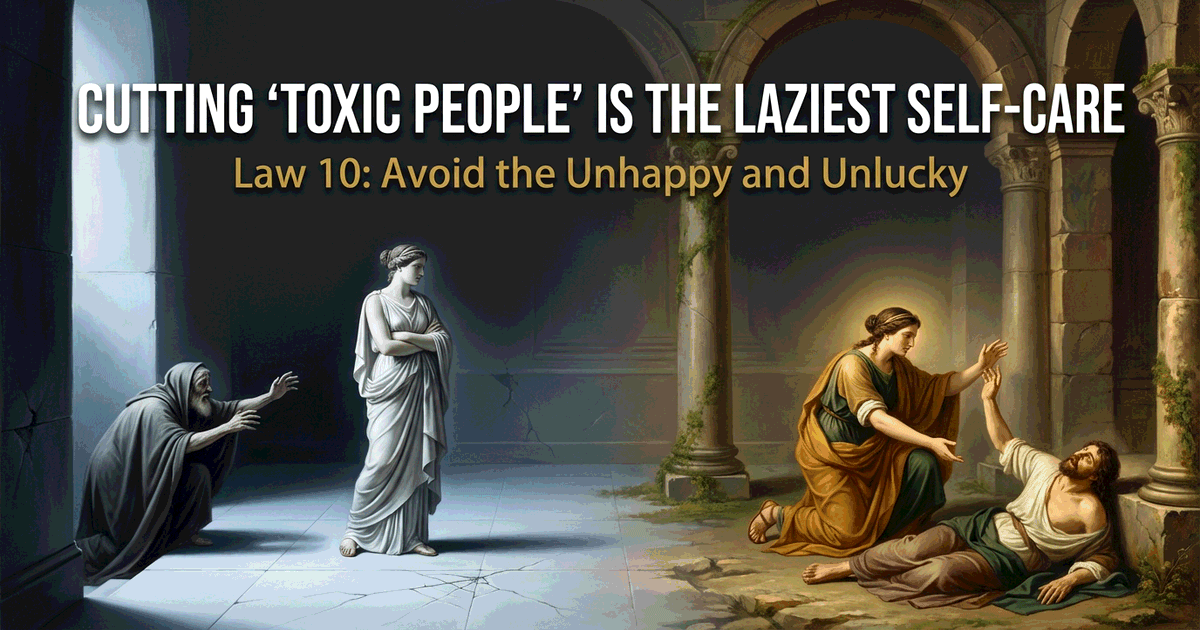
Cutting 'Toxic People' Out of Your Life Is the Laziest Form of Self-Care
By Derek Neighbors on March 22, 2026
Power vs. Virtue: The 48 Laws Examined
A year-long examination of Robert Greene's 48 Laws of Power through the lens of ancient virtue ethics. Some laws we affirm, some we reframe, some we reject entirely.
The self-help industrial complex turned Greene’s Law 10 into a permission slip. Now everyone with an Instagram account diagnoses former friends as toxic and calls the abandonment growth.
Law 10 of Robert Greene’s The 48 Laws of Power:
Avoid the unhappy and unlucky. You can die from someone else’s misery. Emotional states are as infectious as diseases. You may feel you are helping the drowning man, but you are only precipitating your own disaster. The unfortunate sometimes draw their misfortune on themselves; they will likewise draw it on you.
Greene’s core argument: misery is contagious. Unhappy people will pull you into their orbit. And the unlucky carry a kind of infection that spreads to anyone foolish enough to get close.
The Tactical Truth
Greene isn’t making this up. Emotional contagion is real and well-documented. Your brain’s mirror neurons fire watching someone else’s distress. Spend enough time around chronic complainers and you start complaining. Sit with a perpetual victim long enough and the world starts looking rigged against you too.
Some people have made misery a lifestyle. They don’t want solutions. They want witnesses. You offer a path forward and they explain why it won’t work. You suggest a change and they describe why they can’t. The suffering is the point. It’s where they live. And they’re actively recruiting roommates.
Greene sees this pattern clearly. The person who pours their energy into someone determined to stay miserable loses twice: they don’t help the other person, and they drain themselves in the attempt.
Where Greene loses the plot is in the prescription. “Avoid the unhappy” doesn’t distinguish between your friend whose mother died last month and the coworker who has complained about the same problems for a decade without changing a single thing. One of those people needs you. The other needs a mirror and possibly a therapist. Greene treats them identically, and that’s where the law stops being wisdom and starts being cowardice.
The Character Cost
The “cut toxic people” movement started with a legitimate insight and metastasized into something ugly.
It gave people a framework for treating every uncomfortable relationship as a threat. Friend going through a divorce? Toxic energy. Protect yourself. Colleague drowning in a project? Negative vibes. Create distance. Family member battling depression? Sorry, I’m prioritizing my peace.
What these people are actually saying: I only have the capacity for relationships where nobody needs anything from me.
They’re confessing, not setting a boundary.
The person who reflexively cuts struggling people trains themselves out of the capacity for genuine loyalty. They build a social circle optimized for comfort, where everyone performs happiness and nobody tells the truth. The first person who admits they’re having a hard time gets diagnosed and ejected. The group gets more fragile with every cut.
And there’s a delayed cost that Greene never addresses. The person who abandons others during difficulty discovers, during their own inevitable crisis, that they’ve built a network of fair-weather connections. They protected their energy so thoroughly that when they finally need someone to show up for them, the only people left are the ones who will apply the same calculus: Is this person adding to my life right now? The answer during a crisis is always no. So the people who learned “self-care” from the same playbook will pull away, cite the same boundaries, and leave them alone with the problem.
You get back what you modeled. Every time.
There’s also a subtler cost nobody talks about. The person who cuts struggling people loses access to one of the most important sources of growth: watching someone fight through difficulty and come out the other side. The friend who survived the divorce. The colleague who rebuilt after the project collapsed. The family member who found their way through depression. These people carry hard-won wisdom that comfortable people never develop. By retreating from their difficult season, you forfeit the relationship with the person they’re becoming on the other side. And that person, the one forged by what they survived, is usually someone worth knowing.
The ARETE Alternative: Compassion That Doesn’t Drown
The work Greene skips is the work that matters most. Developing the phronesis (practical wisdom) to tell the difference between someone drowning temporarily and someone who has set up permanent residence underwater.
People in temporary difficulty were functional before. They’ll be functional again. They need presence, not solutions. Showing up for them without trying to fix everything, without making their crisis about your discomfort, without needing them to perform recovery on your timeline, that’s one of the highest expressions of character. And it’s where your capacity for real loyalty gets built.
People who have made misery their identity are different. Every conversation circles back to their suffering. They reject solutions because the problem is the point. They don’t want help. They want company in the dark. With these people, boundaries aren’t cruel. They’re necessary. You can wish someone well and refuse to follow them underwater at the same time.
The distinction requires phronesis. You have to know people well enough to read the difference. And you have to be willing to get it wrong sometimes, to stay too long with someone who turned out to be a permanent victim, or to pull back too early from someone who genuinely needed another month of patience.
Greene’s approach eliminates all this difficulty by replacing it with a simple rule: if they’re unhappy, leave. He skips the hard work of discernment entirely. And discernment, not avoidance, is what separates leaders from bystanders.
Ancient Wisdom Connection
The Stoics had a concept for this: sympatheia, the recognition that all humans are connected, woven into the same fabric. Marcus Aurelius wrote that we are made for cooperation, like hands and feet. One foot doesn’t abandon the other because it stepped on something painful.
But the Stoics weren’t naive. Epictetus taught his students to protect their prohairesis (moral character) from corruption. He drew a hard line: you can be present for someone’s suffering without adopting it as your own. Sitting with grief doesn’t mean becoming grieved. Compassion doesn’t require surrendering your equilibrium.
philanthropia (love of humanity) was a core Stoic virtue. Not selective affection for people who make you comfortable. Love for humans because they’re human. The Stoics practiced this while governing empires, advising tyrants, enduring exile, and burying children. They didn’t retreat from suffering. They engaged with it from a foundation stable enough to hold.
That’s the distinction Greene misses entirely. The Stoics would have agreed that some people cultivate misery and will pull you under. But they wouldn’t have prescribed retreat. They would have prescribed strength. Build your autarkeia (inner stability) solid enough that someone else’s pain doesn’t threaten your center. Then show up. Not because it’s pleasant. Because it’s what arete (excellence of character) demands.
Seneca lost his son, endured political exile, and watched friends executed. He didn’t isolate himself from suffering. He wrote letters to grieving friends while processing his own loss. He could do this because his stability came from within, not from the people around him being okay. That’s what real emotional resilience looks like. Not a curated bubble where nobody struggles. A center strong enough to stay present when they do.
The Test
When you last cut someone out of your life, were they genuinely destructive, or were they going through something hard and you didn’t want the inconvenience?
Could you sit with a friend’s real grief for an hour without trying to fix it, escaping into your phone, or mentally calculating when you could leave?
If you got the worst news of your life tomorrow, who would show up? And did you earn that kind of loyalty by showing up when it was their turn?
Final Thoughts
Greene says avoid the unhappy and unlucky. The reframe: build yourself strong enough to withstand someone else’s hard season, and wise enough to recognize when someone has made misery a permanent address.
Cutting people off is easy. Any coward can ghost a struggling friend and call it growth. Showing up when someone is at their worst while keeping your own ground? That takes the kind of strength no self-help book can sell you.
The laziest version of self-care is labeling everyone who needs something from you as toxic. The hardest version is learning to be present for real difficulty without drowning in it. One protects your comfort. The other forges your character.
Your circle shouldn’t be optimized for how it makes you feel. It should reflect who you’re willing to be when things get hard for someone other than you.
Ready to build the kind of strength that can hold steady when someone else is falling apart? MasteryLab.co is where people who are done curating comfort learn to build real capacity.