Most Success Is Just Avoiding Obvious Mistakes
By Derek Neighbors on December 11, 2025
In 2011, JCPenney hired the genius who built Apple’s retail stores. Ron Johnson was going to revolutionize department store retail. His brilliant strategy: eliminate sales, coupons, and clearance racks. Replace them with “fair and square” everyday pricing. No more games. No more fake markdowns. Just honest prices.
The problem was obvious to anyone who’d ever watched a JCPenney customer. They came for the sales. They loved the coupons. The thrill of “getting a deal” wasn’t a bug in the system. It was the entire point.
Johnson ignored this. He was chasing brilliance while stepping over the obvious.
Within 18 months, JCPenney lost 25% of its sales. $4 billion in revenue, gone. The stock dropped 50%. Johnson was fired in 2013.
The smartest guy in retail destroyed a company not because he lacked vision, but because he was so focused on the brilliant move that he couldn’t see the obvious mistake.
Of course, “obvious” is generous. Mistakes are usually only obvious in retrospect. The discipline isn’t seeing what’s clearly wrong. It’s developing the honesty to see what’s in front of you before it costs you everything.
The Fork in the Road
There are two approaches to getting better at anything.
Path A: Get smarter. Work harder. Find the brilliant insight. Chase the edge.
Path B: Stop doing the dumb things. Remove obvious errors. Eliminate what’s not working.
Most people choose Path A because it feels like progress. Path B feels like admitting you were doing something wrong.
Charlie Munger spent decades as Warren Buffett’s partner, and he distilled his approach to success into one uncomfortable observation:
It is remarkable how much long-term advantage people like us have gotten by trying to be consistently not stupid, instead of trying to be very intelligent.
Aristotle called this phronesis, practical wisdom. Not knowing what to do, but knowing what NOT to do. Wisdom manifests more in restraint than action.
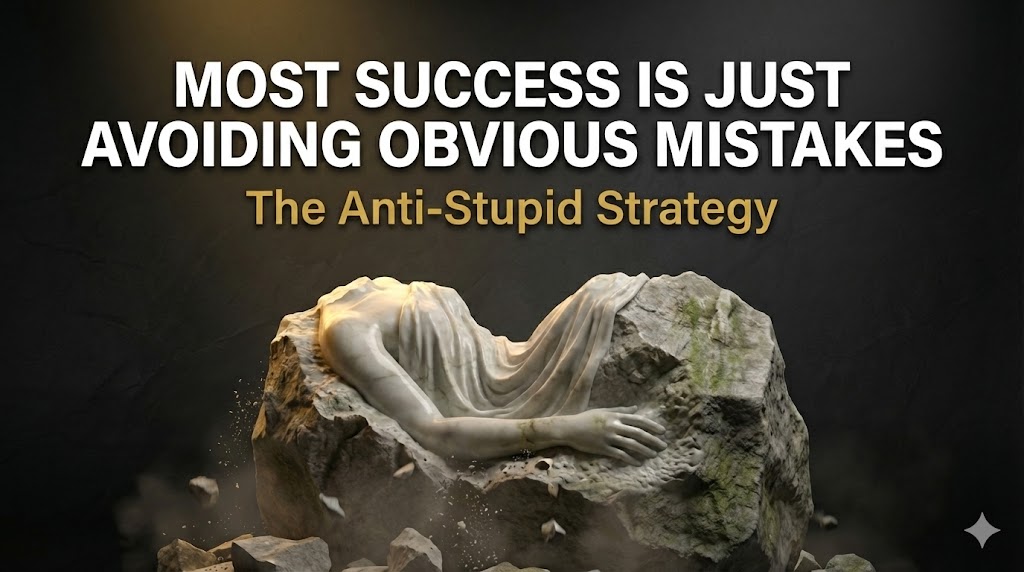
Think of the sculptor approaching marble. Michelangelo didn’t add clay to create David. He removed everything that wasn’t David. The form was already there, hidden beneath what didn’t belong.
Why was David in the marble? Because the sculptor’s job isn’t invention. It’s revelation. The same is true for you. Excellence isn’t something you build from nothing. It’s something you reveal by removing what blocks it. Aristotle argued that every human has a proper function: the capacity to reason well and live accordingly. That capacity is already present. The errors, the bad habits, the self-deceptions are the excess marble. Chip them away, and what remains is what you were always capable of becoming.
Path A: The Seduction of Brilliance
The pursuit of brilliance is intoxicating. It looks like:
Constantly searching for the edge, the insight, the breakthrough. Reading more books. Taking more courses. Seeking more advice. Looking for the strategy that will change everything. Optimizing. Hacking. Maximizing.
The appeal is obvious. It feels proactive and ambitious. Stories of success celebrate the brilliant move. There’s ego satisfaction in being “smart.” And there’s always the hope that one insight will transform everything.
But there are hidden costs.
Brilliance is rare and hard to replicate. The search never ends because there’s always another edge to find. Meanwhile, you’re ignoring the compounding damage from ongoing errors. Tolerating mediocrity in your own habits compounds the same way it does on a team. Complexity breeds more errors. And often, the brilliant move gets completely negated by the stupid mistakes that continue unchecked.
Consider the investor who spends hundreds of hours finding the perfect stock pick while paying 2% fees that guarantee underperformance. The brilliance is irrelevant when the error is constant.
Path A treats success like a treasure hunt. Find the right X, and everything changes. But while hunting for treasure, you’re bleeding from a thousand small cuts.
Path B: The Discipline of Subtraction
The alternative approach is less glamorous but more effective.
Identify what’s clearly not working and stop doing it. Create systems that prevent known failure modes. Use checklists, defaults, and constraints. Subtract before adding.
Warren Buffett’s Rule #1: “Never lose money.” Rule #2: “Never forget Rule #1.”
This isn’t about avoiding all risk. It’s about not making unforced errors that compound against you.
Aviation understood this. Planes didn’t become safer through brilliant engineering alone. The checklist reduced human error by 35%. Simple systems preventing known failure modes. No brilliance required. Just discipline.
Atul Gawande documented the same pattern in medicine. Surgical checklists reduced deaths by 47%. Not smarter surgeons. Fewer stupid mistakes. The checklist catches what expertise misses.
This works at every level of life. The person who finally gets healthy doesn’t discover a revolutionary diet. They stop eating after 9 PM, stop drinking soda, stop skipping sleep. No breakthrough required. The elimination discipline does the heavy lifting. The person who fixes their finances doesn’t find a brilliant investment strategy. They stop buying things they don’t need, stop ignoring their credit card statement, stop pretending next month will be different. The transformation comes from removing what’s clearly not working.
The same principle applies beyond material concerns. The person seeking wisdom doesn’t need the one brilliant insight. They need to stop the habits that prevent clear thinking: the reactive opinions, the unexamined assumptions, the ego that refuses correction. The person pursuing justice doesn’t need a revolutionary theory. They need to stop the small compromises, the convenient blindnesses, the rationalizations that accumulate into character failure.
The approach is straightforward:
What are my known failure modes? What errors have I made more than once? What would I tell someone else NOT to do in my position? What am I doing that I know isn’t working?
The Greeks called this sophrosyne: self-restraint, moderation. Not the flashy virtue, but the one that prevents self-destruction. They understood that most failure is self-inflicted.
The Math That Changes Everything
Here’s why error elimination beats brilliance hunting:
Brilliance has diminishing returns. Error elimination compounds.
One great insight might give you 10% improvement. Removing five obvious errors might give you 50%.
Brilliance requires luck and timing. Avoiding stupidity is always available.
Bill Belichick built the greatest dynasty in NFL history on this principle:
Winning favors the team that makes the fewest mistakes.
Six Super Bowl championships. Not by having the most talented roster every year, but by being the team that beat itself least often.
The math of mistakes is brutal. If you make a 20% error, you need a 25% gain just to get back to even. Errors don’t subtract. They multiply against you.
Munger again:
It’s not supposed to be easy. Anyone who finds it easy is stupid.
The search for easy brilliance is itself a form of avoidance. The hard work is honest assessment of your own errors, and that assessment requires delayed gratification over the dopamine hit of chasing the next breakthrough.
This is why Path B is actually harder than Path A. It requires admitting you’re doing something wrong. There’s no ego boost from “finding the secret.” It feels like retreat, not progress. And it forces confrontation with uncomfortable truths about your own patterns.
There’s another layer: some errors you can’t see at all. Blind spots exist. This is where systems, checklists, and honest feedback become essential. The checklist isn’t just error elimination. It’s brilliance applied to the problem of human limitation. The pilot doesn’t trust their memory. The surgeon doesn’t trust their expertise alone. The discipline of subtraction includes building systems that catch what you’ll inevitably miss.
The inversion question cuts through the noise: Instead of “What would make this succeed?” ask “What would guarantee this fails?” Then stop doing those things.
When Brilliance Actually Matters
Path A isn’t wrong. It’s just out of sequence.
Brilliance makes sense once you’ve eliminated obvious errors. When you’ve earned the right to optimize. In domains where the basics are truly mastered. When brilliance is the actual bottleneck, which is rare.
What about revolutionary innovation? The Wright Brothers, Einstein, the true breakthroughs? Even here, the pattern holds. The Wright Brothers didn’t just pursue flight. They systematically avoided the errors that killed other pioneers: inadequate control systems, untested assumptions, building before understanding. Their brilliance was real. But it only mattered because they didn’t make the fatal mistakes their competitors made. Revolutionary innovation isn’t exempt from error elimination. It depends on it.
The sequence that works:
Subtract first. Remove what’s clearly not working.
Systematize second. Create defaults that prevent known errors.
Add last. Only then chase the brilliant insight.
For your career: What are you doing that you’d tell a friend to stop? What meetings, commitments, or habits are obviously wasteful? What would a checklist for your known failure modes look like?
For your team: What processes exist because of past errors? What mistakes keep recurring? Where are you chasing “better” while ignoring “not broken”?
The excellence equation is simple:
Excellence = (Potential - Obvious Errors) × Brilliance
If obvious errors are high, brilliance is just a multiplier on a small number.
One final note: this discipline isn’t ultimately about worldly success. Success is a side effect. Epictetus was a slave. He didn’t pursue virtue for career advancement. He pursued it because it was owed. The real reason to eliminate errors is that excellence is obligatory. Every removed error is less interference between you and what you’re capable of becoming.
Final Thoughts
The Greeks had a word for this kind of flourishing: eudaimonia. Not happiness in the shallow sense, but the deep satisfaction of functioning as you were meant to function. The sculptor doesn’t add marble to create David. He removes what blocks it. Your work is the same.
Ron Johnson had vision. He had experience. He had the credibility of building Apple’s most successful retail operation. What he lacked was the humility to see the obvious error in front of him.
The uncomfortable audit: What are the obvious mistakes you’re still making while chasing brilliant solutions? What would change if you spent the next 90 days eliminating errors instead of seeking edges?
Write down your five most repeated mistakes. The errors you’ve made more than once. Then create a simple system to prevent each one. The boring truth about excellence is that preventing known failures beats chasing unknown breakthroughs.
No brilliance required. Just honesty about your own patterns.
Most success isn’t about being smart. It’s about not being stupid.
Ready to stop chasing brilliance and start eliminating what’s actually holding you back? MasteryLab provides the framework and community for people done with the treasure hunt, ready for the honest work.