Parrhesia vs Aletheia: Key Differences in Greek Philosophy
Parrhesia and aletheia both involve truth, but they operate in different dimensions. Aletheia concerns the nature of truth itself, the process of reality becoming unconcealed. Parrhesia concerns the act of speaking truth, especially when doing so carries personal risk. You can understand truth without voicing it. Parrhesia is the courage to open your mouth anyway.
Definitions
Parrhesia
(παρρησία)
par-ray-SEE-ah
The courage to speak truth freely and frankly, especially to those in power, regardless of personal risk. In ancient philosophy, parrhesia was considered both a moral duty and a democratic virtue—the speaker accepts danger in service of truth.
Aletheia
(ἀλήθεια)
ah-LAY-thay-ah
Truth as unconcealment. Not merely accurate statements, but the fundamental orientation toward reality as it actually is, the state of being unhidden.
Key Differences
| Aspect | Parrhesia | Aletheia |
|---|---|---|
| Focus | Parrhesia focuses on the act of speaking. It is about the courage and practice of expressing truth to others, particularly to those in power. | Aletheia focuses on the nature of truth itself. It is about reality being disclosed or uncovered from hiddenness. |
| Social Dimension | Parrhesia is inherently social. It requires a speaker, a listener, and a power dynamic where speaking carries risk. | Aletheia can be solitary. Truth as unconcealment can occur in private contemplation, personal discovery, or individual awareness. |
| Risk | Parrhesia involves personal risk by definition. Foucault emphasized that the speaker must have something to lose for the speech act to qualify as parrhesia. | Aletheia does not necessarily involve risk. Discovering truth can be uncomfortable, but the concept itself does not require danger. |
| Virtue Involved | Parrhesia requires courage (andreia). It is a practice that demands moral bravery alongside truth-telling. | Aletheia requires orientation toward reality. It demands intellectual honesty and the willingness to see what is actually there. |
Focus
Parrhesia focuses on the act of speaking. It is about the courage and practice of expressing truth to others, particularly to those in power.
Aletheia focuses on the nature of truth itself. It is about reality being disclosed or uncovered from hiddenness.
Social Dimension
Parrhesia is inherently social. It requires a speaker, a listener, and a power dynamic where speaking carries risk.
Aletheia can be solitary. Truth as unconcealment can occur in private contemplation, personal discovery, or individual awareness.
Risk
Parrhesia involves personal risk by definition. Foucault emphasized that the speaker must have something to lose for the speech act to qualify as parrhesia.
Aletheia does not necessarily involve risk. Discovering truth can be uncomfortable, but the concept itself does not require danger.
Virtue Involved
Parrhesia requires courage (andreia). It is a practice that demands moral bravery alongside truth-telling.
Aletheia requires orientation toward reality. It demands intellectual honesty and the willingness to see what is actually there.
When to Apply Each Concept
When to Choose Parrhesia
Practice parrhesia when you see a truth that needs to be spoken and others are avoiding it. When your team is heading toward a bad decision, when leadership needs honest feedback, or when silence would make you complicit in a problem, parrhesia is the relevant virtue. The question is not whether the truth exists but whether you will voice it.
When to Choose Aletheia
Practice aletheia when you need to see clearly before you can speak or act. When you are confused, deceived, or operating on assumptions, the first task is to uncover what is real. Aletheia is the foundation that parrhesia builds on, because you cannot speak truth fearlessly if you have not first done the work of seeing clearly.
Frequently Asked Questions
What is the difference between parrhesia and aletheia?
Aletheia is truth as unconcealment, the philosophical concept of reality being disclosed from hiddenness. Parrhesia is fearless speech, the practice of speaking truth openly despite personal risk. Aletheia describes what truth is. Parrhesia describes the act of expressing it. A person can perceive truth (aletheia) without ever voicing it. Parrhesia is the bridge between seeing truth and speaking it.
Do you need aletheia before parrhesia?
Yes. You cannot practice genuine parrhesia, fearless truth-telling, without first having access to truth itself. Speaking boldly about something false is not parrhesia; it is recklessness or delusion. The practice requires first doing the work of aletheia (seeing clearly) and then the work of parrhesia (speaking courageously).
Why is parrhesia considered dangerous?
Foucault's analysis of parrhesia emphasized that true fearless speech requires the speaker to occupy a position of less power than the listener. Speaking truth to a king, a boss, or a crowd that disagrees with you carries real consequences. The danger is what makes parrhesia a virtue rather than a habit. Saying what is true when it costs you nothing requires no particular moral strength.
Articles Exploring Parrhesia or Aletheia (26)
Soft Feedback Is Kind to You and Expensive to Them
You saw the problem ten minutes into the design review and said 'solid start, think about the failure cases.' They heard approval and built for three weeks on a design you knew was cracked. Softening the verdict spared you one bad minute. They paid for it in weeks, in a public correction, and in praise from you they can no longer trust. You kept the comfort and they got the bill.

Blend In Long Enough and There Is Nothing Left to Hide
Law 38 of the 48 Laws of Power tells you to think as you like but behave like others. Seneca gave nearly the same advice, for a better reason and with a line Greene never draws. Aristotle explains the bill: there is no inside that survives ten years of an outside that conforms.
Make Someone Untouchable and the Failure Is Already Yours
A founding architect nobody was allowed to question. A senior engineer who questioned him once and got moved. Two years of pull requests with zero comments that everyone called quality. Then the migration that took the platform down, with a root cause that had been raised in the one review that got silenced. Athens ran the same story with Alcibiades in 415 BC and lost a fleet. The moment an organization decides someone is beyond reproach, the failure that follows belongs to everyone who agreed, and there is an old Greek word for the thing they got backwards.
Unspoken Expectations Are Premeditated Resentments
The ticket was green. I still sat in the review angry about a customer note, a rollback, and a demo that were never on the page. She asked when I had put those in writing. I had not. I was collecting a bill for a test I never handed out.
You Wait for Consensus and Call It Thinking
The original thought is already in the room. What is missing is the person willing to say it while it can still lose. Consensus is a tool. It is a poor substitute for a first speaker.
Play to Their Fantasies and You Train Them Off Reality
Law 32 of the 48 Laws of Power tells you to play to people's fantasies: become the oasis of romance in a harsh world, avoid ugly truth, and gain power from the hunger for soft stories. The tactical truth is real. Pleasant pictures gather crowds, and disenchantment makes people angry. The character cost arrives when fantasy becomes your operating system. You train judgment off reality. When the mirage breaks, you earn the rage. The ARETE alternative keeps hope aimed at a hard path people can walk, and restores frank speech that can still lead.

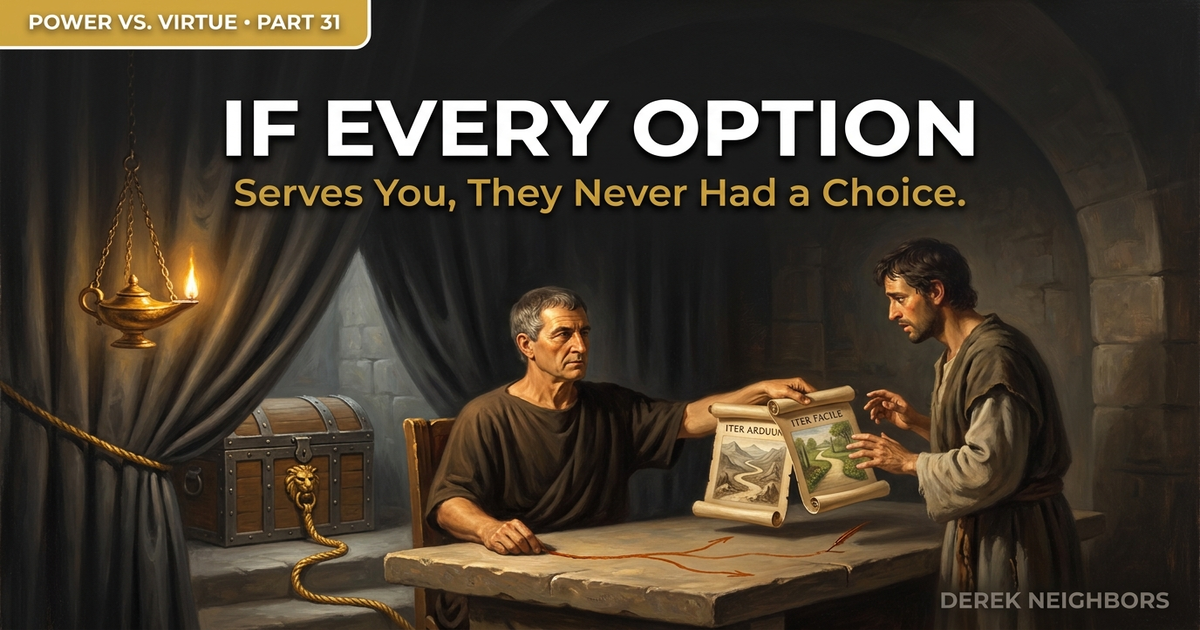
If Every Option Serves You, They Never Had a Choice
Law 31 of the 48 Laws of Power tells you to control the options: get others to play with the cards you deal. The tactical truth is real. Unstructured choice stalls rooms, and people defend outcomes they believe they chose. The character cost arrives when the menu is a rigged deck. Every door already belongs to the dealer. Discovery bankrupts trust. The operator trains contempt for other people's judgment. The ARETE alternative keeps framing as craft and restores real prohairesis: honest constraints, a shared end, and at least one exit that is not already yours.
Your Team Isn't Fighting the Decision. They're Fighting How You Made It.
Leaders keep blaming the decision when the fracture started earlier. People can carry hard outcomes they disagreed with when they were heard first. Being treated as audience to a sealed call is what they refuse.

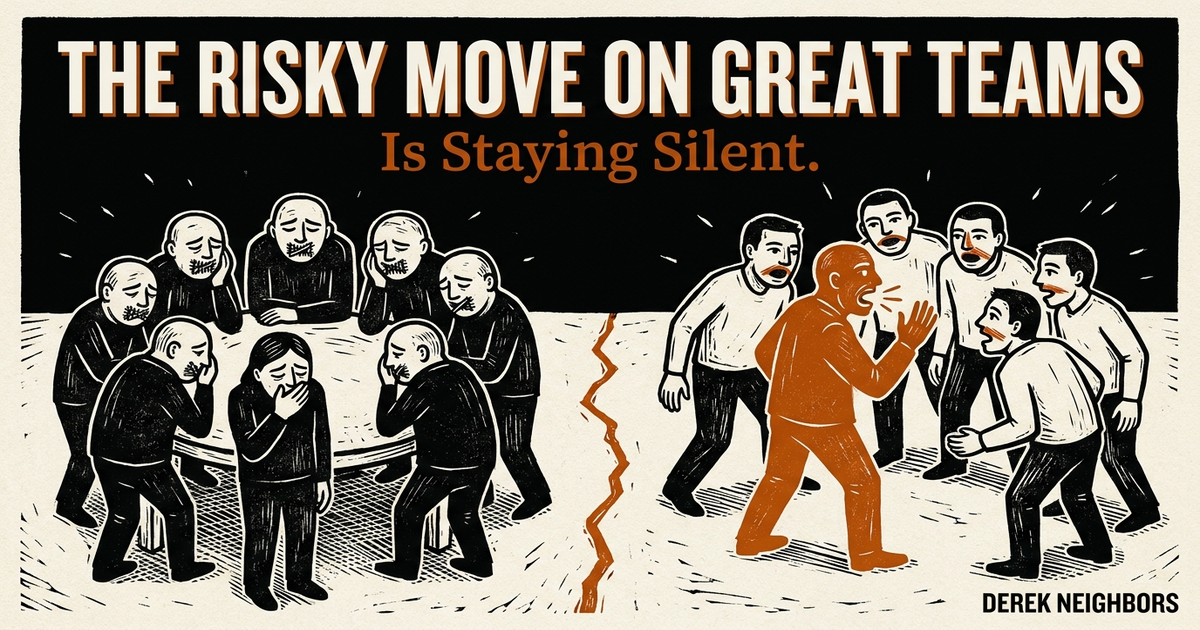
The Risky Move on Great Teams Is Staying Silent
Great teams do not wait for braver people. They install a ritual where declaring the miss is expected and staying quiet is the move that stands out. Calling a Safety is the pattern. Your calendar is the test.
Your Team Isn't Aligned. You Just Share Vocabulary.
The dangerous failure mode on a leadership team is not disagreement. It is the false agreement that arrives when everyone uses the same word and means something different. The plan looks aligned. It ships broken. The Stoics treated definition as the first act of clarity. Publish a glossary before you publish a strategy.

People Want Something to Believe In. Don't Make It You.
Law 27 of the 48 Laws of Power tells you to play on people's need to believe and create a cultlike following. Keep your words vague, favor enthusiasm over thinking, hand out rituals, collect the devotion. The need Greene identified is real. People are starving for something worth believing in. The law fails at the harvest. The Greeks called his method goeteia, the enchanter's craft that bypasses judgment instead of building it, and they left us a portrait of exactly where it ends: a con man with a puppet snake god who opened his rites by expelling every skeptic in the crowd, because one honest question would have brought the whole thing down.

Polish Got Cheap. That's Why Trust Got Expensive.
A flawless apology used to mean someone sat with the weight. Now it often means someone was not in the room. AI made sounding right cheap, and audiences rewired what they trust: hesitation, disclosed uncertainty, and speech that could have embarrassed you.
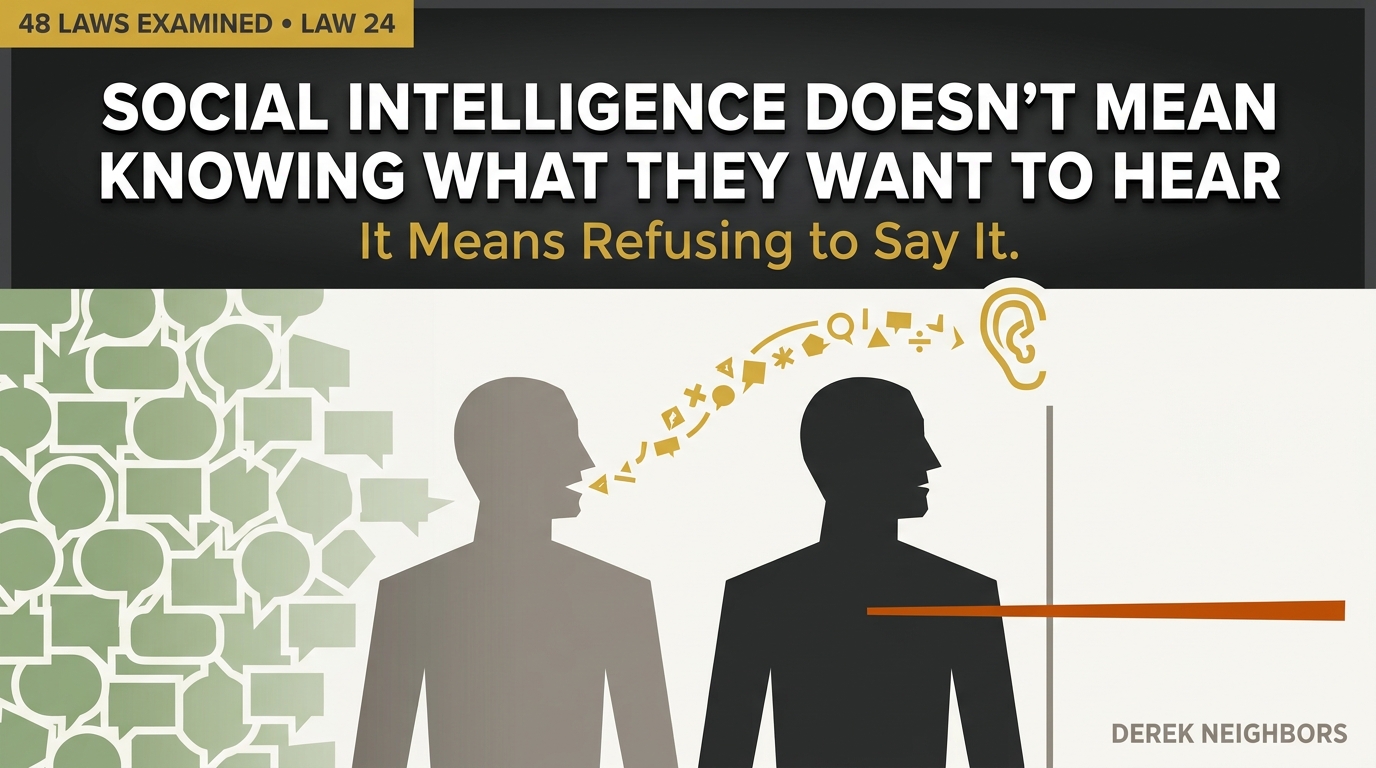
Social Intelligence Doesn't Mean Knowing What They Want to Hear. It Means Refusing to Say It.
Law 24 tells you to become the perfect courtier: master indirection, flatter without obvious flattery, never deliver uncomfortable truths directly. The Greeks had a word for that kind of social facility. They called it kolakeia. They condemned it. Not because flattery fails tactically, but because it corrupts both the giver and the receiver. The alternative is charis: social grace rooted in genuine goodwill, deployed with the courage to say what needs to be said.
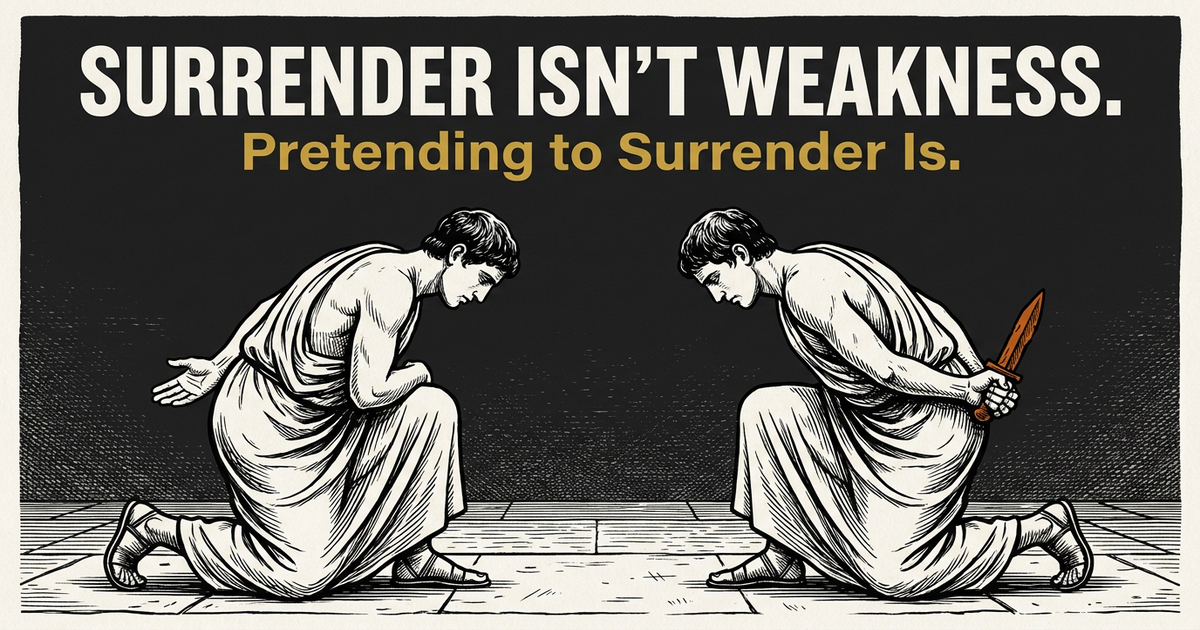
Surrender Isn't Weakness. Pretending to Surrender Is.
Greene's Law 22 tells you to surrender as a counter-trap. The tactic is real, and the Stoics knew the moves it copies. But Marcus Aurelius yielded to preserve his prohairesis. Greene's reader yields to spring an ambush. The heads can look identical; the ends diverge. The test that separates them is whether you could name, out loud, what you yielded for.
Acting Dumb to Get Ahead Works. Until You Can't Stop Acting.
Greene's Law 21 tells you to play the fool so your marks lower their guard. The tactic is real. The Greeks invented it. But Socrates played dumb to make people wiser, and Greene plays dumb to make people poorer. The mask is identical. The cost of running the wrong one is that you eventually cannot take it off.
You're Drowning in Information and Starving for Meaning
We have more facts than any generation in history and less sense of what they mean. The ancient discipline of mythos, narrative meaning, is what turns information into direction. Without it, you are not informed. You are buried.

You Knew It Was Over Years Ago. You Just Couldn't Say It Out Loud.
The truth shows up in a thirty-second moment with no audience. Most people register it, file it, and spend the next five years pretending they didn't. The years of pretending are the actual cost.
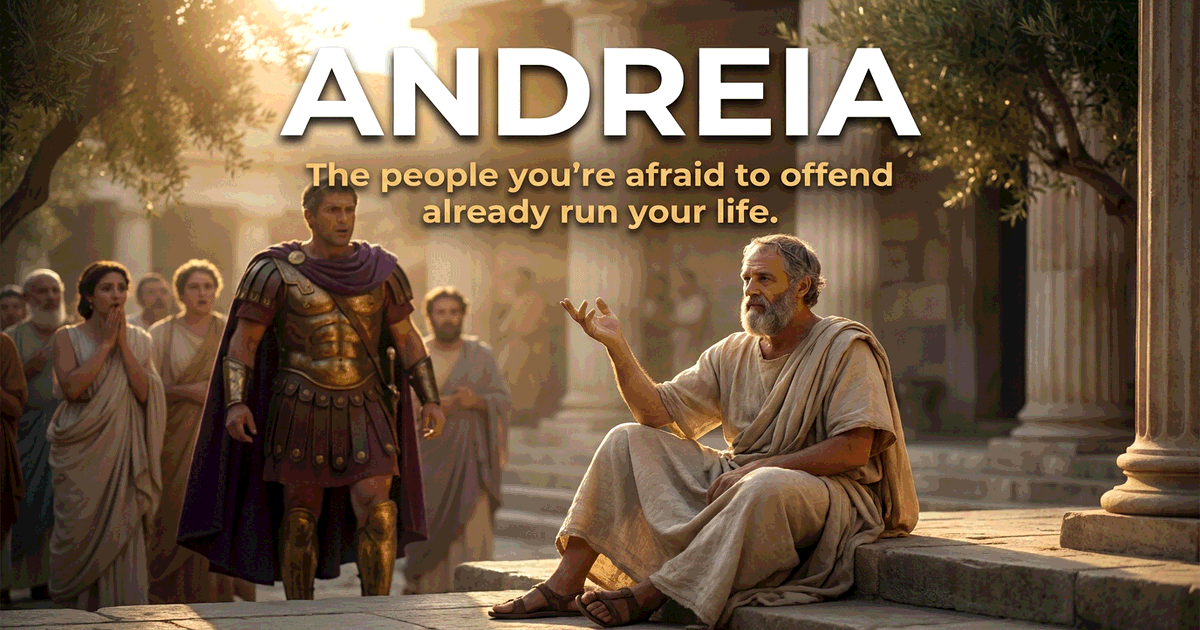
The People You're Afraid to Offend Already Run Your Life
Greene says study people before you act, and never offend the wrong one. Run that as your operating system for a few years and watch what it does to your honesty. The Greeks had a sharper answer.
Your Self-Doubt Is a Tax on Everyone Around You
We treat self-deprecation as humility. Aristotle saw it as the same failure of self-knowledge as arrogance, just from the opposite side. The cost lands on the people around you.
The Gladiators Are Becoming the Emperors. Respect the Arena, Not the Audience.
Last week the Daily Stoic guy lost his composure on YouTube because Ivanka Trump praised Marcus Aurelius. The same week, SpaceX offered sixty billion dollars for a company whose 25-year-old CEO does every podcast himself. These are the same story.
Fear Makes People Obey. It Never Makes Them Follow.
Law 17 says keep others in suspended terror through unpredictability. The Greeks had a name for leaders who ruled through fear: tyrants. And they had a clear record of how every tyranny ends.
The Most Dangerous Liars Tell the Truth
Greene says use selective honesty and generosity to disarm your victim. The Greeks say truth spoken from calculation corrupts the speaker, the listener, and every honest conversation that follows. One creates a short-term advantage. The other creates a permanent disability.
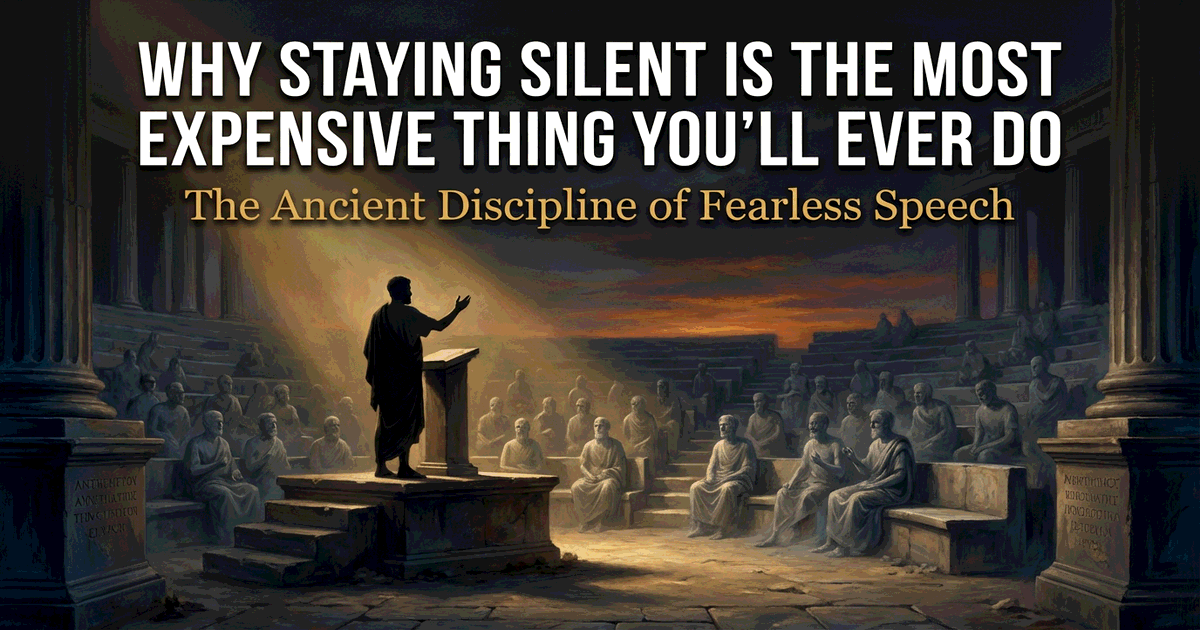
Why Staying Silent Is the Most Expensive Thing You'll Ever Do
Every swallowed truth is a down payment on becoming someone you don't recognize. The Greeks had a word for what's missing: parrhesia.
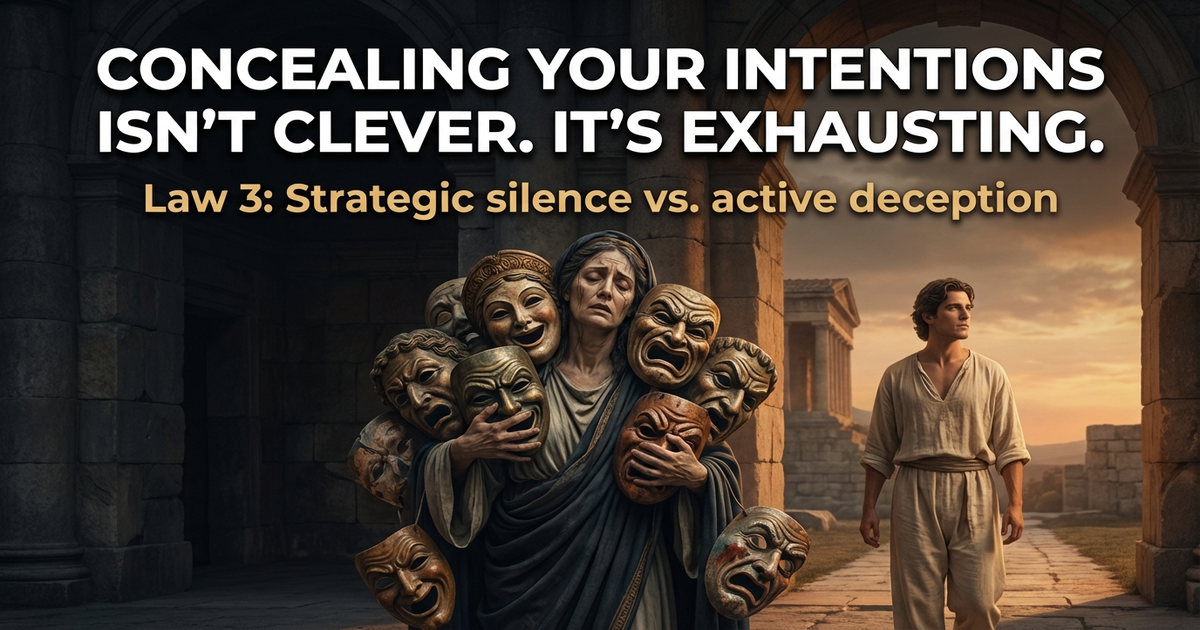
Concealing Your Intentions Isn't Clever. It's Exhausting.
Greene's Law 3 conflates wisdom with manipulation. Strategic silence is phronesis. Active deception is a cognitive tax that compounds into exhaustion and isolation.
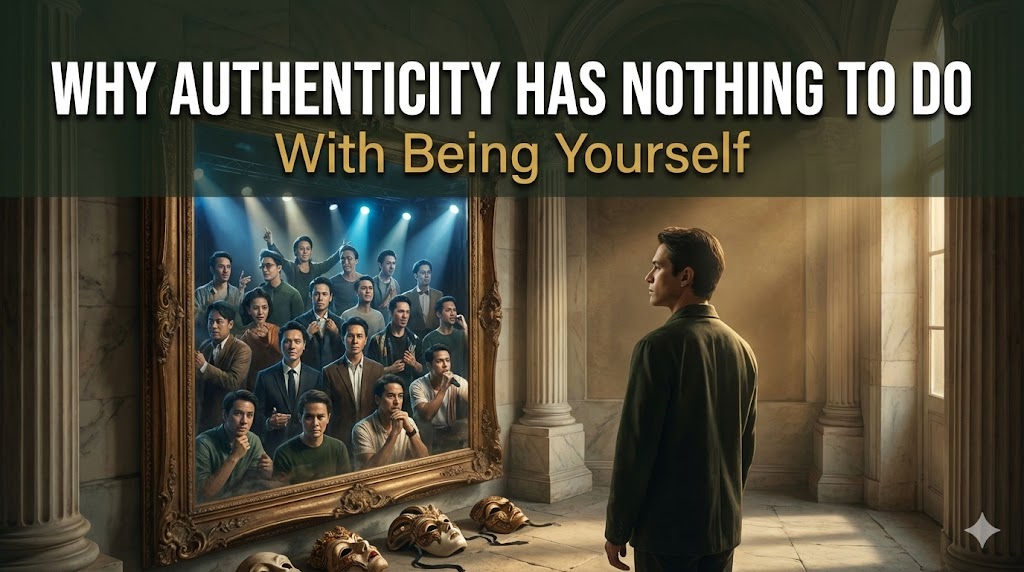
Why Authenticity Has Nothing to Do With Being Yourself
Authenticity has become a personal branding buzzword. The Greeks knew better. True authenticity isn't about expressing your real self. It's about refusing to fragment into different versions for different audiences. Wholeness, not performance.
Character Isn't What You Post. It's What You Practice.
Social media has convinced us that visible virtue is real virtue. Aristotle knew better. Character is the pattern of what you do when no one's watching, not the highlight reel you curate for strangers.