If Every Option Serves You, They Never Had a Choice
By Derek Neighbors on August 3, 2026
Power vs. Virtue: The 48 Laws Examined
A year-long examination of Robert Greene's 48 Laws of Power through the lens of ancient virtue ethics. Some laws we affirm, some we reframe, some we reject entirely.
Law 30 was about what you hide from the stage. Law 31 is about what you put on the table and call a choice.
Robert Greene wants you to deal the cards. The ancient world cared more about whether the person across from you still owned their will after the deal. Both instincts show up in real rooms. Only one of them survives discovery.
The Law
Law 31: “Control the Options: Get Others to Play with the Cards You Deal.”
Greene’s instruction is blunt. The best deceptions present a choice that looks free. Narrow the field until the other person must select among alternatives you designed. Make every path serve your end. People who believe they chose will defend the outcome as theirs, which is more durable than force.
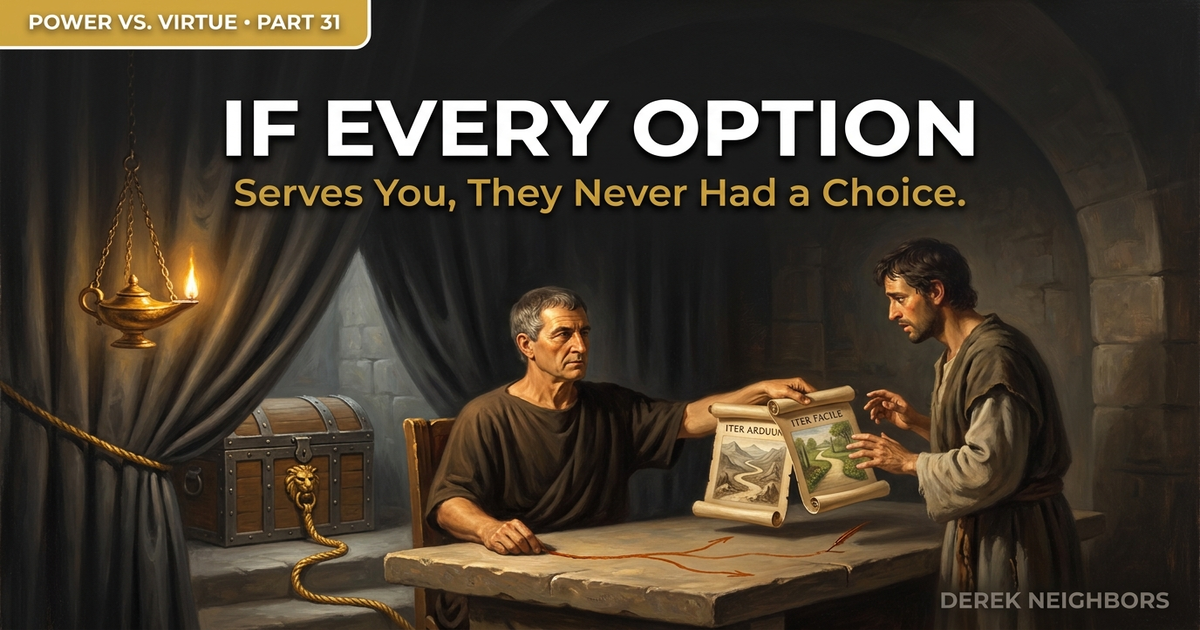
The whole law is a menu that feels free while the dealer already owns every exit.
The Tactical Truth
Parts of this are ordinary leadership, and pretending otherwise is naive.
Unbounded choice stalls rooms. Ask a team “what should we do?” with no frame and you get politics, delay, and a week of side conversations that never become a decision. Good operators put real tradeoffs on the table: ship A by Friday or ship B with the quality bar intact; hire for speed or hire for depth; cut scope or slip the date. People decide faster when the costs are visible. They also commit harder to outcomes they helped select. That half is craft.
I have seen the modern twins for years. Pricing pages with a “good / better / best” ladder that still routes every customer into the same retention machine. Hiring processes that ask candidates to pick between two roles when the org already decided which headcount would be funded. Change programs that offer “option A or option B” after the executive team spent months making option C unspeakable. The pattern is not only corporate. Families offer “stay or leave” when both paths still run on one person’s terms. Friends offer support in two shapes that both protect the asker. We even deal ourselves private menus that look like discipline and still protect the same comfort. Early in my career I ran a version of this without naming it. I thought I was being decisive. Mostly I was avoiding the harder work of saying what was already decided and why.
So yes: design the menu. Do not dump chaos and call it empowerment. Framing is part of the job. Having the power to force compliance does not excuse manufacturing a fake choice. If you can compel the outcome, say so. Pretending the other person decided it is worse than a hard order.
The Character Cost
Greene does not stop at framing. He turns the menu into a trap that protects the dealer.
Fake agency bankrupts trust when the reunion of the paths becomes visible. People can live with a hard no. They struggle to live with a fake choice that was never open. The day someone maps both doors back to your private end, every future “choice” you offer starts sounding fake. I have watched strong teams go quiet after that discovery. They still nod. They stop bringing their real alternatives into the room because the room already proved those alternatives were decoration.
Contempt for other people’s judgment becomes the resting position next. Once you practice inventing freedom for others, you stop needing their wisdom. You need their compliance and their signatures. Keeping people dependent is the sibling move. Law 11 starves capacity. Law 31 starves authorship. Both leave you with followers who can execute your script and cannot improve it.
The dealer atrophies too. Honest persuasion is harder than a rigged deck. If every hard conversation can be solved by narrowing the cards until only your wins remain, you lose the muscle for naming a shared end and surviving a real no. Process without voice creates a different kind of resistance. Rigged options create a quieter kind: people perform agreement and withhold the truth you needed.
There is also the opposite failure, and it deserves one hard line. Dumping an unbounded list of possibilities and calling it freedom is abdication. Leave people a real choice. Do not leave them a landfill.
The ARETE Alternative
The Greek word for the moral faculty of choice is prohairesis. Epictetus treated it as the only estate that is truly yours. A leader who respects prohairesis can still frame options. What they cannot do is steal the estate and leave the chooser only the appearance of deciding.
Freedom worth the name is eleutheria. If the person across from you cannot refuse you without being punished by the structure of the menu, they were never free in the decision that mattered. Political slogans about freedom do not change that.
Truth as unconcealment is aletheia. In option design that means the constraints come into the open. Budget caps, non-negotiable standards, legal limits, and your actual preference belong on the table. Hidden constraints that only appear after someone “chooses” wrong are still concealment.
Practical wisdom is phronesis. Aristotle’s point is that cleverness about means is empty unless it aims at a good end. Designing a menu that always routes to your private win can be clever without being wise. The end itself is telos. Shared means the people choosing can name it and contest it, not only hear you assert it. If you cannot say the telos out loud in front of the people choosing, you are dealing and calling it framing.
You control whether constraints are disclosed and whether an exit can actually change the outcome. You do not control whether people thank you for the process or prefer a nicer story about their freedom.
A closed menu announced as closed can be honest. Safety, legal duty, and a non-negotiable standard sometimes leave one path. Say that. Presenting a closed menu as an open choice is the vice. Under genuine urgency, announced closure differs from fake openness. When the load can bear it, invite the third path before you lock the set.
Real authorship is not kinder management. arete in leadership includes leaving people the capacity to choose and act for reasons. A culture that only produces signatures trains people to execute scripts and stop thinking.
In practice the sequence looks like this.
First, name the non-options before you offer the options. “We are not cutting the safety standard. Inside that constraint, here are the two viable paths.” People can disagree with a constraint. They cannot work with a constraint that only appears after they pick wrong.
Second, leave a real exit: a path that can change the outcome against your preference without career or relational punishment baked into the structure. If both doors already fund your preferred outcome and refusal is career damage, stop calling it a decision. Call it an announcement that wants a signature. Hide the sweat if the stage needs cleanliness. Do not hide the fact that the choice was never open.
Third, when time allows, ask what they would add before you close the menu. One question is enough: “What option am I not seeing that still respects the constraint?” If the answer never changes the set, you were not listening. You were fishing for a signature.
Fourth, state whose end the decision serves. Shared company survival is a real end when the people choosing can name and contest it. Your private convenience named strategy will not survive daylight. arete has no patience for menus that teach people their authorship is decorative.
Then decide. Let people own a path because they could have refused it, not because you trapped them into defending it.
Ancient Wisdom: Choice That Remains Choice
Epictetus is useful here because he was not soft about agency. He was exact. Circumstances press. Other people press. Your judgments and commitments remain the field you can govern. When a leader designs options to evacuate that field from someone else, they are practicing a form of theft that looks civilized.
Aristotle sharpens the other edge. phronesis aims means at ends worth having, and winning the room without that aim is a thinner skill. A menu that always returns to your pocket may win the quarter. It trains a culture that stops bringing better means into view, because better means were never allowed to count.
aletheia makes the difference visible. Honest framing puts the real limits on the table. Rigged framing invents alternatives that were never open. When people notice, you do not get credit for cleverness. You get a reputation for fake choice.
This is why eleutheria cannot be faked for long. People eventually notice that every path reunited behind the scenes. After that, your authority still produces motion. It stops producing commitment.
The Test
Five questions. Answer them somewhere honest.
In your last hard decision, could someone take a path against your preference without career or relational punishment baked into the setup?
If both paths already served your preferred end, why did you call it a choice instead of an announcement?
Which constraints did you name out loud, and which ones only appeared after someone picked “wrong”?
What option would the other person add if they trusted the menu was still open?
When people defend an outcome as “their decision,” did they author it, or did they inherit a deck you already owned?
Final Thoughts
Law 31 contains a craft truth this series will not throw away. Leaders must frame options. Chaos treated as freedom is abdication. The ancient correction is simple and expensive: prohairesis remains real only when the menu includes an exit that is not already yours. Design clarity. Disclose constraints. Aim at a shared telos. If every option serves you, the person across from you did not choose. They signed. Signing does not build arete.
If you want teams that can still author hard decisions without the rigged deck, MasteryLab is where we train leaders to frame options without stealing the will.