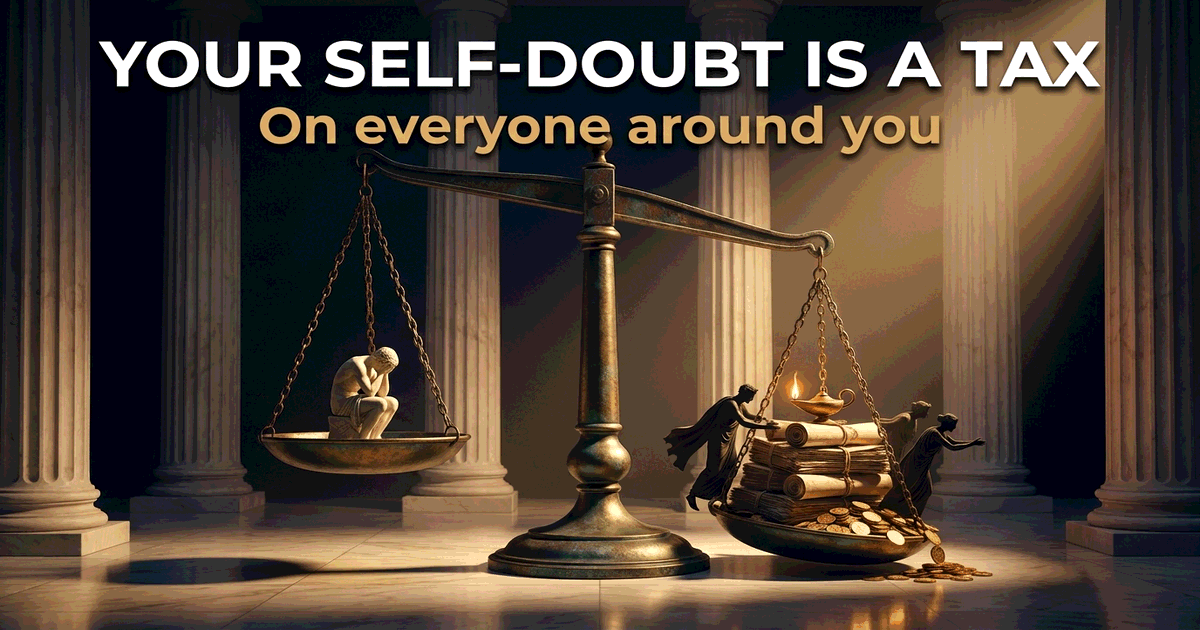
Your Self-Doubt Is a Tax on Everyone Around You
By Derek Neighbors on May 7, 2026
There is a person you know who never seems quite sure they are good enough.
You probably consider them humble. They are quiet in meetings. They downplay their wins. They preface their good ideas with “this is probably stupid, but…” When you compliment their work, they deflect. They have been doing their job competently for years and they still ask, with apparent sincerity, whether they should really be in the role at all.
You like them. Most people do. They feel safe to be around. They are not threatening. They do not seem to be jockeying for position. In a culture of loud self-promotion, their reluctance to claim themselves reads as a moral marker. Modesty. Self-awareness. Maybe even wisdom.
Many cultures hire these people on purpose. Many leaders promote them when they can. We tend to treat their self-deprecation as a feature.
Then we spend hours every week reassuring them. Years, in aggregate. Energy that could have gone somewhere else.
And we tell ourselves, while we do this work, that we are being kind.
The Assumption
The cultural script is unmistakable. Confidence is dangerous. Self-doubt is safe. The person who claims their capacities is suspect; the person who minimizes them is reliable.
This script governs hiring. We screen for the candidate who admits their flaws and discount the one who states their strengths plainly. It governs promotion. The leader who takes credit reads as risky; the leader who deflects reads as steady. It governs friendship. We trust the friend who says “I don’t really know what I’m doing” more than the friend who says “I’m good at this and I know it.”
And underneath the script is an assumption nobody examines. We assume the doubt is honest. We assume self-deprecation is the same thing as accurate self-knowledge. We assume the person who says they are unsure has actually done the work of looking.
We almost never check whether the assumption is true.
The Crack
The first crack appears when you take inventory.
Pick any team that has a chronic doubter on it. Track the energy ledger across a month. Where does the team’s emotional bandwidth actually go?
The doubter expresses uncertainty about their own work. The team leader spends thirty minutes reassuring them. The doubter expresses doubt about the project. Two colleagues send long encouraging messages. The doubter wonders out loud whether they should even be in this role. Their manager calls a one-on-one to bolster them. Hours every week, across an organization, get poured into the management of one person’s relationship to themselves.
Now ask the question almost nobody asks. What does the doubter contribute back to the energy ledger? Do they prop anyone else up? Absorb anyone else’s anxiety? Carry anyone else’s load when it gets heavy?
In most cases, very little. They rarely return what they extract. Their attention is already heavily occupied, on themselves. The doubt is not an occasional eruption. It is the ongoing weather of their inner life, and it requires the climate around them to keep adjusting.
This is a strange dynamic to call humble.
Mechanically, it is the opposite. The humble person directs attention outward. The chronic doubter requires the room to direct attention inward, at them, perpetually. They occupy more emotional bandwidth than the loudest person in the room. They simply disguise the demand as need rather than entitlement.
Something does not add up.
The Investigation
A working definition before going further. Self-knowledge in this piece means the accurate assessment of your own capacities and limits, calibrated against actual evidence rather than against mood or social feedback. It is a discipline, not a feeling. The person with self-knowledge has done the work of reading their own evidence, drawing conclusions, and acting from those conclusions even when the room is suggesting otherwise.
There are two different conditions our culture lumps into “self-doubt.” They look similar from the outside. They behave very differently under examination.
The first is genuine epistemic uncertainty about a specific task. The surgeon who says “I am not the right person for this particular procedure” is doing accurate self-assessment. It is bounded. It is responsive to evidence. It produces a useful outcome: someone else does the procedure, and everyone is better served.
The second is chronic, generalized self-doubt that does not resolve with evidence, training, or feedback. The person who has been a competent designer for ten years and still asks every week whether they are any good. The leader who has built three successful teams and still wonders out loud whether she belongs in leadership. The mother of grown children who still asks her family every Sunday whether she failed them. The husband of thirty years who still needs his wife to confirm, weekly, that she chose well.
The pattern is not an office condition. It runs in marriages, friendships, families, and faith communities just as readily as it runs in conference rooms. The illustrations in this piece are mostly professional because that is the world where I have measured the cost most precisely. The principle is older and broader than any workplace.
A note on limits before going further. Some chronic self-doubt is clinical: depression, severe anxiety, post-traumatic conditions, neurodivergent wiring. The argument here is about a character pattern, not a medical one. Where the doubt is medical, the work looks different and often requires support beyond philosophy. Telling someone in clinical depression that their self-doubt is selfish is not precision. It is cruelty. Honesty about that distinction is part of the discipline this piece is arguing for.
This second version is the one we praise as humble. It is the one that taxes the people around it.
The ancient Greeks had a precise word for accurate self-assessment: megalopsychia, the great-souled person. Aristotle does not treat megalopsychia as arrogance. He treats it as the disciplined virtue of seeing yourself clearly. The great-souled person knows what they are good at, claims it without theatrics, and refuses to pretend otherwise. Aristotle pairs this with sophrosyne, temperance, which keeps self-knowledge from tipping into vainglory.
Aristotle’s most interesting move is the one nobody quotes. He treats chronic self-deprecation as a vice, the deficiency of megalopsychia. The “small-souled” person who refuses to claim their actual capacities is failing at self-knowledge in the same way the arrogant person is, just from the opposite direction. Both refuse to see themselves accurately. Both have a relationship to themselves that requires constant adjustment by others.
The arrogant person needs to be brought down. The small-souled person needs to be brought up. Same dependency. Different direction. The same observation showed up in a piece I wrote about why leaders who have to assert authority have already lost it. Both directions of self-misjudgment break the room.
Look closely at the mechanism. Chronic self-doubt does not produce humility. It produces a steady, ongoing demand for reassurance from people whose job is something else. The dependent soul keeps the spotlight permanently aimed at itself, just at a flattering angle, and we have agreed to call this retreat.
Calling it that is an observation about where the energy goes, not a moral verdict on the doubter.
The Revelation
The paradigm shifts when you trace the energy carefully.
Self-doubt that does not resolve with evidence is not humility. It is a self-focused condition that costs other people their energy, their patience, and their time, and it disguises that cost as need rather than demand.
The chronic doubter is, in many rooms, among the most self-focused people present, even when nobody would describe them that way. Every conversation eventually circles back to whether they are good enough, whether the project is going well for them, whether their performance is acceptable. The team meeting becomes a venue for managing their feelings. The friendship becomes a long maintenance project for their inner state. The marriage becomes a daily reassurance ritual that never reduces the underlying anxiety because the underlying anxiety was never the point. The conversation about the anxiety was the point.
This is not what humility looks like. Genuine humility, what the ancients called sophrosyne, is the steady ability to direct attention outward. To do the work without needing constant feedback. To take in critique and adjust without spiraling. To carry a colleague’s anxiety occasionally instead of always being the one whose anxiety gets carried. To be in a room without the room having to organize itself around your inner weather.
The revelation is mechanical, not moral. We have been mistaking noise about the self for self-awareness. We have been mistaking constant self-deprecation for self-knowledge. They are different operations entirely. One produces wisdom and clear action. The other produces a dynamic in which other people pay continuously for the doubter’s refusal to accept themselves.
Beneath the mechanics sits a deeper claim the ancients took for granted. Chronic self-doubt is, at its root, a failure of reason to engage with reality. The rational soul is built to assess itself accurately. When it abdicates that work, it does not become humble. It becomes a soul that requires others to use their reason on its behalf. Reading your own evidence is not a productivity habit. It is the soul’s basic act, the one that makes every other act possible.
Calling this pattern selfish is not cruel. It is precise. The word here is mechanical, not moral. The doubter is not plotting to harm. They are running a pattern in which their own internal state requires others to keep adjusting their environment. Where the energy goes is where selfishness, in the technical sense, lives. The cost has to land somewhere. In every chronic-doubter dynamic I have seen across two decades of leadership work, the cost lands on whoever has the patience to keep absorbing it. That patience runs out eventually, and the doubter usually finds someone new.
The Application
Three things change when you see this clearly.
Stop confusing chronic self-deprecation with humility in others. The colleague who constantly questions their own competence after years of accumulated evidence is not modest. They are running a pattern that taxes the team. The friend whose every conversation circles back to whether they are loveable is not vulnerable. They are extracting reassurance on a schedule. Address it kindly, but address it. Enabling the pattern is not love. It is fuel for a fire you will eventually have to evacuate. The same logic applies in reverse to leaders who keep solving their team’s problems instead of letting them grow: the rescuer and the doubter run the same cycle from opposite seats.
Audit your own ledger. If you are the doubter in some part of your life, the question is not “am I good enough?” The question is: who in my life has been paying for this pattern? How many hours of someone else’s life have been spent reassuring me? What did they not get done because they were busy holding me up? parrhesia, the ancient Greek practice of frank speech, applies inward as well as outward. Tell yourself the truth about what your doubt has cost the people who love you, and the people who work with you. Most chronic doubters have never sat with this number honestly. The number is large.
Do the work of accurate self-assessment yourself. Not “I am amazing” and not “I am terrible.” Specific. Calibrated. What can you do? What can’t you? What evidence do you actually have? megalopsychia is the disciplined refusal to keep asking other people to answer the question you should be answering yourself, and it has nothing to do with arrogance. Read your own evidence. Take notes. Adjust.
The work of self-knowledge belongs to you. When you outsource it permanently, you are charging the people around you for a job you were supposed to do.
People close to chronic doubters often discover, when they finally stop paying the tax, that the relationship was not built on what they thought it was built on. The reassurance was the relationship. Once you decline to provide it, the relationship sometimes ends.
That is clarifying. A relationship that required you to maintain someone else’s self-image was not operating between equals. Both parties may have called it love. It functioned as something more transactional than that, even when neither party named the transaction.
Final Thoughts
The hardest move is the simplest. Stop asking. Start observing.
The evidence about who you are has been available the whole time. You have been refusing to read it because asking other people to read it for you keeps the focus on you in a way that genuine self-knowledge would not. The evidence is more boring than the conversation. The conversation produces care. The evidence produces only itself.
Self-doubt that goes years without resolving is not the modest condition we have agreed to call it. It is the inverted form of the very ego it pretends to oppose, asking for the same attention the loud person demands, just dressed in different clothes.
The genuinely humble person is hard to spot precisely because they take up so little oxygen. They do the work, take the feedback, adjust, and move on. The doubter cannot do this because the work was never the point. The work was the occasion for the conversation about themselves.
Drop the pattern. Read the evidence. Stop charging the people who love you for a job that was always yours.
If you’re ready to build the disciplined self-knowledge that ancient virtue demands, MasteryLab.co helps leaders forge the character that excellence requires.