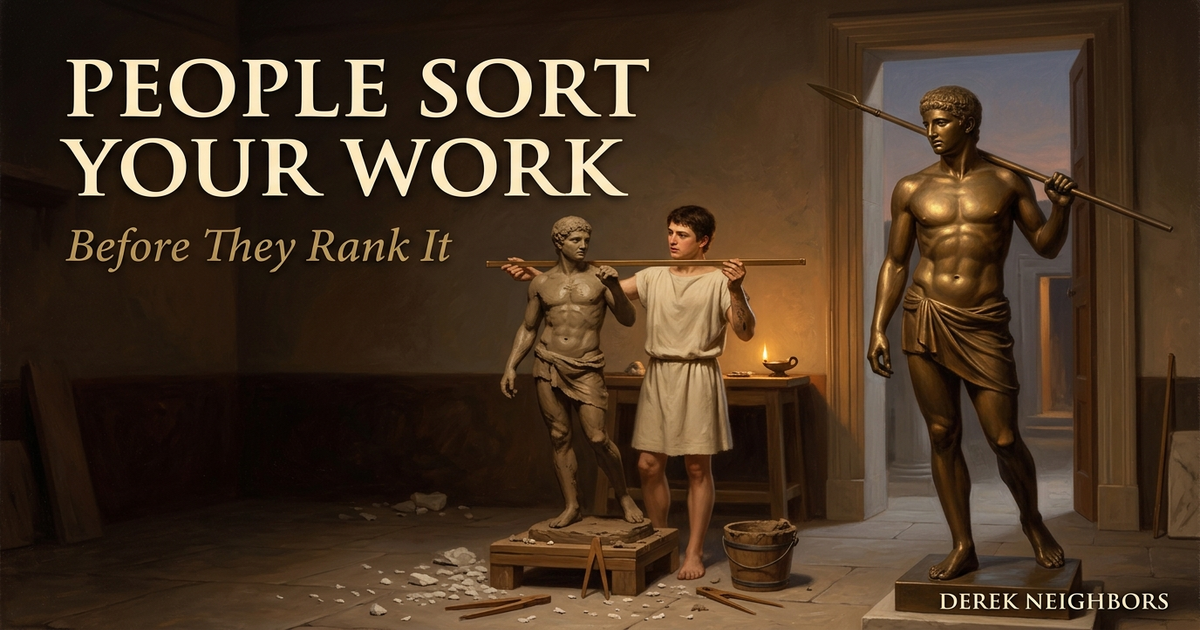
People Sort Your Work Before They Rank It
By Derek Neighbors on November 8, 2026
Every few months a new Ruby web framework launches with a post that opens, “Unlike Rails, we believe…” and spends six paragraphs on philosophy. The comments ask what people always ask about Rails. How long until I have a working app? How good are the docs? What breaks on upgrade day? The post answered none of them, so the comments did, and the framework got filed as a Rails alternative that is not ready.
That is the order people judge new work in. First they sort it into a category and decide what it sits next to. Then they rank how good it is, using the measures that shelf already has. A launch post can skip the first step, and the audience will still take it.
Most people with something new to show fight the sorting. They say the work has no real competitors, or that comparing it with the leader misses the point. I understand the instinct, because the comparison is frightening when you are new. In my experience it almost never works. People sort you before they rank you, and the honest way through is to pick up the measuring rod the best are already judged by and hold your work against theirs.
Why People Judge the Category Before the Quality
Nobody judges a new thing from first principles. They do not have the time, and most of them do not have the expertise. So they reach for something they already know and use it as the reference. A new database gets weighed against Postgres. A new engineering manager gets weighed against the last one, by a team that remembers every habit the last one had.
Comparison is how people make sense of something new in the few minutes they will give it, and it is a fair way to do that. The newcomer’s question is whether to help them make it or leave them to guess.
The Ancient View: Polykleitos and the Measuring Rod
The Greek word kanon meant a straight rod or rule, probably from kanna, the Greek word for a reed. Builders held it against a wall or a beam to see whether it ran true. Over time it came to mean any standard you hold something against, and it reached English as “canon.”
In the fifth century BCE, the sculptor Polykleitos of Argos used the word as the title of a book. His Canon is lost, but later writers describe it. The physician Galen says it set out the proportion of every part of the body to every other part, finger to finger, the fingers to the palm and wrist, and on up the figure. Polykleitos then made a bronze statue to show the rule in practice, usually identified as the Doryphoros, the Spear Bearer. One line of his survives in a quotation by Philo of Byzantium: perfection comes about “little by little, through many numbers.”
What I keep coming back to is that Polykleitos made his work easy to measure on purpose. He wrote the standard down, then cast a figure anyone could check against it. Pliny the Elder says artists called the statue the Canon and drew the lines of their own work from it as if from a law. A young sculptor in that world knew exactly which shelf he stood on and what he would be judged by.
About a century later came Lysippos, who changed the proportions. His figures have smaller heads and slimmer bodies, and they read as taller and lighter than the older bronzes. According to a remark Cicero passes on, he also called the Doryphoros of Polykleitos his teacher.
If the Doryphoros was his teacher, Lysippos learned the canon well enough to work beside it, and then he changed it. His difference was easy to see because anyone looking at a Lysippos already knew the Spear Bearer. They could see exactly where he departed and decide whether the departure was better. A sculptor who skipped the training and announced a new human body would have been sorted as a weak Polykleitos and forgotten.
The Modern Problem: Claiming the Difference First
In 1981, Al Ries and Jack Trout described the same habit in their book Positioning. People keep small ladders in their heads, one for each category, with a few names on the rungs. A new product gets slotted onto a ladder next to names the buyer already knows and ranked against them.
Ries and Trout also gave newcomers a way out. In The 22 Immutable Laws of Marketing, they wrote that if you cannot be first in a category, you should set up a new category you can be first in. Sometimes that is the right call. Some work really is new, and forcing it onto an old ladder would hide what it does. Most newcomers who claim a new category are relabeling an old shelf, though, and buyers can tell. Calling your product “the first AI-native project tool” does not stop a buyer from comparing it with the project tool already open in another tab.
When a newcomer fights the sorting, the audience sorts the work anyway, often onto a worse shelf than the one the newcomer would have picked, and then ranks it on the measures the newcomer ignored. The claim of difference, with nothing beside it to compare against, reads as bluster.
The same thing happens inside companies. A new VP of engineering arrives and, in the second week, tells the team its code review process is broken. Maybe it is. The team has not yet decided whether this person is a strong engineer who has run teams like theirs, or someone from a different kind of shop who does not understand this one. Until the team has sorted the new VP, it cannot weigh anything the VP says. A leader who first ships work that clears the team’s bar, on the team’s own measures, earns the standing to change those measures.
Borrow the Measure, Keep the Method
The way through is to pick up the rod the best already use. Find the shelf your work belongs on, find what the best work on that shelf is measured by, and put yours beside it on those measures. Then say how yours is different, in the same units.
A reader might hear that as advice to copy the leaders. I wrote earlier about why best practices get you average results: copy how the leaders work and you land in the middle of everyone else who copied them. Borrowing the measure is a different move. You take how the work is judged and keep how the work is made. Lysippos used Polykleitos’s proportions as the yardstick for his own changes, which is why viewers could see the changes at all.
For the new framework, that means leading with the time to a working app, the docs, and the upgrade story, then saying where yours wins in those terms. Something like “a working app in the same ten minutes, and two years of upgrades that never broke one.” Once the reader has that, the philosophy has somewhere to land.
Holding your work beside the best on their terms also improves the work, because it shows you exactly where yours falls short. Polykleitos said perfection comes little by little, through many numbers, and you cannot make those small corrections without a measure to make them against.
The measures are worth borrowing because they tell you the truth about the work. How the audience ranks you afterward is out of your hands, and a good rank on a measure you know is hollow tells you nothing.
Sometimes a measure on the shelf is wrong. Lysippos plainly thought the old proportions were, or he would not have changed them. Meet the measure first, or show that you could, and then argue against it in the shelf’s own terms. His slimmer figures could only be judged against the Spear Bearer, and that comparison is what let people see the argument he was making.
The opposite mistake gets less attention. A newcomer can meet every measure on the shelf, never say what is different, and end up as a competent copy of the leader. Lysippos did change the canon. Once your work can stand beside the best, say what you would change, and say it plainly.
How to Earn the Seat This Week
-
Write the shelf sentence. Finish this the way a stranger would: “It’s a __, like __.” Write what a stranger would say, even if you wish they would say something else. If you cannot finish it, show the work to three people who do not know it, give them one minute, and ask them to finish the sentence.
-
List the measures the best on that shelf are judged by. Read reviews, complaints, and comparison threads about the leader, and skip its marketing page. Complaints show you what people measure, because people complain about the things they were counting on. Take the measures from the most demanding users and the best practitioners, since stars and launch-day upvotes count popularity, which is a different thing. Keep the list to five measures or fewer.
-
Put your work beside theirs. This is a good job for a model. Give it the five strongest examples on your shelf plus your own work, ask it to pull out the measures reviewers use most, and have it score yours against each one with no flattery. Then ask it to write the harshest fair review of your work from someone who loves the leader. The model has no stake in your launch, which is what makes it useful here. Read the review without defending your work, and mark which points are true.
-
Close the gap that disqualifies you. Usually one measure takes you off the shelf entirely: no docs, no upgrade path, or a feature every buyer expects. Fix that one before you write a word about your difference, and leave the smaller gaps for later.
-
Say your difference in the shelf’s units. Put it in terms a buyer can check against the leader, such as “same setup time, half the upgrade pain.” If you want to see how people earned a seat on your shelf, study the ones still becoming instead of the finished legends, because their gaps are still visible.
FAQ
Why do people categorize new work before judging its quality?
Nobody has time to judge each new thing from scratch, so people compare it to something they already know. They first decide what it is, such as a web framework like Rails or a project tool like the one they already use. Then they rank it on the measures that category already has. Marketers Al Ries and Jack Trout described this as ladders in the mind, one for each category.
What does kanon mean?
kanon is the ancient Greek word for a straight rod or rule that builders held against a wall or beam to check whether it ran true. It probably comes from kanna, the Greek word for a reed. Later it meant any standard you measure something against, and it became the English word canon. The sculptor Polykleitos used it as the title of his book on the proportions of the human body.
Should you create a new category instead of competing in an existing one?
Only if the work really is new and putting it on an existing shelf would hide what it does. Ries and Trout argued that if you cannot be first in a category you should set up a new one, and sometimes that is right. Most newcomers who claim a new category are relabeling an old one, and buyers compare them with the leader anyway.
How do you stand out as a newcomer without sounding arrogant?
Say what shelf your work belongs on, find the measures the best work on that shelf is judged by, and show your work beside theirs on those measures. Fix the gap that would disqualify you first. Then state your difference in units a buyer can check, such as the same setup time with half the upgrade pain.
Final Thoughts
People decide what your work is before they decide whether it is good, and they judge it with the measures its shelf already has. Polykleitos wrote those measures down and cast them in bronze. Lysippos learned them before he changed them, which is why his change could be seen. Find your shelf, borrow its measures, and put your work next to the best on them. Fix whatever disqualifies you, and then say what is different in units people already trust.
Holding your work against the best on purpose, and getting better a little at a time, is the daily work of craft. That is what MasteryLab is for.