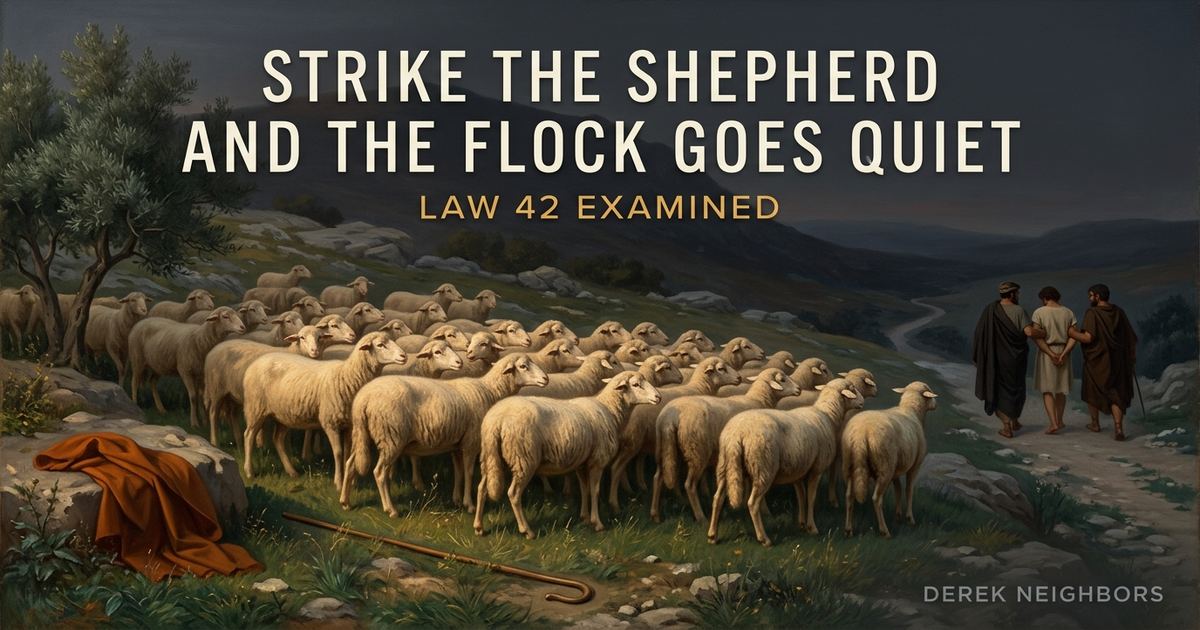
Strike the Shepherd and the Flock Goes Quiet
By Derek Neighbors on October 19, 2026
Power vs. Virtue: The 48 Laws Examined
A year-long examination of Robert Greene's 48 Laws of Power through the lens of ancient virtue ethics. Some laws we affirm, some we reframe, some we reject entirely.
Law 41 was about the person you replace. Law 42 of the 48 Laws of Power, Strike the Shepherd and the Sheep Will Scatter, is about the person on your team you would most like to see gone.
Most leaders have had one. Maybe it is the staff engineer who blocks every launch with one more question, or the early employee whose DMs carry more weight than your all-hands. Greene’s advice for dealing with that person is fast and it often works. I think it is one of the most damaging laws in the book, because of what the rest of the team learns while they watch you follow it.
The Law: Strike the Shepherd and the Sheep Will Scatter
Law 42: “Strike the Shepherd and the Sheep Will Scatter.”
Greene’s judgment runs like this. Trouble in a group can often be traced to one strong person: the one who stirs things up, the arrogant subordinate, the one who poisons goodwill. Give that person room and the others fall under their influence. Do not wait for the trouble to grow, and do not try to negotiate, because people like this cannot be won back. Isolate them or banish them. Strike the source and the group loses its center.
The title is older than Greene. It comes from the prophet Zechariah, and the Gospels of Mark and Matthew quote it on the night before the crucifixion. Greene keeps the image and flips who the reader is supposed to be. In his version, you are the one holding the staff.
The Tactical Truth
One person really can sink a team.
In 2006, Will Felps, Terence Mitchell, and Eliza Byington ran an experiment with small work groups. They planted one actor in some of the groups, playing a jerk, a slacker, or a constant pessimist. The groups with that one person did 30 to 40 percent worse than the groups without him, and the rest of the group started to pick up his behavior. Anyone who has managed engineers has seen a version of this: one senior person sneers in code review, and within a quarter the juniors stop asking questions in the team channel.
Greene is also right about waiting. A problem with one person rarely fixes itself. The manager who hopes the sneering will stop on its own usually finds, six months later, that two good engineers have left and the sneering has a fan club.
The move itself is very old, and it works. Herodotus tells of Periander, tyrant of Corinth, who sent a messenger to ask Thrasybulus, tyrant of Miletus, how to keep a city under control. Thrasybulus said nothing. He walked the messenger through a field of wheat, and every time he saw an ear standing taller than the rest he cut it off and threw it away. The messenger went home confused. Periander understood at once and began killing the men in Corinth who stood out.
Aristotle tells the same story in the Politics and then makes an uncomfortable point. Democracies did the same thing. Athens had ostrakismos, ostracism, a vote the citizens could choose to hold once a year. Each voter scratched a name on a broken piece of pottery, and the man with the most votes went into exile for ten years without a trial. Aristotle says it had the same effect as cutting the tall ears. The man who stood out was removed, and the city got quieter.
So Greene has history on his side when he says the move works. Keep two lists apart, though. What the team does after you act belongs to them. Whether you tell the person the truth, let them answer, and decide in the open belongs to you. Greene’s law puts all its effort into managing the team’s reaction and none into the second list.
The Character Cost
Start with the act, before any of the costs. Isolating someone in the dark, without telling them why and without letting them answer, treats a person as an obstacle to be moved around. You cut them from the invite, take them off the project, stop routing decisions through them, and let them figure it out. Even when the person really is causing harm, doing it this way denies them the one thing every person on a team is owed, which is a true account of what they did and a chance to respond. It would be wrong even on a day it cost you nothing, and the costs below come on top of it.
The first cost is that Greene’s test catches the wrong person. Look at who his list names: the one who stirs things up, the arrogant one, the one who poisons goodwill. Some people really do poison a team, and that last phrase can name real harm. The trouble is that Greene’s test never asks for evidence and never gives anyone a hearing. It catches the bully, and it catches the engineer who keeps asking why the security review was skipped, and it has no way to tell them apart. In my experience the person a leader most wants gone is more often the second kind.
Athens has the best example. Plutarch says that during the vote to ostracize Aristides, a statesman so fair that Athenians called him “the Just,” a man from the countryside who could not write handed his piece of pottery to a stranger and asked him to write “Aristides” on it. The stranger asked what Aristides had done to him. Nothing, the man said. He did not even know Aristides. He was tired of hearing him called the Just everywhere he went. The stranger was Aristides. He wrote his own name on the shard and handed it back, and the city exiled him.
Aristotle also saw where the tall-ear method ends up. In Book V of the Politics he lists the ways a tyrant keeps power: cut down the outstanding, get rid of anyone with spirit, ban the common meals and the clubs, and keep people from knowing one another so they never trust each other enough to act. Law 42 is the first item on a tyrant’s list, and the other items tend to follow it.
Second, “do not negotiate” throws away the information. The conversation Greene tells you to skip is where you find out whether the person has a real complaint. Maybe the staff engineer blocking launches has watched three of them go out with no rollback plan. Maybe the senior IC with the loud Slack channel is saying out loud what half the team believes about the roadmap. Once you have decided the person cannot be won back, you never ask. You remove the person and keep the problem they were pointing at.
Third, the team is watching, and the sheep rarely scatter. They go quiet. The whole team saw what happened to the person who spoke up, and it did not take a memo to explain it. The next time a junior engineer sees a migration that will lose data, they will do the math on whether saying so is worth it. I have watched teams take years to recover from one removal done in the dark, and some never did. The silence costs more than the troublemaker ever did, and it never shows up on a dashboard.
Fourth, the label itself is the start of a faction. Thucydides watched civil war tear apart the city of Corcyra and wrote that, in faction, which the Greeks called stasis, words changed their meaning. Caution was called cowardice, moderation was treated as weakness, and anyone who argued against the extreme line became a man to be suspected. Calling a colleague “the troublemaker” works the same way. Once the word sticks, everything that person says gets heard as trouble, including the things that are true. You have split the team into the people with you and the person against you, and you did it with one word.
Fifth, if the team really would scatter when one person leaves, look at how the team is built. A team can grieve a great informal leader without anyone having failed. But a team that only holds together because of one informal leader has a single point of failure, the same way a codebase does when only one engineer understands the billing service. Greene’s answer is to remove the point of failure and replace it with yourself. Notice what that makes everyone else: sheep, a mass with no judgment, waiting to be pointed somewhere.
Plato put that view in the mouth of Thrasymachus. In Book I of the Republic, Thrasymachus says a shepherd fattens the sheep for the owner’s table, so rulers treat the ruled the same way, for their own profit. Socrates answers that the shepherd’s craft, considered as a craft, aims at the good of the sheep. Making money off them is a different craft. Greene’s law takes Thrasymachus’s side of that argument. And like Law 15, the method gets learned by everyone who watched it work, including the person who will someday want you gone.
Plato also saw what the practice does to the person who uses it. In Book VIII of the Republic, Socrates says the tyrant has to watch for anyone brave, high-minded, or wise, and purge them. He calls it the opposite of a doctor’s purge, which removes the worst and keeps the best. The tyrant ends up surrounded by people who will never tell him he is wrong. A leader on the third removal for disagreement has become someone who cannot stand to hear it, and that is a smaller, less free life whether or not the company ever pays for it.
The ARETE Alternative
Aristotle described what a team needs in place of a shepherd. In the Nicomachean Ethics, Book IX, he names it homonoia, usually translated as concord: people of one mind about what is just and useful, who act on it together. He calls it political friendship. He also says only good people can really have it, because bad people each grab for more than their share, watch each other, and fall into faction.
Aristotle is careful about what that agreement covers. People who hold the same opinion about the stars are not in concord, he says. Concord is about practical things that matter, like what the city is for and what is fair. On a team, that means agreeing on what you are building and how people get treated, which leaves plenty of room to argue about how to build it.
That gives a different target. Greene wants a group that follows a person, ideally you, and has nobody else to follow. Aristotle wants a group that agrees about what the work is for, which can survive losing anyone, including the leader. You get there through frank speech, which the Greeks called parrhesia: people saying what they see, to the person who needs to hear it, without first checking what it will cost them. A team that has seen one person removed for frank speech will not give you any more of it.
If you are the one on the team, frank speech is your job too. A leader who punishes frank speech explains why people go quiet, and it does not change what they owe. When you see the migration that will lose data, saying so is yours to do, and so is the risk that comes with it.
None of this means you keep everyone. The work starts with one honest question: is this person disagreeing with me, or harming other people?
Disagreement, even loud and annoying disagreement, is the thing a leader most needs and least wants. The person who argues with your plan is doing the job you would pay a consultant for. Bring them closer. Ask them to write the objection down, then answer it in writing, where the team can see both. You might change the plan, or keep it with the team knowing why. Either way, the objection made the decision better.
Harm is different. Bullying, lying about the work, sabotaging other people’s projects, or treating the juniors with contempt are real, and Greene is right that you cannot wait. Act fast. Tell the person directly what the behavior is, with examples, and let them answer. Give them a clear chance to change and a date. If nothing changes, remove them, and tell the team the reason in words they could repeat.
Harm is judged by how someone treats people and the work, whatever their opinions are. An engineer can be right about the roadmap and still have to go because of how they treat the juniors. When that happens, act on the conduct and keep the objection: write it down and answer it after they are gone. That is harder than a silent reassignment and it takes longer, and it is the only version where the team learns the right lesson: bad behavior gets you removed, and disagreement does not.
Athens learned this about Aristides. Two years after the vote, the Persians were coming, and the city passed a decree calling the exiles home. Aristides came back and fought for the city at Salamis and Plataea. The man they had removed for being too admired was one of the people they needed most.
Name the behavior, not the person. Before you act, write down what the person did, with dates. “Called a junior’s PR garbage in the team channel on the 3rd and the 17th” is something you can act on. “Is a problem” or “poisons the team” is a label, and labels are how factions start.
Tell them first. The person should hear it from you before they hear it from the org chart. If you have never said it to them directly, you have not given them a chance to change, and you do not yet know whether they would.
Ask what they see. This is where I start with the model. Before the conversation, I give Claude the person’s last month of PR comments and Slack messages and ask it to write the strongest version of their complaint, in their words. It has no stake in whether I like them. Often the complaint is about something real, and I walk into the conversation knowing what it is. Then I decide.
Decide in the open. Whatever you decide, keep them, move them, or let them go, give the team the reason in one sentence they could repeat. If the honest reason is “they disagreed with the leader too often,” you already know the decision is wrong.
Grow more than one person the team trusts. If one informal leader holds the team together, that is a single point of failure, and fixing it is your job. Give other people real decisions, let them run the design reviews, put their names on the work. A team with five people it trusts cannot be scattered by removing one.
None of this depends on rank. The tech lead who drops a reviewer from the PR rotation without a word because the reviewer keeps requesting changes is following Law 42. So is the new engineering manager who stops inviting the senior engineer who disagrees in public. So is the founder who sidelines the early employee everyone still goes to for the truth about the roadmap. The intern who asks the loud senior engineer what they are really worried about is doing what Aristotle described.
Ancient Wisdom: the tall wheat, the shard, and concord
Aristotle’s Politics, Book III, chapter 13, tells the wheat field story and sets it next to ostracism. He says the problem of the man who stands out is common to every kind of government. He grants that the case for ostracism has a kind of political justice in cities built the way most cities are, and then adds that factions often used it for their own advantage rather than for the good of the city. In the best city, he says, a person of outstanding virtue should not be cut down at all. The citizens should be glad to follow him.
Book V, chapter 11, is the tyrant’s list. Read it next to Law 42 and the match is hard to miss: remove the outstanding, break up the groups where people talk, and make sure nobody trusts anybody enough to act together.
Plutarch’s life of Aristides gives the countryman, the shard, and the recall before Salamis. It is the clearest single story I know about what a group loses when it removes the person who stands out.
Thucydides, Book III, chapters 82 and 83, describes the civil war at Corcyra and how faction changed what words meant. The passage is short, and every leader who has heard a colleague called “difficult” should read it once.
Plato’s Republic, Book I, has Thrasymachus and the shepherd, and Socrates’ answer that every craft aims at the good of what it works on. Book VIII has the tyrant’s purge of the brave and the wise. Aristotle’s Nicomachean Ethics, Book IX, chapter 6, has homonoia, concord among people who agree about what is just and act on it together.
Side by side, for a leader with one difficult person on the team:
| Greene’s strike | The open way | |
|---|---|---|
| Who gets removed | Whoever threatens your control | Whoever harms other people |
| What the person hears | Nothing, until the org chart changes | The behavior, with examples, and a chance to answer |
| What you learn | Nothing | Whether the complaint was real |
| What the team learns | Speaking up gets you cut | Bad behavior gets you cut, and disagreement does not |
| What holds the team together | You | Agreement about what the work is for |
The Test
Think of the person on your team you would most like to see gone. Can you write down what they did, with dates, without using a label?
Is that person harming other people, or disagreeing with you?
Have you told them directly, in words they could repeat back, what needs to change?
What is the strongest version of their complaint, and have you checked whether it is true?
And the one that decides: if your team watched you handle this person from start to finish, what would they learn about speaking up? If the answer is “keep quiet,” change how you are handling it before you do anything else.
Final Thoughts
Greene is right that one person can drag a team down and that waiting makes it worse. His test for who that person is measures the threat to your control instead of the harm to the work, so it catches the truth-teller along with the bully. Removing someone in the dark, without a true account or a hearing, is wrong by itself. It also throws away whatever they were trying to tell you, teaches everyone watching to keep quiet, and turns you into a leader nobody tells when you are wrong.
Aristotle’s concord holds a team together without a shepherd. Separate disagreement from harm. Bring the person who disagrees closer and answer them in writing. Tell the person who harms others exactly what they did, give them a chance, and if nothing changes, remove them in the open with a reason the team can repeat. Then grow enough trusted people that no single removal, including yours, could scatter anyone.
Law 43 is next, and it is about working on the hearts and minds of others.
Leading a team that can disagree with you out loud, and keeping the people who harm it from setting the tone, is part of the craft. That is what MasteryLab is for.