Why Authenticity Has Nothing to Do With Being Yourself
By Derek Neighbors on January 17, 2026
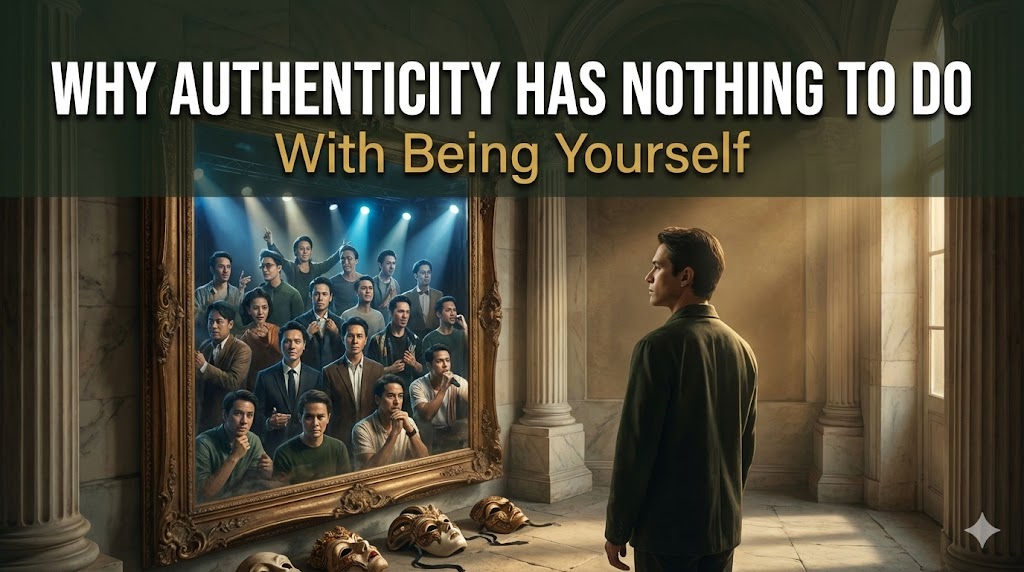
I used to have a LinkedIn self, a Twitter self, a work self, a friend self, and a family self. Each slightly different. Each requiring its own maintenance.
The LinkedIn version was polished and professional. The Twitter version was edgier, more provocative. The work version was competent and measured. The friend version was relaxed and irreverent. The family version was whatever my parents expected me to be.
I thought I was being authentic by expressing different facets of my personality. I was actually just performing five different shows for five different audiences.
The exhaustion wasn’t from being fake. It was from being too many versions of real.
This isn’t a professional-class problem. Whether you manage five platforms or navigate one community, the fragmentation happens the same way. You don’t need multiple audiences to divide yourself. You only need the gap between what you think and what you say, between who you are alone and who you perform for others. A person with one context can fragment just as thoroughly as someone juggling dozens.
The Authenticity Industry
“Be yourself” has become the most useless advice in existence. Not because it’s wrong, but because we’ve completely misunderstood what it means.
Open LinkedIn and you’ll find people crafting their “authentic personal brand.” They share carefully curated struggles that make them look good. They post vulnerable moments that have been rehearsed and refined. They express their “true selves” in ways optimized for engagement.
This is authenticity as performance. Showing the real you, strategically. Being vulnerable in ways that build your brand. Expressing your genuine feelings in formats that drive likes.
The assumption underneath all of this is that authenticity is about expression. That somewhere inside you is your “real self,” and the challenge is finding ways to let that self out. To show people who you really are.
This gets it exactly backwards.
The Crack in the Mirror
I noticed something strange about the people who seemed genuinely comfortable in their own skin. They weren’t working on their authenticity at all.
They weren’t crafting personal brands. They weren’t practicing strategic vulnerability. They weren’t thinking about how to express their real selves more effectively.
They were just the same person everywhere they went.
Same at work. Same with friends. Same online. Same with strangers. No translation required between contexts. No code-switching. No remembering which version to be in which room.
And I realized: the most authentic people I knew weren’t better at self-expression. They had simply stopped maintaining multiple versions of themselves.
The exhaustion I felt wasn’t from hiding who I was. It was from the cognitive load of managing five different identities. Remembering what each audience expected. Tracking which persona had said what. Living in constant low-grade fear that the wrong version would show up in the wrong room.
Authenticity as expression creates more fragmentation. You’re now expressing yourself in multiple ways for multiple audiences.
What if authenticity was about something else entirely?
What the Greeks Actually Meant
The Greeks had a word for character: ethos. But ethos didn’t mean your personality or your self-expression. It meant the settled disposition of your soul. Who you ARE, not what you show.
ethos was revealed through consistency. Through being the same person across situations. Through the alignment between your private thoughts and public actions.
Consider the original meaning of the word “integrity.” We use it to mean honesty, but that’s a reduction. Integrity comes from “integer,” meaning whole, undivided, complete. A building has structural integrity when all its parts work together, when nothing is fragmented or at war with itself.
The Greeks understood authenticity as this kind of structural integrity. Not expressing your true self, but being undivided. Not showing people who you are, but being the same person whether anyone is watching or not.
This is what authenticity actually means: the discipline of integration, the refusal to fragment, the commitment to being one person across all contexts.
And this isn’t merely beneficial. It’s required for human flourishing. A divided self cannot fully exercise its rational capacity. The proper function of a human being, what Aristotle called ergon, is to live according to reason. Fragmentation sabotages this function. When you’re performing for audiences, you’re not reasoning clearly. You’re calculating. When you’re managing contradictions between personas, your rational capacity is consumed by maintenance rather than actualization. Integration isn’t optional for eudaimonia. It’s prerequisite.
They had another concept: parrhesia, which means fearless speech. Not strategic vulnerability or curated honesty. Fearless speech means saying the same truth regardless of audience. Speaking to power the same way you speak to peers. Not adjusting your message based on who’s listening.
parrhesia isn’t about expression. It’s about consistency. The courage to be one voice in every room.
The Revelation
Here’s what I finally understood: Authenticity is the character discipline of wholeness, not the personal branding of self-expression.
The goal isn’t to express your true self more effectively. The goal is to be one self.
When you stop fragmenting, something remarkable happens.
The leverage of shame requires secrecy. When you’re already honest about your flaws, there’s no surprise to weaponize. Others can still disapprove, but the power of exposure, the threat that someone will find out, disappears. There’s nothing to expose because nothing is hidden.
You can’t threaten someone who owns their weaknesses publicly. The leverage doesn’t exist. What are you going to reveal that they haven’t already acknowledged?
You can’t compete with someone who stopped competing for approval. They’re not playing the game. The social currency you’re hoarding has no value in their economy.
This isn’t about strategic vulnerability, performing weakness to appear relatable. That’s just another mask, one shaped like openness. This is about having nothing to protect because there’s nothing left to hide.
The invulnerability comes from integration. When you’re the same person everywhere, inconsistency can’t be discovered. When you own your flaws, they can’t be weaponized against you. When you stop managing different versions, you stop fearing which version will show up.
But invulnerability is a consequence, not the purpose. Integration is intrinsically good for the soul, not merely instrumentally useful. External fragmentation, the different personas you present, reflects and reinforces internal fragmentation, the war between parts of your soul. When you’re divided externally, you lose access to yourself. Self-knowledge becomes impossible because there’s no stable self to know. And without self-knowledge, you can’t access truth. A fragmented person can gather information but cannot engage in genuine inquiry. The soul at war with itself cannot see clearly.
The “authentic personal brand” is an oxymoron. Brands are managed. Wholeness isn’t. The moment you’re curating your authenticity for an audience, you’ve created another fragment to maintain.
The Cost of Fragmentation
Every version of yourself you maintain is a tax on your energy.
There’s the cognitive load of remembering which self goes where. The anxiety of potential exposure when worlds collide. The internal conflict of holding contradictory positions for different audiences.
But the deeper cost is erosion of self-trust. When you’re five different people, which one is real? When your beliefs shift based on who’s in the room, what do you actually believe? When your values flex for context, what are your values?
Fragmentation creates a kind of internal homelessness. You live in multiple identities but belong to none of them. You’re performing everywhere, which means you’re present nowhere.
And the fear never stops. Fear of being found out. Fear of inconsistency being discovered. Fear that someone from context A will encounter the version of you that lives in context B.
The energy you spend managing this fear is energy unavailable for anything else.
The Practice of Integration
Integration isn’t something you achieve. It’s something you practice. And it’s obligatory for everyone, not just those with complex professional lives. The slave with one master can fragment between servile compliance and inner rebellion. The hermit can fragment between solitary thoughts and the persona they’d present if visitors arrived. Circumstances don’t determine the obligation. Rational capacity does.
Start with a simple question: Would you say this in front of everyone who matters to you? Your boss, your parents, your friends, your social media followers, all in the same room. If the answer is no, you’ve found a fragment.
The gap between your selves is where your energy disappears. Close the gaps by bringing consistency to your inconsistencies. Not by becoming bland or inoffensive. By deciding what you actually believe and standing by it regardless of room.
This requires tolerance for disapproval. Some audiences prefer certain versions of you. When you integrate, you lose those audiences. The LinkedIn crowd might not like the unfiltered version. The family might struggle with who you’ve actually become. Some friends exist only in the context of a particular persona.
Integration costs some relationships built on fragments. Some will end because they required a version of you that no longer exists. But others can evolve. Relationships that began in fragmentation can survive integration if both parties are willing to meet the actual person. The question is whether they valued the performance or the performer. Some fragment-based relationships become deeper when you integrate. Others can’t make the transition. Either way, discussing these costs isn’t evaluating integration by its outcomes. It’s acknowledging consequences without letting them determine the choice.
Own your flaws before others can use them. The things you’re hiding are the things that can be weaponized against you. When you own them publicly, you disarm them. Not strategically, not as a power move, but as a recognition that hiding requires maintenance you’re no longer willing to provide.
Say no to situations that require you to be someone you’re not. Every time you accept an environment that demands fragmentation, you strengthen the fragmentation habit. Every time you refuse, integration becomes easier.
The Character Work
This isn’t self-help. It’s character formation.
ethos is built through repeated alignment of internal and external. Every time you speak the same truth to different audiences, integration strengthens. Every time you refuse to fragment, wholeness deepens.
Integration requires what expression doesn’t: sacrifice. Some opportunities require a version of you that no longer exists. Some relationships don’t survive the transition to wholeness. Some approvals disappear. These are facts, not tragedies. Approvals are externals. Their presence or absence changes nothing about the work.
But the freedom is real. Not the performed freedom of “being yourself” for an audience. The actual freedom of having nothing to manage, nothing to hide, nothing to fear exposure of.
Final Thoughts
Authenticity has been colonized by personal branding. We’ve turned a character virtue into a marketing strategy. We practice strategic vulnerability and call it being real.
The Greeks knew better. ethos is not expressed. It’s lived. Integrity is not performed. It’s the structural condition of being undivided.
The question isn’t “How do I express my authentic self more effectively?”
The question is “Am I willing to be one person?”
One person, every room. The same voice regardless of audience. Nothing hidden that could be exposed, nothing performed that could be contradicted.
That’s not personality. That’s discipline.
And it’s the foundation of every genuine relationship, every sustainable success, and every lasting peace of mind.
If you’re ready to stop managing multiple versions and start building the character that integration requires, MasteryLab.co is where people committed to wholeness over performance gather. Not to curate authenticity. To practice it.


