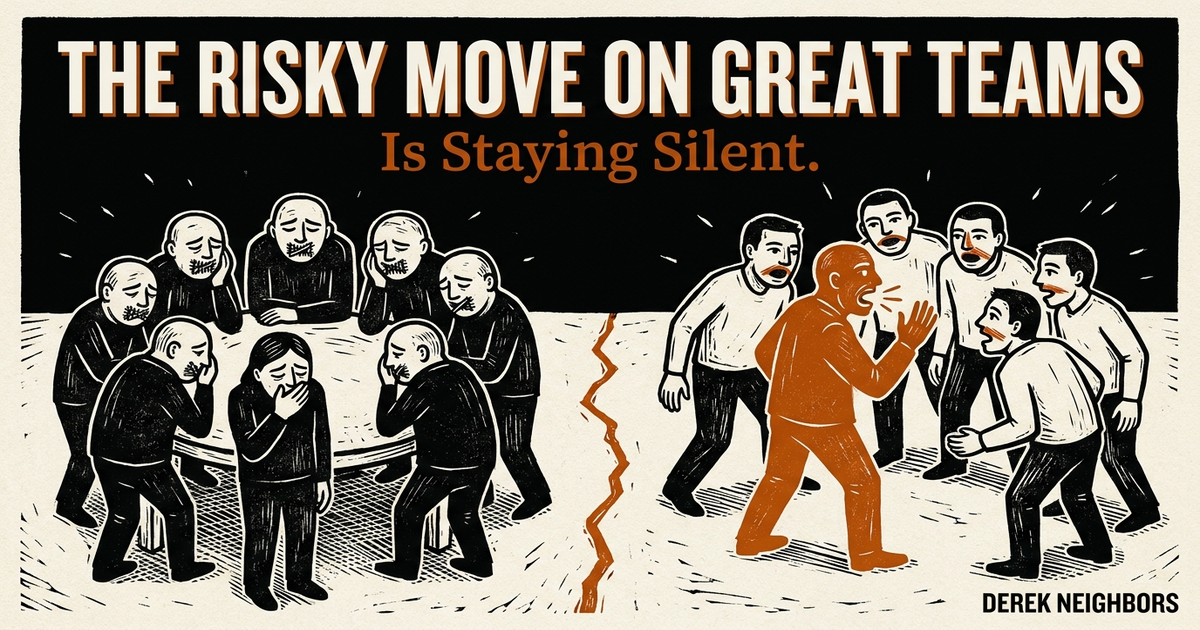
The Risky Move on Great Teams Is Staying Silent
By Derek Neighbors on July 26, 2026
After every flight, the Blue Angels sit down with the tape.
Every pilot owns mistakes out loud. Same script every time. Call a safety. Name the miss. Commit the fix. Say you are glad to be here. “I’m calling a safety. I was twenty feet too high on the base turn. I’ll fix my safety. I’m glad to be here.” Then the next pilot. Then the next. When the show demands it, the debrief runs for hours.
On that team, the weird move is not calling a safety.
I keep coming back to that sentence. Not because fighter jets make leadership sexy. Because most of the teams I coach still treat ordinary honesty like a special operation. They hire for “candor.” They put psychological safety on the slide deck. Then they wonder why the hard fact shows up after the plan is already moving.
They do not have a shortage of brave people. They have never installed a slot where declaration is the default and quiet is the outlier.
I already wrote about what silence does to a person: the character tax of swallowing what you know. This piece is the other half. Character asks whether you will speak. Ritual asks whether the room made speaking ordinary.
The Surface Problem
Your culture already claims it wants the truth.
Onboarding says “speak up.” Managers ask for open feedback. The values deck mentions safety. The meeting still rewards the person who keeps the temperature even.
So you get the usual symptoms. Smooth stand-ups. Late launch surprises. Critique that waits for a private channel. Leaders respond with more training on tone, more anonymous forms, more one-on-ones that collect heat and produce no commit-to-fix.
None of that installs a moment when every person must declare.
If honesty only happens when someone decides to be a hero, you do not have a practice. You have a dependency on whoever still has andreia (ἀνδρεία) left in the tank.
The System
Under the posters sits a price list nobody printed.
On most teams, candor costs status and belonging. Silence costs almost nothing in the room. That inverted map turns parrhesia (παρρησία), frank speech under risk, into a personal character test. Practiced long enough, the map trains a hexis (ἕξις) of withholding: a disposition that keeps work-truth private by default.
Leaders ask for challenge and then punish friction. Peers watch who gets air cover after a hard sentence. New hires learn fast. Save courage for survival. Do not spend it on Tuesday’s small miss.
You may not control whether the company adopts an elite debrief. You control whether you declare the miss you saw, whether you protect or punish candor in any room you influence, and whether you put a flip on any calendar you own. Authority changes the scale. It does not create the obligation.
I have watched the same map on product teams, exec teams, and volunteer boards. Industry does not matter. What happens after the inconvenient fact does. If the fact-teller loses status, the room updates. Next quarter it is smoother and dumber. aletheia (ἀλήθεια), unconcealment, shows up as an emergency instead of a rhythm.
The Leverage Points
Calling a Safety is a cost flip, not a personality upgrade.
The Blue Angels did not wait for braver pilots. They changed what bravery is for. Ordinary honesty stopped being heroic. It became the entry fee. Silence became the thing that stood out.
Named rituals do that work. Calling a Safety. Cone of candor. Truth stick. Honesty hat. The label matters less than the function. A named, recurring, every-person ceremony makes non-participation visible. Participation becomes normal. The room stops hunting for a volunteer hero and starts noticing who stayed quiet.
The ceremony is a tool. The demand underneath it is aletheia: surface work-truth while the fix is still cheap. You can owe that without ever hearing of the Blue Angels.
The leader going first collapses fear faster than any speech about openness. When the person with the most to lose owns a concrete miss before asking anyone else to, the room recalibrates. Nice leaders skip this because discomfort now feels expensive. Kind leaders pay it while the truth is still cheap.
I have seen leader-first fail one consistent way: the “miss” is fake. Vague humility about “communication” fools nobody. A specific altitude error, a late decision, a skipped check, those teach. Soft fog teaches people to perform apology without risking truth.
Repetition finishes the job. You do not get hexis from a values offsite. You get it from enough cycles that the body stops treating honesty as emergency mode.
The Intervention
Build the flip on purpose.
1. Name the ritual. If the room cannot say it out loud, honesty stays optional. Call it something specific. Put it on the calendar. Same script every time: miss, fix, gratitude. Unnamed “be more open” is a wish.
2. Leader takes the first safety. Every cycle. No exceptions for thirty rounds before you judge the culture. Own a concrete miss. Name the fix. Skip the syrupy gratitude performance. If you only model candor when you look good doing it, you taught the opposite lesson.
3. Every person, every cycle. Volunteers recreate the old hierarchy: the brave speak, the careful watch. The roster speaks. Junior people included. Quiet experts included. The point is not equal airtime for feelings. The point is equal obligation to the work’s truth. If you have no miss this round, say that out loud. Inventing a safety to fill the slot is theater.
4. Protect it from theater. Performative self-flagellation is not parrhesia. Weaponized confession is not safety. See the full parrhesia and eleutheria guides for how frank speech depends on inner freedom. Use phronesis (φρόνησις): judgment. Truth in service of the work. Target work-truth that would change the plan while the fix is still cheap, not gossip, malice, or every private sentence. No score-settling sold as honesty. No public flogging with a nicer name.
5. Track the missing declaration. When a surprise arrives late, ask which ritual slot should have caught it. Do not hunt for a villain first. Hunt for the empty seat in the script. That question trains the system faster than another speech about courage.
Expect the first month to feel awkward. Good. Awkward means the price list is moving. If it feels smooth on day one, you probably installed theater.
After three cycles, ask a quiet high-performer what they still will not say in the ritual. Their answer tells you whether you flipped the map or only renamed the meeting.
This is different from cultivating disagreement. Disagreement culture answers whether dissent is allowed. Ritual mechanics answer whether honesty is cheap enough to be routine. You need both. Most teams buy posters for the first and skip the second.
It is also different from shared vocabulary. Definitions clear the fog. Rituals clear the fear. A glossary without a safety slot still leaves people nodding at words they will not challenge.
The Results
When the cost structure flips, the room changes before the talent does.
Honesty becomes expected. Bravery gets reserved for novel risk, not for basic facts. Errors surface while they are still cheap. Treat that as a niceness upgrade and you will miss the point. Collective arete requires that the work’s truth can surface while rational action is still possible. A smooth room that buries the miss leaves the group’s capacity unactualized.
You will notice smaller tells first. Someone corrects a plan in the meeting instead of after it. A junior person names a risk without looking at the door. A leader gets interrupted with a fact and stays in the conversation. Call those soft skills if you want. I read them as price signals.
People stop confusing psychological safety with comfort. Comfort is soft chairs and soft truths. Safety is the belief that interpersonal risk will not be punished, which is what lets challenge happen early. Teams that cannot take a tease often cannot take a safety either. Both failures are reciprocity failures. The leader wants challenge outbound and insulation inbound.
Long term, aletheia stops depending on heroic individuals. The organization becomes harder to fool, including by itself. The win is not a nicer meeting. It is a truer one.
Final Thoughts
Stop waiting for a ceremony to make you honest. If you saw the miss, the declaration is still yours. If you lead any room, the flip in that room is still yours. If you cannot redesign the company’s calendar, you still control whether you punish candor or protect it when someone else pays first.
Name the ritual where you can. Go first. Make every person declare. Protect the practice from theater. Keep doing it until honesty no longer feels like courage and silence starts to feel like the gamble.
The Blue Angels already proved the geometry. On a great team, the risky move is staying silent.
Ready to build teams where truth is routine instead of rare? Join MasteryLab and forge the character systems that make excellence the default.