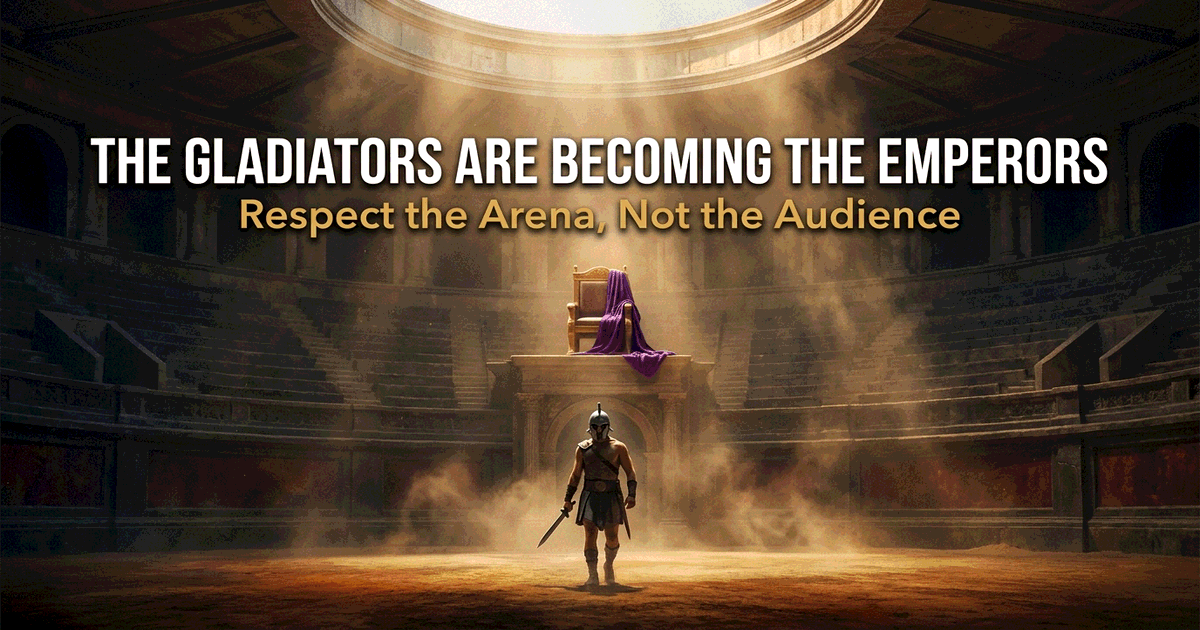
The Gladiators Are Becoming the Emperors. Respect the Arena, Not the Audience.
By Derek Neighbors on May 2, 2026
Last week the Daily Stoic guy lost his composure on YouTube.
Ivanka Trump had gone on The Diary of a CEO and said Meditations shaped her. She quoted Marcus Aurelius. She kept the book on her nightstand. Within days, Ryan Holiday, who has built an empire selling Stoicism in book and merchandise form, posted a response video arguing she does not really practice the philosophy. The internet flagged the obvious irony in roughly six hours: a Stoic teacher cannot maintain equanimity when someone he disapproves of likes his favorite book.
The same week, SpaceX announced a deal to acquire Cursor for sixty billion dollars. Cursor is an AI code editor whose 25-year-old CEO, Michael Truell, does every podcast himself. No PR handler. No marketing team. No prepared talking points. In October 2024, Truell and his three co-founders sat for two and a half hours on Lex Fridman explaining how the product works, because there was no one else in the building to do it. The company started with roughly fifty people, zero product managers, and no marketing department. By the time SpaceX came calling, it had crossed two billion dollars in annual revenue.
These two events are the same story, told from opposite sides of a wall that is collapsing in real time.
The wall: the gap between people who do the work and people who narrate the work. That gap built the entire leadership-influencer economy of the last twenty years. AI is closing it. And as it closes, the asymmetry that made commentator-class careers possible is becoming visible to audiences who could not see it before.
The arena always knows.
The Pattern Has a Name
The Greeks had a word for the difference between deeds and words. ergon meant the work itself, the function, the actual thing being done. logos meant the speech about it, the account, the explanation. Aristotle made the distinction load-bearing in his ethics. Character is revealed through ergon. logos can be borrowed. The work cannot.
Epictetus, born a slave with a broken leg, made the distinction even sharper. He spent his entire teaching career attacking students who could recite Stoic doctrine without being able to live a single day of it. His most cutting line: “Show me a Stoic, if you can. Where or how? But you can show me an endless number who utter small arguments of the Stoics. Show me a man who is sick and happy, in danger and happy, dying and happy, in exile and happy, in disgrace and happy. Show him: I desire, by the gods, to see a Stoic.”
He was not asking for a polished speaker. He was asking for evidence. Body, biography, scars.
Notice what Epictetus was and was not. He never built a company. He never ran a department. He taught philosophy in a small room in Nicopolis with a broken leg, a slave’s history, and the constant threat of imperial banishment hanging over the work. By any modern operator-versus-commentator binary, he sits on the wrong side of the line. He does not. The arena is not the boardroom or the founder’s seat. The arena is wherever the faculty of choice meets real consequence with no buffer to absorb the cost. A slave teaching philosophy under threat of exile is in the arena. A parent raising a child through a long illness is in the arena. A craftsman doing the same work for forty years without applause is in the arena. A CEO who has built a parachute around every decision is not. The test was never occupation. The test was always whether the person had to live with what they chose.
Marcus Aurelius wrote Meditations in a military tent on the Danube during a plague that killed five to ten million people across the Roman Empire. He was simultaneously commanding legions, governing in absentia, and grieving children who died young. He never published the notes. They were addressed to himself, in Greek, from a war camp. He was not selling Stoicism. He was using it to survive an empire that was trying to come apart in his hands.
Seneca is the complicated case. Wealthy advisor to Nero. Slave owner who wrote about the equality of all humans. Preacher of simplicity who lived in luxury. Critics in his own lifetime called him a hypocrite, and the charge has never fully gone away. But when Nero ordered him to die, Seneca opened his veins and dictated philosophy until his body finally gave out. He did not perform the role. He paid for it with his blood. The most damning line he ever wrote applies to almost every leadership guru working today: “No man has treated mankind worse than he who has studied philosophy as if it were some marketable trade, who lives in a different manner from that which he advises.”
Three thousand years later, Theodore Roosevelt stood at the Sorbonne and gave the West its modern version of the same idea. The credit, he said, belongs to the man in the arena. Not the critic. Nassim Taleb formalized it again in 2018: don’t tell me what you think, tell me what you have in your portfolio.
Same idea. Different vocabulary. Across three thousand years, the people who actually did the work kept noticing that the people who only talked about the work were unreliable narrators of it.
The Commentator Class
The leadership-influencer economy depends on a specific arrangement: the speaker has not done the work the audience hires them to explain.
Ryan Holiday started as marketing director at American Apparel under Dov Charney. His first book was called Trust Me, I’m Lying, and it taught readers how to manipulate the press through fake controversy and viral planting. He then took those exact tactics and applied them to ancient philosophy. The Daily Stoic store now sells Memento Mori medallions for thirty dollars apiece, with a bundle of nine for two hundred and fifty seven. The model works. The model is also, by any classical standard, the thing Seneca warned against. Stephen Kent at Geeky Stoics wrote a piece titled “Ryan Holiday Has This All Wrong.” Benjamin Cain called him “no philosopher at all but just a self-help writer.” None of this is news. What is news is the Holiday meltdown over Ivanka, which was the model breaking on camera. The impulse to defend Stoic practice from misappropriation is not itself un-Stoic. Cato confronted Caesar. Marcus banned cruelties he found incompatible with virtue. What broke was the form. A composed teacher would have written quietly about what genuine Stoic practice requires and let the writing do its work. The Daily Stoic brand owner reached for a public response video that protected commercial territory and called it philosophy. The reaction was the one his business model demanded, and that demand is the tell.
Simon Sinek is the cleaner case. He has never operated at the scale he advises. He has run a small consultancy and a content company that exist to sell his own ideas, not the kind of organization he tells Fortune 100 leaders how to run. He has not had P&L responsibility for hundreds of people through a downturn. His career path is ad agency copywriter to solo consultant to thought leader. His speaking fees run between two hundred and four hundred thousand dollars per keynote. Start With Why repackages Jim Collins from 1994 and Everett Rogers from 1962. The Infinite Game lifts directly from James Carse’s 1986 philosophy book and, according to multiple academic reviewers, misrepresents the original ideas. His neuroscience claims about the limbic brain have been called inaccurate by working neuroscientists. The frameworks sound clean in a conference room. They tend to lose definition the moment an operator tries to apply them under pressure.
This is not a personal critique. The pattern is structural. The model demands it. You cannot sell wisdom as a product without becoming, eventually, the thing you warned against. The audience of executives who fly Sinek in for a keynote does not want the truth that nobody who has actually run a billion dollar company would have time to package leadership for them in tidy three-circle frameworks. The audience wants the framework. The model supplies the framework. Everyone leaves the room satisfied except the operator who has to actually implement what the keynote made sound easy.
pistis, faithfulness or trustworthiness, is the Greek concept for the consistency that holds character together over time. The commentator class trades pistis for reach. The trade compounds. Eventually the gap between what you teach and how you live becomes the only thing your audience can see.
The Arena Is Collapsing the Gap
Cursor launched with roughly fifty people, zero product managers, zero marketing department, and zero PR staff. All four co-founders are MIT engineers. They did every podcast. They wrote every blog post. They ran every demo. In October 2024, Truell and his co-founders sat through two hours and 38 minutes on Lex Fridman talking about machine learning architecture and code verification challenges, with no talking points, because the alternative was not having someone else do it. There was no one else. The company has since grown to over a hundred people and crossed two billion dollars in annual revenue. In April 2026, SpaceX offered sixty billion dollars to acquire it. The team is larger now. The model has not changed. There is still no communications department. The engineers still do every interview.
Aman Sanger, his co-founder, posts infrastructure decisions on X as they happen. His feed reads like an engineering log that happens to be public. Database migrations. Throughput improvements. Real numbers from real production. No marketing approval cycle, because there is no marketing.
Anthropic’s Claude Code is the same pattern at a larger company. Boris Cherny built Claude Code as a side project in late 2024. By early 2026, his personal X thread about how he uses the tool went viral and got covered by Fortune and VentureBeat. Someone on the internet turned it into a CLAUDE.md file that started spreading independently. He ships somewhere between ten and thirty four pull requests per day and has not written a line of code by hand since November of last year. He does Lenny’s Podcast, the Pragmatic Engineer, and the Every podcast. He is simultaneously the most productive engineer at the company and the most visible communicator for the product. Those are the same role now.
Cat Wu, who built Claude Code with him, does live coding demos at conferences. Amanda Askell, the Anthropic philosopher who shapes Claude’s character, talks publicly about her own work. Not someone else’s interpretation of it. Her own.
The traditional model: executives speak, marketing crafts, engineers stay invisible behind NDAs. The new model: whoever built it is whoever explains it. There is no intermediary layer. There is nowhere to hide. When a question comes from the audience, the answer is technical and specific because the speaker actually wrote the code being asked about. Authority no longer needs to be asserted. It shows up in the answer itself.
This is what ergon looks like in 2026. The deed and the speech come from the same person, and audiences can immediately tell the difference between someone who has done the thing and someone who has read about it. The asymmetry that built the influencer economy is collapsing because the audience for technical work is now technical enough to verify the speaker in real time.
Respect the Arena, Not the Audience
The deeper shift has nothing to do with authenticity as aesthetic. The real question underneath all of this is who has standing to speak.
Roosevelt’s actual Sorbonne speech was not about ignoring critics. It was about civic duty. He argued that the success of a republic depends on ordinary citizens doing their work, and that judging effort merely by outcome was the move of a small mind. The arena was the place where words and deeds had to match. Modern users strip the speech of that civic context and use the famous passage as an immunity card against criticism. The original meaning was the opposite. Roosevelt built accountability into the arena. He did not exempt the fighter from it.
The leadership-guru economy did the same trick at scale. It built careers commenting on arenas the speaker never entered, then used the rhetoric of “the man in the arena” to deflect questions about why the speaker had no scars. That model is dying because AI is collapsing the distance between building something and explaining it. There is no way to dress up a keynote when the audience can pause the video and ask whether the speaker has actually shipped what they are describing. The kind of attention that produces real work cannot be performed. It can only be done.
This is not a charge against synthesis or teaching as such. The historian who studies fifty failed founders and writes the pattern can earn standing. The biographer who lives inside another person’s choices for years can earn it. The teacher who has practiced teaching long enough to know what it costs can earn it. Teaching is itself an ergon. Rigorous synthesis is itself an ergon. Contemplation pursued under the discipline of reason is itself an arena, and an old one. What breaks the standing is not the absence of operating. It is the absence of any practice serious enough to leave its marks on the practitioner. Material outcomes do not produce virtue. They only test it. Cursor’s revenue is not what makes their engineers credible; engineers being the same people who do the work and explain the work, with no professional polish layered between them and the audience, is what makes them credible. Strip the revenue and the principle still holds.
Marcus Aurelius hated the gladiatorial arena. He banned blunt-edge fighting and tried to make the games less brutal. But he understood what the arena revealed. The cost of being wrong inside it was real. He governed the same way. War on the Danube. Plague in Rome. A trusted general declaring himself emperor based on a false rumor. Marcus did not treat any of it as content. He treated it as the work, and his philosophy was the operating system he ran while doing it. He was not a spectator narrating the empire. He was a practitioner running it. The Meditations survived because the man writing them was simultaneously living the conditions they described.
The leadership lesson is uncomfortable for an entire profession. Stop optimizing for the opinions outside the arena. Stop performing for the commentator class. Build the thing. Ship the work. Take the scars. Trust that audiences who matter will find the difference between someone who has done it and someone who has packaged it without you needing to point at the difference yourself.
parrhesia, the courage to speak the truth that costs you something, was the Stoic discipline most relevant to public life. Volume had nothing to do with it. The discipline was being willing to say the true thing when the true thing had a price. The commentator class cannot practice parrhesia because their business model requires them to never say anything that would lose them an audience. The practitioner-leaders winning right now can practice it because their authority does not depend on keeping the audience comfortable. Their authority depends on the work continuing to ship.
Final Thoughts
The Holiday meltdown was the model breaking in public, not an accident of temperament. A man who sells equanimity cannot afford to lose it on camera, but the model demanded he respond, because his brand depends on owning the right to comment on Stoic source material. When someone he politically opposes claimed access to the same texts, his options were silence or reaction. Silence would have been Stoic. Reaction was profitable. He picked the model.
The Cursor team’s ascent has no marketing strategy behind it for one obvious reason. They never built a marketing layer to filter the signal. The gladiators are talking because there is no one else in the building to do it, and the audience has noticed that the unfiltered version is more useful than the polished one ever was.
For leaders watching this shift, the question is which side of the wall you are standing on when it falls. Are you accumulating opinions for the audience outside the arena? Or are you bleeding for the work inside it? The answer is going to become visible faster than most leaders expect, because the same forces collapsing the gap between engineer and communicator are about to do the same work in every other domain where the public has been kept on the wrong side of a translation layer.
Marcus wrote in a war camp. Epictetus taught from a slave’s scars. Seneca died with his veins open, dictating philosophy until the bath water rose around him. The era and the technology change. The standard does not. The work proves the worker, and the worker who does the work earns the right to talk about it.
Respect the arena. The opinions outside it never counted in the first place.
If you’re done borrowing wisdom from people who have never had to live it, MasteryLab.co is where leaders learn to operate from inside the arena instead of narrating it from the seats.