Make Someone Untouchable and the Failure Is Already Yours
By Derek Neighbors on September 6, 2026
Years ago I worked with a software company whose core platform had been written by one person in its first year. He built it while the rest of the company was still arguing about the roadmap, and it worked, and the business ran on it. That was the origin story, and everyone could tell it.
For a long time the deference was earned. He was right more often than anyone in the building, and every design review for years ended the same way: he built this, so he knows. I want to be fair to that room, because that is how immunity always starts. It starts with a record, and it becomes immunity on the day a question starts costing the person who asks it.
The Setup
The platform ran the business. The story ran the platform. Nobody had decided that on purpose. It had accumulated, one review at a time, until the question “should we do it his way” stopped being asked because the answer had been the same so many times.
If you are a leader, you have a version of this person somewhere in your org right now. It might be the founding engineer, the rainmaker, or the head of product who was there for the pivot: someone whose record has quietly become a rule. This is a cousin of the team that falls apart without one person, and it is worse, because a team that depends on someone still asks them questions.
The Journey
The first time I saw the cost, a senior engineer pushed back in a review on a data model decision. It was a real objection, about how a table would behave at ten times the volume. The room went quiet the way rooms go quiet when someone has touched the thing everyone has agreed not to touch. The architect answered briefly. The engineer dropped it.
A quarter later that engineer was moved to another team, for reasons that were unrelated and that everyone understood were related.
After that, nobody pushed back. I went and looked, later, at the pull requests. Two years of changes to the core platform with zero review comments on anything he wrote. People called that quality. It was the sound of a room that had learned what questions cost.
The small failures got explained away in the same period. An incident traced to his module was written up as an edge case. The postmortem named the on-call engineer’s response time as the action item, and everybody signed it.
Here is the part most people miss: the protection changed him too. He stopped explaining his decisions, because nobody asked for the explanations anymore. He started answering objections with the record instead of with reasons. The ancient word for what was growing in him is hubris, and it is worth being precise about it, because most people use it to mean arrogance. Aristotle, in the Rhetoric, defines hubris as doing or saying something that shames another person for the pleasure of feeling superior. Arrogance is an opinion you hold about yourself, while hubris is an act against someone else that treats them as beneath account.
He had not started arrogant. The room taught him that a question was disrespect, and he learned the lesson the room was teaching. I have written before about the leader who dishes out sharp feedback and cannot take it. This was the organizational version: a whole company building a person who could not be questioned, and then being surprised at who it built.
And it changed the org in the mirror image. The people who could have caught the next flaw were the same people who had watched what happened to the last person who tried.
The Turning Point
The migration took the platform down for most of a business day. The root cause was a decision from year two, about how a table would behave at volume. It had been raised exactly once, in the review that got silenced, and never again.
In the room afterward the CEO asked how nobody had caught it. Nobody gave the honest answer out loud, so I will give it here. Somebody caught it. We moved him.
That was the moment the story cracked, and what came out of the crack was a verdict on everyone else in the room. The man who made the decision in year two had been wrong about a table, which engineers are wrong about every week. The failure belonged to every person, the CEO first, who had decided that his story was too precious to check. Robert Glazer put it in one sentence that I have not been able to improve: when someone becomes beyond reproach, the failure belongs to everyone who decided that was acceptable.
Athens ran the same story twenty-four centuries earlier and paid more for it.
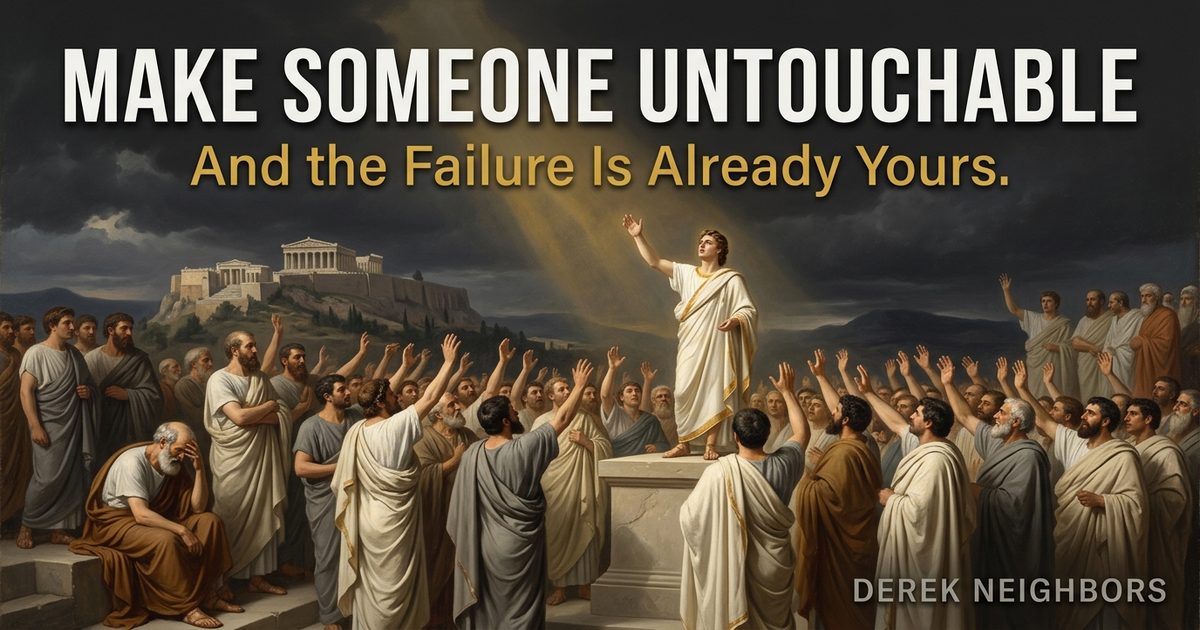
In 415 BC the most gifted man in the city was Alcibiades. Ward of Pericles, student of Socrates, brilliant, beautiful, and reckless, with a record that made the assembly’s mouth water. He wanted Athens to invade Sicily. Nicias, the cautious general, did not, and he tried a clever move: he told the assembly that the expedition would need a force so enormous that surely they would drop the idea. Thucydides records what happened next. The assembly voted him the enormous force. The warning became a bigger budget, because a city that cannot check its prodigy has lost the ability to hear a warning as anything but an estimate.
The expedition was destroyed in 413. Athens lost a fleet, an army, and eventually the war. Thucydides is blunt that the city’s inability to handle Alcibiades, first by refusing him nothing and later by refusing him everything, was the ruin of it. The failure belonged to Alcibiades and to every hand that went up.
The Resolution
The company did two things, and both were about explanation.
Nothing merged anymore without a comment from someone outside the author’s team, and that included the architect. And his designs had to be explained to the room by a different engineer before they were approved. If nobody else could explain the decision, it was not approved, no matter who made it. Explaining became the check that the story had removed.
He was furious for about a month. Then, to his credit, he got better, and I mean better as an engineer and not only easier to work with. What he had lost in the protected years was aidos, the Greek word for the restraint that fires before you transgress, the sense of being watched by people whose opinion counts. It is the opposite of hubris, and Aristotle was careful to call it a brake rather than a virtue: aidos is what guards a person until sophrosyne, settled self-command, no longer needs the brake pulled from outside. He had lost the brake because nothing external had triggered it in years, and once the questions came back, so did the restraint, which is the first step back toward the settled kind. Some people in his position leave instead. Either outcome is cheaper than the outage.
The organization got something back too. parrhesia, frank speech, returned about the one thing that mattered most, which is the thing it had been missing about for longest. The engineer who had been moved was invited back to the platform team. He declined, and I did not blame him.
There is an old Greek word for beyond reproach, and the company had been using it backwards. anepileptos means, literally, not able to be laid hold of. The ancients used it for conduct so clean that a critic had nothing to grab. Paul uses it in his letter to Timothy for what a leader must be. That is the earned version: a person whose work gives nobody a handle because it is open, explained, and checked every day. The company had inverted it into the granted version, a person nobody is allowed to lay a hand on. The first has to be renewed every morning, and the second is granted once, usually out of gratitude, and rots from the day it is given.
The Principle
Immunity from questioning is never a compliment, and it is not the same as trust. Trust is deference in proportion to a record, and it stays open to the next piece of evidence. Immunity is deference that no evidence is allowed to revoke, and the marker between them is simple: trust becomes immunity on the day a question starts costing the person who asks it. Immunity is a decision an organization makes, almost always as thanks for a real record, and the failure that follows is booked to whoever made the decision, which means the protectors own the larger share. The protected person keeps his own, because he owed the explanations whether or not anyone asked for them.
Three tests find it before the outage does.
Who has had zero pushback for a quarter, and why? Agents write and review the code now, so the pull request tells you nothing. Look at the human decisions the agents inherit: the specs, the architecture rules, the instructions files in the repo. Who wrote them, and who else has ever changed a line? Then look for the design review where someone pushed back and the meeting where someone said no to them. If the answer is one author and no objections, treat it as a warning light. Clean work draws questions and answers them well.
What happened to the last person who questioned them? Ask the juniors. If the answer is a transfer, a cooling, or a reputation for being difficult, the organization has already priced the question, and everyone knows the price.
Can a new hire explain their last big decision? Not recite that they made it, but explain why. If the only available explanation is the record, the record has replaced the reasoning, and the reasoning is what you were paying for.
Then make explanation the price of approval for everyone, the star most of all. Rotate who reviews whom so the same deference does not calcify in the same pairings. Write the origin story down with dates and diffs and let people check it, because a legend with a commit history is a fact and a legend without one is a liability.
None of that requires the star’s cooperation. The rules are yours, the temperament is theirs, and the rules work either way. What the rules cannot do is supply the wanting. They are scaffolding for a disposition, and a leader who does not want to be questioned will get perfunctory comments and rubber-stamp reviews inside a week, while the star learns that the rule does not apply to them. The habit has to live in the person at the top first, visibly, on their own designs.
The best people want this. I have never met a truly excellent engineer who resented being asked why, because being asked why is how they stayed excellent. The ones who resist it have already started to decay, and an organization that protects them from the questions is the one that finishes the job.
Final Thoughts
Nobody is beyond being questioned. The earned kind of beyond reproach belongs to the person who survives the questions, never to the one who was spared them, and the person who most needs to hear that is usually the one the room stopped saying it to years ago. Athens could not tell Alcibiades no and it lost a fleet. The company could not tell its architect no and it lost a day, a good engineer, and two years of decisions nobody had looked at.
The moment you grant someone immunity, the next failure is already yours. What arete names in a leader is the refusal to hand out that immunity, and it starts with refusing to accept it when the room offers it to you.
If you want a room where nobody is exempt from being asked why, including the people who built the thing, MasteryLab is where that habit gets practiced in public.
FAQ
What is the difference between hubris and arrogance?
Arrogance is an opinion you hold about yourself: that you are better than the people around you. hubris, in Aristotle’s definition, is an act against another person, doing or saying something that shames them for the pleasure of feeling superior. Arrogance can stay inside a head, while hubris lands on someone else and treats them as beneath account. In organizations it is usually learned. A person nobody may question learns that questions are disrespect and starts treating the askers accordingly.
What is the opposite of hubris?
The Greek opposite of hubris is aidos: the sense of shame and reverence that stops a person before they transgress, in front of others and in front of themselves. Humility is close but weaker, because humility is a self-estimate and aidos is a brake that fires in the moment. A person protected from all questioning loses aidos first, because nothing external ever triggers it. Restore the questions and the brake comes back.
What does it mean to be beyond reproach?
The Greek word is anepileptos, literally “not able to be laid hold of.” It described conduct so clean there was nothing for a critic to grab, and Paul uses it for what a leader must be. Organizations invert it: instead of a person whose conduct gives nobody a handle, they create a person nobody is allowed to lay a hand on. The first is earned daily by staying open to questions, and the second is granted once, out of gratitude, and rots.
Who was Alcibiades and why does he matter for leaders?
Alcibiades was the most gifted Athenian of his generation, ward of Pericles and student of Socrates, and in 415 BC he persuaded the assembly to invade Sicily. Nicias tried to frighten the city out of it by demanding an enormous force, and the assembly voted him the force. The expedition was destroyed in 413 and Athens never recovered its position in the war. A city or a company that cannot check its prodigy turns every warning into a bigger budget, and the failure belongs to the people who voted.