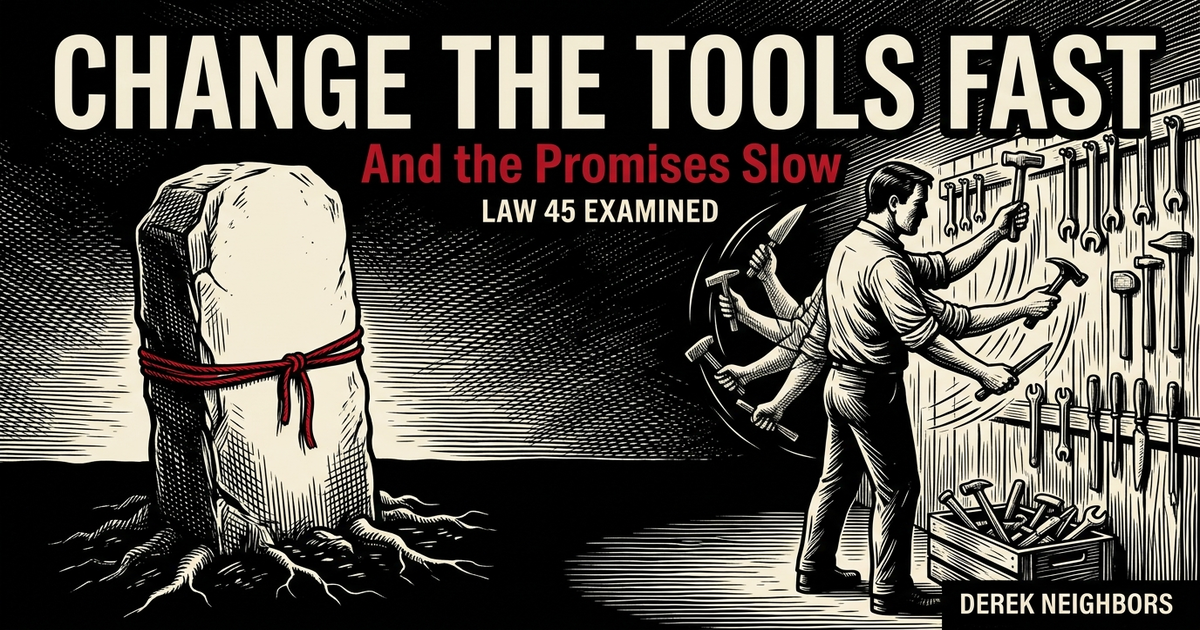
Change the Tools Fast and the Promises Slow
By Derek Neighbors on November 9, 2026
Power vs. Virtue: The 48 Laws Examined
A year-long examination of Robert Greene's 48 Laws of Power through the lens of ancient virtue ethics. Some laws we affirm, some we reframe, some we reject entirely.
Law 44 ended by saying change was next. Law 45 of the 48 Laws of Power, Preach the Need for Change, but Never Reform Too Much at Once, is advice almost every new leader has heard in some form: go slow, and respect what was here before you change it.
I see it go wrong two ways this year. One leader announces a transformation every quarter, and the team’s actual week never changes. Another keeps every meeting and every title exactly as they were, and moves the real decisions somewhere else. Greene would call the second leader skilled. I think his pace advice points at the wrong things, and his method asks you to lie about what changed. The better rule is to change the tools fast and the promises slow, and to tell people which is which.
The Law: Preach the Need for Change, but Never Reform Too Much at Once
Law 45: “Preach the Need for Change, but Never Reform Too Much at Once.”
Greene’s argument goes like this. People agree that change is needed in the abstract, but in daily life they run on habit. Too much that is new, all at once, feels like an attack, and people revolt against it. So if you are new to power, show respect for the old ways. When you do change something, make it feel like a small improvement on the past.
His lead story is Thomas Cromwell, Henry VIII’s chief minister. Cromwell drove the dissolution of the monasteries in the late 1530s, closing hundreds of religious houses and moving their land and wealth to the crown. In 1536 a rising in the north, the Pilgrimage of Grace, named him among the counselors the rebels wanted gone. In 1540 he was beheaded. Greene reads the story as a man who reformed too much, too fast.
The law’s real ancestor is Machiavelli. In the Discourses, Book I, chapter 25, he advises anyone reforming an old state to keep at least the shadow of the old ways, so the people do not feel that anything changed even when everything did. His example is Rome after the kings were driven out. The two new consuls kept the king’s twelve lictors, the attendants who walked ahead of him carrying rods. The Romans also created a “king of sacrifices” to perform the king’s religious duties, so nobody would miss having a king.
The Tactical Truth
Greene is right about a lot of this.
People do resist change they did not ask for and were given no reason for. A new VP who arrives in January and rewrites the architecture, the on-call rotation, the planning process, and the promotion criteria by March has made an enemy of everyone who built any of them. Whether each change was right barely matters. They arrived together, from a stranger, and the team reads the whole bundle as a verdict on their past.
Respect for what people built is real, too. Most of a team’s old ways are there because somebody once had a reason, and people who built a working system have earned some patience before you replace it.
The strongest case for Greene is Augustus. After the civil wars he controlled the armies and the money of Rome, and he kept the republic’s offices running around him. Rome still had consuls and a senate, and it still held elections. In the Res Gestae, his own account of his reign, he says he handed the republic back to the senate and people, and that afterward he had more influence than anyone but no more official power than his colleagues. He ruled for about forty years and died in his bed. Julius Caesar took the title of dictator for life and was killed about a month later. Side by side, the two careers look like Greene’s law working exactly as written.
Before you use any of it, sort out what is yours. Whether people accept a change belongs to them. Whether you told them plainly what is changing, what is staying, and why belongs to you. Greene’s law is written almost entirely about the first part.
The Character Cost
Start with the act. Keeping the old name on something you changed, so people will not notice it changed, gives them a false picture of their own situation. They think they still have what they had, so they plan around it and do not object, because they do not know there is anything to object to. The wrong is done on the day you do it, whether or not anyone ever finds out.
The test for this one is simple. Would someone who knew the old version call the new one the same thing? If the people who sat in the old standup would say the new one is a status report to a director, it needs a new name.
The test works whether or not you meant anything by the name. Keeping a name in order to hide a change is the wrong described above. Keeping one out of habit is a lapse, and once the test shows the name misleads people, keeping it from then on is a choice.
The first cost is that the names outlive what they meant. Tacitus, writing about a century later, describes Rome at Augustus’s death in a few lines. At home everything was quiet, and the magistrates had the same names as before. The young men had been born after the battle of Actium, most of the old ones during the civil wars, and how few were left who had seen the republic. The offices were all still there, and after forty years almost nobody remembered what they used to do.
Work has its own version. A company keeps saying “teams own their roadmaps” for two years after the roadmap started arriving from the exec offsite. The phrase is still in the onboarding deck. New hires believe it, and the people who have been there a while stop believing anything in the deck. Once a few of your words are known to mean something else, people discount the rest of what you say. The person keeping the names pays too. After a few years of choosing words for how a change will look, you lose track yourself of what you changed, and you start believing the onboarding deck.
The second cost is in the first half of the law. “Preach the need for change” turns change into a sermon, and a leader can preach it for years. Some companies announce a transformation every planning cycle: AI-first, then platform-first, then back to customer-first, each with an all-hands and a new slide, while what the team does on a Tuesday barely moves. People learn to treat the announcements like weather. When the change that matters finally comes, it gets the same shrug as the last four.
Third, a change too gradual for anyone to notice is a change nobody got to object to. Greene presents slowness as kindness, and it often works as concealment instead, which costs you everything objections are good for. The engineer who would have told you the new approval step breaks hotfixes at 2 a.m. never says it, because nobody announced an approval step. It arrived one small rule at a time. I made the case against hiding where you are going in Law 3. Slicing a reform thin enough that nobody can see it is the same move, spread out over a year.
Fourth, the pace rule protects the reformer and sends the bill to everyone else. “Never reform too much at once” is advice for surviving at court. It says nothing about what the work needs. Even Cromwell is a weaker case than Greene makes it. The rebels of 1536 hated his reforms, and they were crushed. What brought him down four years later was the marriage he arranged between Henry and Anne of Cleves, which the king hated, and the rivals at court who used it against him.
Meanwhile, the people stuck on the dying thing pay for every month you go slow. For a lot of teams in 2026, that bill comes due in AI. I keep seeing teams run a careful six-month pilot of a coding model, with a steering committee and a survey, while the model they are piloting gets replaced twice. By the time the pilot reports, it has studied a tool nobody uses anymore, and the engineers who could have been shipping with the new one spent half a year on the old way so the change would feel gentle.
Fifth, “people are creatures of habit” is a low opinion of people, and for builders it is mostly wrong. Engineers swap libraries, languages, and frameworks all the time. Teams move to a new editor in a week, with no memo, when the new one is obviously better at the work they do every day. What people fight is a change with no reason given, and a change to something they were promised. Greene puts those in the same pile as everything else and tells you to go slow on all of it, so you end up going slow on the things that should move fast.
The ARETE Alternative
Aristotle took up this exact question, and he drew a line Greene never draws.
In the Politics, Book II, chapter 8, he discusses a proposal from Hippodamus, the city planner: give public honors to anyone who discovers something useful to the city. That sounds like a standing reward for reform, and Aristotle takes it seriously. In the arts, he says, change has clearly helped. Medicine and athletic training improved by leaving their ancestral methods behind. Old customs were often crude anyway. The early Greeks carried weapons everywhere and bought their wives from one another.
Then he says the comparison with the arts is false. A craft, techne, gets better when its methods change, because the methods exist to get the work done. Law, nomos, works differently. People obey a law mostly out of habit, and a habit takes a long time to form. Change laws lightly and you weaken the habit of obeying any of them. So when the improvement is small, Aristotle says, leave some mistakes of the lawgivers alone. The city gains less from the change than it loses when people learn that the rules can always change.
That is a better version of Law 45, and it splits the law in two. A tool is valued for what it produces, and you can judge it fresh every time you use it. A promise is valued because people can plan around it, so most of its worth comes from staying put. Tools and methods are craft. Change them whenever something better arrives, and the sooner the better. Promises are closer to law. That covers how people’s work gets judged, who carries the pager, who owns which system, what the review bar is, and what you told someone about their role when they joined. People plan their lives around those. Change them rarely, in the open, and only when the gain is worth what it costs a team to learn that its rules can move.
Aristotle did not say laws should never change, only that they should not change lightly or for small gains. Holding on to a promise that has stopped working is its own failure. If one team carries the pager for a system everyone ships to, and that team is burning out, the honest move is to change the promise, out loud.
Sorting a given change into one column or the other takes judgment, and that judgment is phronesis, practical wisdom: seeing what this situation calls for. A new coding model is craft. Making “uses the new model” part of the performance review is a promise, and it deserves the slow, open treatment even when the model itself goes in on day one.
Plato, Aristotle’s teacher, would have pushed back on this split. In the Laws, Book VII, he argues that even a change in children’s games changes the children, who grow up wanting different laws. Methods are not always neutral, and some tool changes carry a change to the people inside them. A model that writes most of the code changes what a junior engineer gets practice at. The way through is to sort the parts. The model goes in on day one, and what it changes about how people learn and how they are judged goes in the promise column, to be changed slowly and in writing.
Solon shows what the honest version looks like at full size. Athens around 594 BCE was close to civil war over debt. Poor Athenians had borrowed against their land and then against their own bodies, and many had been sold into slavery. Solon, given the power to fix it, cancelled the debts and freed the people enslaved for them. That is about as much reform at once as a city can take, and he said exactly what he had done. In a poem that survives, he says he pulled up the boundary stones that marked mortgaged land and brought home Athenians who had been sold abroad.
Plutarch adds a detail that matters here. The Athenians, he says, liked to give hard things gentle names, and Solon started it: he called the cancellation of debts the seisachtheia, the shaking off of burdens. A gentle name for a change everyone can see does no harm. Everyone in Athens knew what had happened to the debts. Machiavelli’s twelve lictors were the opposite case, because their whole point was to keep people from seeing what had changed.
Solon was honest about the size of what he did, too. Asked whether he had given the Athenians the best laws, Plutarch reports, he said he had given them the best they would accept. Neither the rich nor the poor got everything they wanted, and he turned down the chance to make himself tyrant. Then, according to Herodotus, the Athenians swore to keep his laws for ten years, and Solon left the city for those ten years so nobody could pressure him into repealing any of them. He made a big change, said so, and let it stand long enough to work.
Put together, an honest reform says what is changing, what is staying, and why, in words people can check, and it moves at the pace the work sets: fast for tools and methods, slow for the promises people depend on.
At work, that comes down to five practices.
Sort the change into tools and promises. Before any reorg, rollout, or new process, write two columns. Tools and methods go on the left: the editor, the model, the CI setup, the meeting format. Promises go on the right: how people are evaluated, who is on call, who decides what, what someone was told about their job. In my experience, a lot of fights about pace are really about the right column.
Change the tools this week, and say so. Put the best model you can get on real work now, on the hardest ticket in the backlog instead of a sandbox. When a better one ships, run it on the same task the day it comes out, and switch if it wins. Tell the team in one line: we are on the new model as of today, and here is why. Nobody needs a steering committee to change a tool.
Change a promise in writing, with the reason, the date, and what people lose. If on-call is moving from one team to every team, say that, say why, say when it starts, and say what it costs the people who were never on call before. Do it once, and do not make the change sound smaller than it is. I wrote about the bill for promises made in a bad year in The Promise You Made When Nobody Was Buying. Changing a promise costs something in a good year too, which is the reason to do it in the open. Expect pushback when you do. How people react is up to them, and your part is to answer the objections in the open and change the plan only when someone gives you a reason. A hard room is no reason to hide the next change.
Keep an old name only if the thing is the same. If the standup is now a status update for a director, call it a status update. If “team-owned roadmaps” now means the team picks the order within a plan someone else wrote, say that instead. Use the test from earlier: would the people who remember the old version call it the same thing?
Ship the change, then leave it alone. Solon left for ten years. You can manage one planning cycle. After a reorg, commit to no new reorg for a set time, and use that time to learn what the change did. A team that gets reorganized every six months never finds out whether any of the structures worked. This applies to promises and structure. You still swap the model when a better one ships.
None of this depends on rank. The staff engineer who joins and wants to rewrite the service in week two faces the same choice as a new VP: name the change, give the reason, and know whether you are proposing a new tool or breaking a promise somebody made to the people who built it. The engineering manager who keeps saying “you all own this” while routing every decision through themselves is running Law 45 at small scale. So is the founder who tells the original team that nothing about the culture will change after the funding round, while hiring a layer of managers above them. The manager handed a reorg from above, with instructions to call it a realignment, is in the same spot. You did not choose the change, and what you tell your own people about it is still yours: you can say plainly what is different for them, even when the announcement upstairs did not. The intern who opens a pull request adding a lint rule, with two lines explaining why, is doing it the way Solon would.
If you are on the receiving end, ask the question that cuts through it. When a leader says nothing important is changing and the org chart says otherwise, ask what is different for you on Monday. If the answer is about the vision and never gets to your Monday, you are probably living inside Greene’s version.
Ancient Wisdom: the twelve lictors, the same names, and the boundary stones
Machiavelli’s Discourses on Livy, Book I, chapter 25, is the clearest statement of the law, with the consuls’ twelve lictors and the king of sacrifices.
The Res Gestae of Augustus, section 34, is Augustus describing his power the way he wanted it remembered. Read Tacitus’s Annals, Book I, chapters 2 and 3, right after it for the other view: the same names for the magistrates, and hardly anyone left who had seen the republic.
Aristotle’s Politics, Book II, chapter 8, has Hippodamus, medicine and athletic training, the weapons and the bought wives, and the argument that laws differ from crafts because they run on habit. Plato’s Laws, Book VII, around 797, has the children’s games.
For Solon, read Plutarch’s Life of Solon from chapter 15 for the gentle names and “the best they would accept.” The Constitution of the Athenians, attributed to Aristotle, quotes Solon’s own poem about the boundary stones in chapter 12. Herodotus, Book I, chapter 29, has the oath and the ten years away.
Side by side, for a leader about to change how a team works:
| Greene’s reform | An honest reform | |
|---|---|---|
| What people are told | Nothing much is changing | What changes, what stays, and why |
| Old names | Kept, so nobody notices | Kept only if the thing is the same |
| Pace | Slow everywhere, to protect you | Fast for tools, slow for promises |
| Objections | Avoided by changing in small slices | Asked for before the change lands |
| Afterward | Another gentle improvement | Left alone long enough to learn from |
The Test
Think of the last change you made to how your team works. Did you say what was changing, or did you let them find out?
Which names in your organization no longer mean what they meant when you started using them?
What tool or method are you moving slowly on to keep things comfortable, while a better one is already available?
What promise did you change without saying so out loud?
And the one that decides: if someone who joined three years ago read your onboarding docs today, would they recognize the place they work? If they would say “that is not how it works here,” the docs are telling new people something false, and fixing that is on you.
Final Thoughts
Greene is right that people fight change they were given no reason for, and that a newcomer who rewrites everything at once makes enemies. His fix is to keep the old forms so nobody notices what changed, and it can work for a long time. Augustus kept the consuls and the senate for forty years. By the end, Tacitus says, almost nobody was left who had seen the republic, and the names no longer told anyone anything. Keeping a name so people will not see the change is a lie on the day you do it, whether or not anyone catches you. It also costs you the objections that would have improved the change, and the trust people put in your words.
Aristotle drew the line Greene missed. Crafts get better by changing, and laws hold because people are used to them. So change the tools fast, starting with the best model on your hardest problem this week. Change the promises slowly, in writing, with the reason and the cost. When you make a big change, do what Solon did: say plainly what you did, name what people lost, and then leave it alone long enough to find out whether it worked.
Law 46 is next: Never Appear Too Perfect.
Knowing what to change fast and what to protect is part of leading well. That is what MasteryLab is for.
FAQ
What is Law 45 of the 48 Laws of Power?
Law 45 is Preach the Need for Change, but Never Reform Too Much at Once. Robert Greene argues that people accept change in the abstract but run on habit day to day, so too much change at once provokes revolt, and new leaders should make every change feel like a small improvement on the past. This series reframes the law. People do resist change they get no reason for, but keeping the old names so nobody notices a change is a lie, and the right pace depends on what you are changing.
What does preach the need for change but never reform too much at once mean?
It means talk about change openly while making the real changes slowly and in small pieces, keeping the old forms in place so people do not feel much has changed. Machiavelli gave the same advice in the Discourses, pointing to Rome’s new consuls keeping the king’s twelve attendants after the kings were expelled.
What is the seisachtheia?
The seisachtheia, Greek for “the shaking off of burdens,” was Solon’s cancellation of debts in Athens around 594 BCE. It freed Athenians enslaved for debt and cleared the mortgages on their land. The name was gentle, but the change was plain to everyone, and Solon described it openly in his own poems.
How do you lead change without people resisting it?
Separate tools from promises. Tools and methods, such as editors, AI models, and meeting formats, should change quickly, because they improve when they change. Promises people plan their lives around, such as how work is judged and who is on call, should change rarely, in writing, with the reason, the date, and what people lose. Most resistance comes from changes with no reason given and from promises changed without anyone saying so.