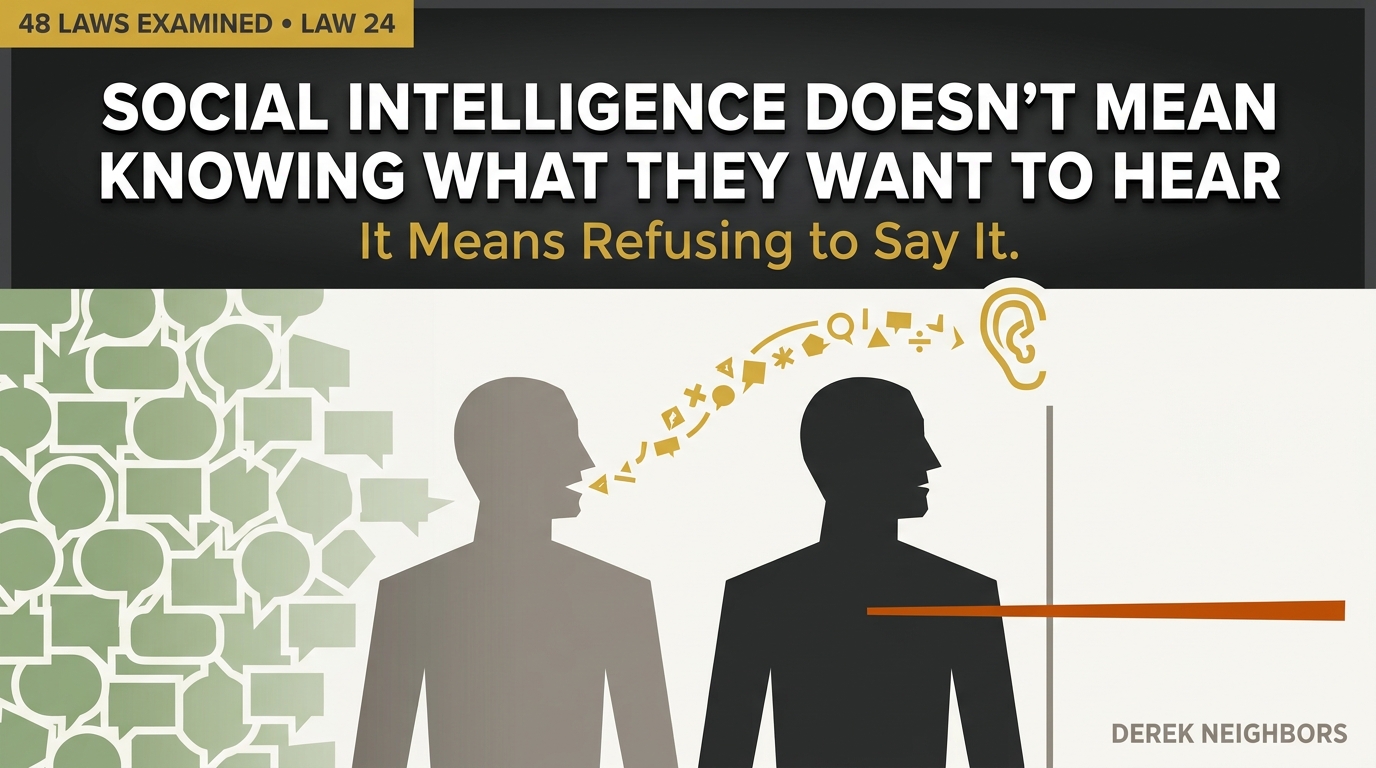
Social Intelligence Doesn't Mean Knowing What They Want to Hear. It Means Refusing to Say It.
By Derek Neighbors on June 18, 2026
Power vs. Virtue: The 48 Laws Examined
A year-long examination of Robert Greene's 48 Laws of Power through the lens of ancient virtue ethics. Some laws we affirm, some we reframe, some we reject entirely.
The Law
Law 24: “Play the Perfect Courtier”
Robert Greene’s instruction: Master the rules of the court. Learn indirection. Deflect ego collisions. Make your superiors look good. Never outshine. Never deliver bad news directly. Flatter without obvious flattery. Become so smooth at navigating social dynamics that your navigation itself becomes invisible.
The courtier archetype succeeds by reading and serving the preferences of those in power. Truth and directness get subordinated to social harmony and self-advancement.
The Tactical Truth
The observation underneath is real. Social environments have rules. Ignoring those rules is expensive. The executive who blunders into political dynamics without reading them gets eaten. The new hire who speaks truth to power on day three rarely survives to day thirty. Organizations run on relationships, and relationships respond to social skill.
Greene is right that social facility matters. Many idealists fail because they treat politics as beneath them. You cannot change a system you do not understand. You cannot understand a system you refuse to navigate.
The tactical kernel: learn the game. Know what people want to hear. Understand what moves the room. This is not optional for effectiveness.
The Character Cost
The problem is what Greene tells you to do with that knowledge. Perform. Become so skilled at indirection that you never have to deliver an uncomfortable truth directly. Make flattery your default operating mode.
The Greeks named this: kolakeia. Flattery. They treated it as a corruption of genuine friendship and a danger to the soul of both the flatterer and the flattered.
The flatterer loses access to their own judgment. When your default is to say what people want to hear, you train yourself to suppress your actual assessment. The faculty you use to perform for others is the same faculty you use to see clearly. Use it long enough for performance and it stops functioning for perception. You become skilled at reading the room and incapable of trusting your own read.
The flattered lose access to truth. Leaders surrounded by courtiers become blind. They think they are making good decisions because everyone agrees. They are actually making isolated decisions because no one dares disagree. The courtier who flatters for advancement does not serve the leader they flatter. They starve them of the information they need to lead.
Frank speech dies. In environments dominated by courtiers, the person willing to speak truth becomes the threat. They expose the hollowness of the agreement everyone else performs. The courtier system expels truth-tellers because truth-telling reveals that the consensus was never real.
The end state: the room can recite the preferred script while truth has no remaining speaker. The organization runs on performed agreement. Real problems fester because naming them would break the spell.
The ARETE Alternative
The alternative is not social ignorance. It is not blundering into every room saying whatever you think. It is not mistaking rudeness for honesty.
The alternative is charis: grace, charm, social facility rooted in genuine goodwill rather than calculated performance. Someone with charis reads the room. They understand what people want to hear. And then they deploy parrhesia, frank speech, when it matters. They say what needs to be said because it serves the person hearing it, not because it serves their own position.
The distinction is simple. Kolakeia says what they want to hear to gain advantage. charis says what they need to hear because it serves them.
Both require social intelligence. Both require reading the room. The difference is the purpose. The flatterer optimizes for their own position. The person with genuine social grace optimizes for the flourishing of the relationship and the work.
Practical markers help clarify which one you are practicing:
Can you deliver hard feedback with genuine care for the person hearing it? Do people come to you when they need the truth, even when it is uncomfortable? When you disagree with power, do you find a way to say so, or do you perform agreement? Is your social skill in service of the work or in service of your position?
Ancient Wisdom
The Greeks did not condemn social skill. They valued charis and expected leaders to have it. What they condemned was the corruption of social skill into performance.
Aristotle in the Nicomachean Ethics distinguishes the flatterer from the friend who speaks truth: the flatterer praises to please, and the friend praises to benefit. The words can match. The purpose decides whether praise serves the friend or the flatterer.
Plato’s Gorgias treats kolakeia as one of the imitative pseudo-arts that mimics real skill while producing harm. Flattery imitates friendship the way cosmetics imitate health. It looks like care. It functions as manipulation. The receiver cannot tell the difference in the moment. The damage accumulates over time.
The Stoics added parrhesia as the counter-virtue: the willingness to speak frankly even when it costs you. Epictetus treats frank speech as a duty, not a risk to be managed. The person who withholds truth to preserve position has already lost what matters. They have traded their integrity for comfort they will eventually lose anyway.
Marcus Aurelius writes: “Do not be driven this way and that, but always be guided by what is right.” The courtier is driven by the room. The person of character is guided by what is right, then navigates the room accordingly.
The Test
Here is the diagnostic.
In the last month, have you said something true to someone with power over you, knowing it was not what they wanted to hear?
If yes, you have parrhesia. You are using social skill in service of truth.
If you cannot remember a single instance, ask yourself why. Is it because you genuinely agreed with everything? Or is it because disagreement felt too expensive?
The perfect courtier never has to answer that question. They have trained themselves not to ask it.
Final Thoughts
Law 24 contains genuine wisdom about social dynamics. The error is in treating flattery as the response to that wisdom. Kolakeia works in the short term. It costs everything in the long term: your judgment, your relationships, and the organizations that depend on hearing truth.
The alternative is charis deployed with courage. Read the room. Understand what people want to hear. And then say what they need to hear, with care and genuine goodwill, when the work requires it.
The gap between knowing what people want to hear and refusing to say it is where leadership actually lives.
If you are ready to build the kind of character that speaks truth when it costs something, MasteryLab provides the framework and community for people who are done performing and ready to lead.