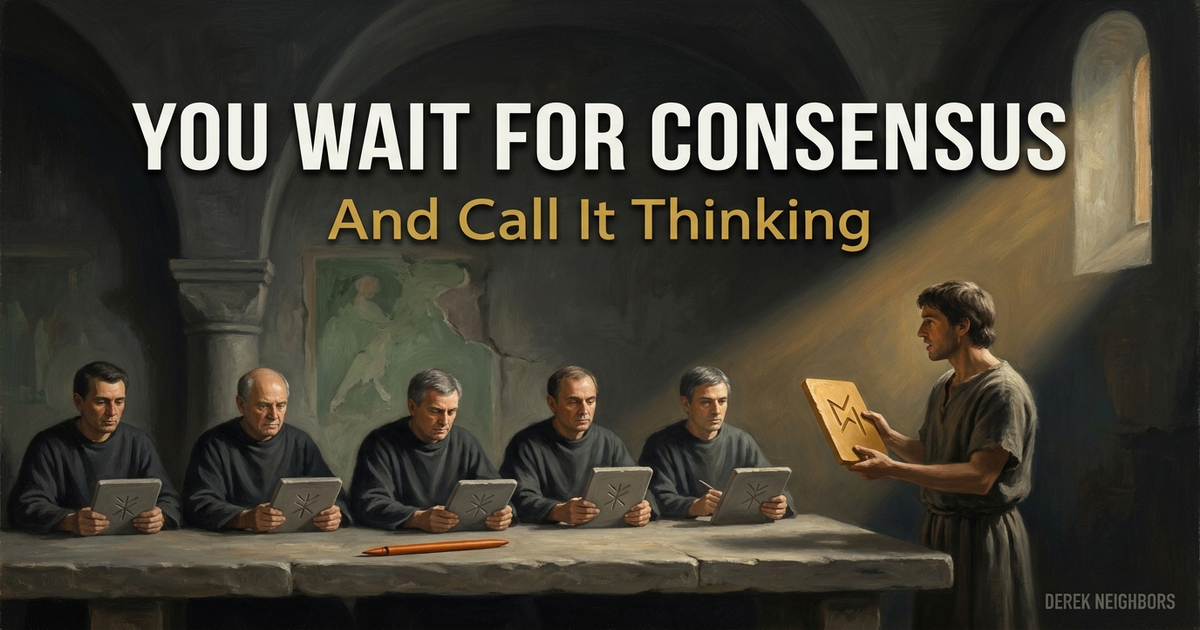
You Wait for Consensus and Call It Thinking
By Derek Neighbors on August 22, 2026
We were in a product review that had already decided to keep a line nobody used. I had the sentence in my notes: kill it, move the engineers to the replacement. Two other directors had the same sentence. Nobody said it. We funded another year.
A competitor shipped the replacement in April. In May the room aligned. The alignment was cheap because the market had already voted.
I keep seeing this in rooms that pride themselves on being collaborative. The original thought is already present. What is missing is the person willing to say it while it can still lose.
You owe that sentence in the room you already occupy. A standup, a 1:1, or a design critique still counts. Missing a director seat limits which roadmap you can kill. It does not cancel the blocked-dependency sentence, the hire name, or the “this will break Friday” line. arete here is the disposition of putting a true new claim into shared speech. The staff meeting is one instrument. The excellence is the completed thought in common.
Path A: Consensus First
Path A looks like respect. You wait for language the room already has. You wait for two other people to nod. You wait for the VP to float the idea so you can build on it.
What you actually do is poll. You take a thought that would change the work and you hold it until it is safe. By then it is a remix of what everyone already suspected.
I have done this as the person hired to tell the truth and as the person with the title. I told myself I was protecting other people’s political capital. I was buying cover. The thought arrived after it could matter.
Safe remixes feel like thinking because they use the same words as thinking, option and alignment, while they stay copies of the current slide with a polite question mark.
The Greeks called imitation mimesis. Aristotle said we learn by copying worthy models. That is a real path to craft. Path A copies the room’s current map and treats the copy as a contribution, so judgment never gets practiced. You stay second on purpose.
Path B: First Public
Path B is uglier in the moment. You say the sentence while the room still treats the old model as the law. You look early. You look reckless. Someone asks if you have data. You often do not have the data they want, because the data they want is last year’s category.
Keep it to one clear claim, said early, that can be wrong. A pile of half-formed takes is a different failure, and it trains the room to stop listening.
I have paid this tax. I once told a leadership team their platform was a folder of scripts with a nicer name. The room went quiet in the way rooms go quiet when you have named the thing they were protecting. Two people later thanked me in the hallway. The hallway is where consensus hides when it does not want a first speaker.
parrhesia is frank speech that accepts the cost. See parrhesia. doxa is the reputation you are trying to keep clean. Path B spends a little doxa on purpose so the work can move.
andreia here is being first with a thought the room does not yet have a word for. That costs more than charging a hill you already named.
You do not control whether they accept it. You control whether the true claim gets said while it can still lose, and whether you own it after. The nod, the hallway thanks, and the title’s mood are outside that.
What Both Paths Share
Both can look like good citizenship. Path A waits so nobody feels ambushed, and Path B speaks so the work does not stall. The shared failure is treating the staff meeting as the birthplace of the thought. The thought was born earlier, usually on a walk or a customer call. The meeting is where you either pay the first-speaker tax or you keep your reputation as the reasonable one.
The inner-critic piece on this site is about editing while you create, in private. Idea assassins is about other people killing a spark. Stop explaining the move is about acting before you brief the jury. This piece is narrower. You already have the thought. You are waiting for a vote so you never have to be the person who looked wrong in public.
Fear’s question still shows up here. It asks whether the cost is worth it. The cost it means is your face in the room. The cost it hides is a year of work the market later makes obvious.
The Real Difference
The difference is who pays for being early.
In Path A, nobody in the room pays. The market pays later. The team pays in a wasted year. You keep the reputation of the reasonable one.
In Path B, you pay in the room. You might be wrong. phronesis is what keeps this from becoming noise. You do not dump every half-formed take. You pick the one claim that would change the next quarter if it were true, and you put it on the table before the slide has a box for it.
kainotomia is making-new. See kainotomia. Aristotle used the word for a new arrangement in a constitution, and he was often suspicious of it. New arrangements look like instability. That suspicion is still in your staff meeting. The room flinches at a new claim because new claims rearrange who was right last quarter. Novelty for its own sake is a different vice. The work is saying a true new claim before the room has language, then letting judgment decide whether a vote is owed.
The unused line was already failing. Silence did not create that failure. It delayed the sentence that would have stopped funding it. A flight-safety sign-off, a drug-label change, or a plant lockout still needs a real vote. Taste and zombie product lines do not get to borrow that vote.
The staff meeting is an instrument. What matters is the true new claim made common while it can still lose. A 1:1 or a written sentence before the meeting can carry the same work. The prize is that claim in the open, not the sport of speaking first.
If you cannot defend the claim once you have said it, you were repeating someone else’s sentence. Own the sentence or keep it off the table.
How You Practice
Say the sentence in the room before the slide has a heading for it. One sentence, not a deck. If you need a paragraph, you are still campaigning.
Name when a vote is owed. Safety, legal, a cut that lands on people who cannot answer. Say this needs a vote out loud so the dodge cannot borrow that language for a taste call.
Audit last week’s comments. How many were remixes of the existing slide? How many were a claim the room did not already have words for? If the list of new claims is empty, you polled.
Rotate first speaker. If the same VP always opens, the room is trained to wait. Make the person closest to the work speak first, before the title speaks.
Pay the hallway tax in the room. If you will thank someone later for saying it, say it yourself while it can still lose.
None of this says skip agreement. The mean is a first speaker plus a vote when a vote is owed. The excess is a new take every ten minutes so nobody can plan. The deficiency is a room that only speaks after the outcome is safe.
Headcount and title do not grant arete. They often make first speech more expensive, which is why people with titles get so good at Path A. A junior in standup still owes the sentence. A title does not buy a pass.
Final Thoughts
Consensus is a tool. It is a poor substitute for a first speaker. Original work starts as a sentence that can still fail in public. Wait for the room to already agree and the original work is already gone. You spent the meeting staying safe.
Say the sentence. Let the vote come after, and only when a vote is actually owed.
If you want a community that will hear a new claim before it is safe, MasteryLab is where people practice first speech in public.
FAQ
Is waiting for consensus always a dodge?
No. Safety, legal, and a change that lands on people who cannot answer still need a vote. Taste, product direction, and the sentence that would kill an unused line do not get to borrow that rule. If you cannot name why a vote is owed, you are polling so you never have to be first.
What is kainotomia in Greek philosophy?
Kainotomia is making-new. Aristotle used it for constitutional innovation and often treated it with suspicion, because a new arrangement rearranges status. The staff-meeting flinch at a new claim is the same old fear. Novelty for its own sake is a different vice. The work is saying a true new claim before the room has language.
How is this different from brainstorming or speaking up more?
Brainstorming collects volume. This is one clear claim, said early, that can be wrong. Speaking up more can still be remixing the slide. The test is whether you said something the room did not already have a heading for, while the old model still looked like the law.
How do you practice being the first speaker without becoming noise?
Pick the one sentence that would change the next quarter if it were true. Say it before the slide has a box for it. Name out loud when a vote is actually owed. Audit last week’s comments for remixes versus new claims. Rotate who speaks first so the title does not open every time.