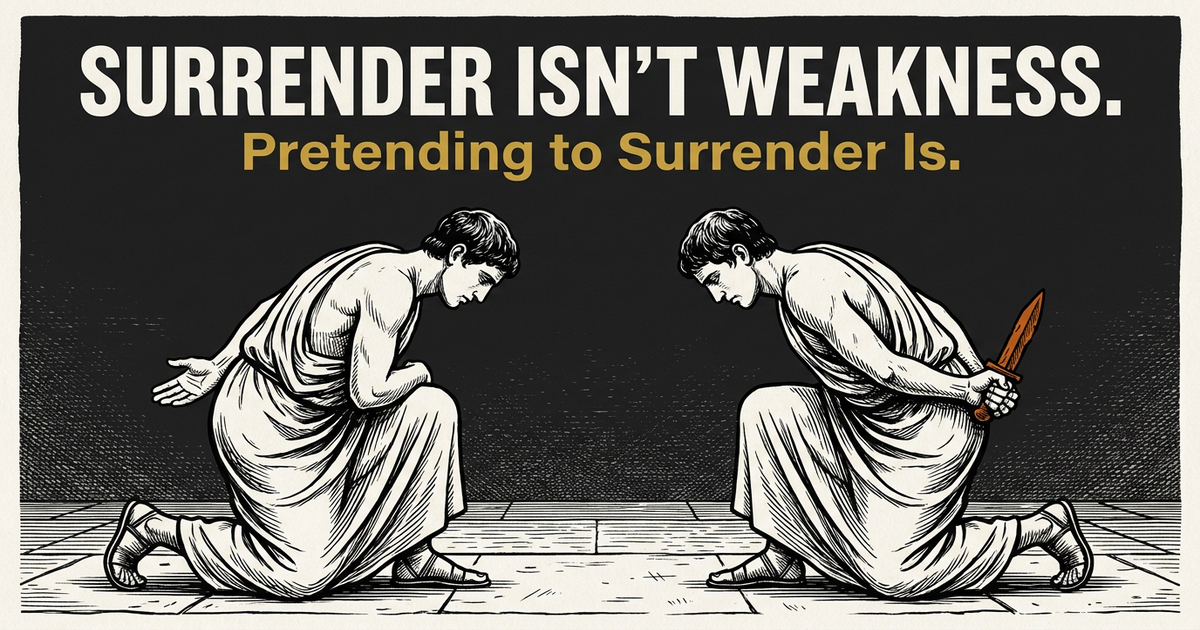
Surrender Isn't Weakness. Pretending to Surrender Is.
By Derek Neighbors on June 2, 2026
Power vs. Virtue: The 48 Laws Examined
A year-long examination of Robert Greene's 48 Laws of Power through the lens of ancient virtue ethics. Some laws we affirm, some we reframe, some we reject entirely.
There is a person in almost every contested room who has perfected the art of looking like they surrendered. They concede the small point. They defer in the meeting. They smile while the louder voice claims the territory. Everyone reads the gesture as character. Some of them are right. Most of them are not.
Years in, you start to notice the temperature of the smile is slightly off. The concessions did not actually concede anything. Every yield was a wind-up. Every step back was positioning. The person you watched lose every round was running the room the whole time, and the people who trusted the surface of the gestures are still trying to understand why nothing they thought was settled stayed settled.
This is the bill on Robert Greene’s twenty-second law. The bill is paid first by the audience, in trust, and then by the performer, in something more expensive than trust.
The Law
Greene’s Law 22 is “Use the Surrender Tactic: Transform Weakness into Power.” His framing: when you are weaker than your opponent, never fight for honor’s sake. Choose surrender instead. Surrender gives you time to recover, time to plot, time to wait for your moment. It also disorients the stronger party, who came expecting resistance and got compliance. The position of seeming defeat is the position from which the real counter-stroke is launched.
The case studies are familiar. Mao yielding to Chiang Kai-shek for years before the regime turned over. Talleyrand surviving every regime in France by appearing to bow with each new master. The tactical concession that buys the strategic kill. Greene treats the appearance of surrender as a sophisticated instrument of power, and the actual stance of yielding as the trap into which the stronger party walks.
The Tactical Truth
I will give Greene the kernel cleanly before I take everything else away.
Fighting every battle for the sake of honor is one of the most reliable ways to lose a life. The person who has to win every visible round burns the fuel needed for the rounds that actually decide anything. phronesis, practical wisdom, includes a brutally important sub-skill: knowing which fights are worth your character and which fights yielding to is the more powerful move.
A real concession can do work no aggression can do. It can defuse a confrontation that would have cost both sides more than the issue was worth. It can redirect the energy of an opponent. It can preserve a relationship that would have broken on the rocks of one rigid stance. It can buy the time needed to see whether the thing you were fighting for actually mattered.
The Stoics were unsentimental about this. Epictetus and Marcus Aurelius both treated the willingness to yield externally as a sign of inner strength, not weakness, provided the yielding was real and the territory inside was protected. The faculty that mattered (prohairesis) was held back. The external thing went.
So the gesture itself is not Greene’s invention, and the gesture itself is not the problem. Humans have known about strategic yielding for as long as there have been losing positions. The law tips somewhere precise. The hinge, as it was with Law 21, is the telos, the end the yielding serves.
The Character Cost
Three escalating costs. Same shape as the bill on Law 21, because both laws teach the same operating system in slightly different clothes.
First, the surrender becomes performance, and performance becomes hypokrisis. The Greek word for an actor was hypokritēs, the one who delivers a part on stage. The word’s journey into English as “hypocrite” is the whole story of what happens when the stage gets confused for the room. A single tactical yield is a move you make. A career of tactical yields, every concession privately marked as a wind-up, is a posture you become. You meant to perform the loser. After enough years, the performance has trained the performer, and you no longer have an honest yielding move available even when honest yielding is what the moment requires. The instrument has been bent into one shape, and the bent instrument is the only one your hand knows.
Second, you bankrupt pistis. The Greeks treated trust as a form of social capital that the community deposits in a person based on the legibility of their gestures. When a person yields, the community reads it as a real concession and adjusts. Run Greene’s law for a decade and the people around you learn the shape of your moves. Your future concessions, the real ones, get read as setups. The people you most need to take a real yield from you, a spouse, a partner, a board member, a peer, will read every step back as positioning. You have made it impossible for yourself to ever again make an unguarded gesture, because you taught the audience that every gesture was strategy. The currency you traded for short-term advantage is the only currency on which deep relationships actually run, and you cannot replace it once it is gone.
Third, and worst, you corrode the prohairesis itself. This is the Stoic warning, and it is the one most readers will skip past at first reading. prohairesis is the faculty of moral choice, the one place where the Stoics said character actually lives. When you build a habit where every external position is provisional, when every concession is privately filed as bait, the inner faculty itself slowly stops being a faculty and becomes a back office of the performance. You wanted to keep the inside protected by yielding on the outside. You used the inside, instead, to administer the lie. The thing you were trying to preserve became the thing you spent.
The ARETE Alternative
The alternative is not the opposite extreme. The opposite extreme is the person who refuses to yield to anyone on anything, who treats every disagreement as a duel and every loss as humiliation. He is not preserving his character either. He is being eaten by it. Pride that cannot yield is another version of hypokrisis in a different costume. He is performing strength to himself, and the performance has the same long-term cost.
The arete path is sophrosyne applied to the gesture of yielding. sophrosyne is restraint that does not need to win the room. It is the trained capacity to ask, in real time, whether this particular fight is worth what it would take from your character to win it, and to step back if the answer is no. The yield is real. The yield does not have a counter-trap inside it.
There is a Stoic distinction that does most of the work here. The Stoics taught that you yield externally to preserve internally. You let go of the externals you do not control so that the prohairesis, the one thing you do control, stays clear and unobligated. The Greek word enkrateia, the related virtue of inner mastery, is the upstream version of the same idea. You yield the small things so that the big thing, the faculty itself, never gets tied up in a fight that does not matter.
The diagnostic that separates the two yieldings is brutally simple. sophrosyne yielding is yielding you can name out loud, to the person you yielded to, without losing anything by naming it. “I stepped back from that fight because it was not worth what it would have cost.” That sentence is a complete statement of the move. The other yielding, the hypokrisis version, cannot survive being named. The yielder must keep the telos concealed or the move stops working. That is the line. One yielding leaves the room. The other yielding moves to the next room with its mask still on.
Ancient Wisdom
It is worth sitting with what the Stoics meant when they used the language of yielding, because the modern reader assumes “Stoic” means “endure with a stone face.” It does not.
Marcus Aurelius, Meditations IV.23: “Whatever the universe gives me to bear, I will bear it willingly.” This is yielding. It is also, simultaneously, the highest possible refusal to be moved on the only territory that matters. He yields what he cannot control. He does not yield the prohairesis. The two moves are inseparable. The yielding outside is the protection of the not-yielding inside.
Epictetus, Discourses I.1: “Of all things some are in our power, others are not in our power.” The whole architecture of Stoic surrender rests on this dichotomy. You concede the external course early and without drama, because you were never going to control it. You hold the inner faculty inviolate, because that is where character is made.
This is the opposite of Greene’s tactic, and it sits right next to the operating logic of the prohairesis paradox we examined in Law 1’s adjacent territory. Greene’s reader concedes the external in order to control it later by indirection. The Stoic concedes the external because controlling it was never the point. One yields to perform power. The other yields to be free of needing to. Same word, opposite telos. The pattern keeps repeating because the temptation keeps reappearing, and because the surface gesture is so close to indistinguishable that even the people running the wrong version can talk themselves into believing they are running the right one.
The Test
Run this when you catch yourself yielding on something that matters.
Stop and ask: would I tell the person I yielded to, in plain words, what I yielded for? Could I look at them and say the actual reason out loud?
If the answer is yes, “I stepped back from this because it was not worth what it would have taken to win,” “I conceded this point because you are right on the substance,” “I let this go because the relationship is more important than the issue,” you are practicing sophrosyne, and you owe no one an apology. The yielding is honest. The prohairesis is intact.
If the answer is no, if the gesture only works as long as the reason is concealed, you are running Greene’s law, and the bill is accruing. aletheia, truth as unconcealment, is the test. What survives being said out loud is the move. What needs to stay hidden to function is the con.
The room cannot tell the two yieldings apart in real time. The yielder always can. That is the only diagnostic that has ever mattered, and it is the one you can run on yourself in five seconds once you decide to.
Final Thoughts
The kernel of Law 22 is worth keeping. Do not fight every battle for honor’s sake. Concede small ground when conceding it preserves the larger thing. The willingness to yield is part of the equipment of any mature phronesis. The Greeks would have endorsed it. The Stoics built a whole discipline on it.
The full law is a different animal. It is the deliberate, sustained manufacture of false yielding for the purpose of springing a counter-trap, and the longer you run it, the less of you is left to spring anything with. You set out to win the long game by losing the short ones. You wake up in middle age the person nobody believes when they yield, the person whose concessions are read as positioning whether or not they are, and the person whose own inner faculty has been spent administering the deception. The mask was supposed to protect what was underneath. The mask, run long enough, becomes what is underneath.
Yield when yielding is right. Tell the person you yielded to, in plain words, what you yielded for. The two together are not weakness. They are arete.
Excellence requires the courage to yield without performance, not the cleverness to stage defeat. MasteryLab.co is where leaders trade the tactical mask for the developed self.