Character Isn't What You Post. It's What You Practice.
By Derek Neighbors on December 1, 2025
I caught myself drafting a LinkedIn post about integrity while simultaneously ignoring an email I didn’t want to deal with.
The post was going to be good. Thoughtful. Something about keeping commitments even when they’re hard. The kind of content that gets saved and reshared.
And there I was, avoiding a small commitment because it was inconvenient. Not even a hard one. Just boring. The irony didn’t hit immediately. I was three sentences into the post before I noticed what I was doing.
Performing the virtue. Dodging the practice. Breaking the integrity loop in real time.
I deleted the draft. Answered the email. And sat with the uncomfortable recognition that I’d been about to broadcast something I wasn’t living.
This wasn’t the first time. It wasn’t even the tenth. I’ve written about discipline while procrastinating. Talked about presence while distracted. Posted about authenticity while curating my image.
The gap between what we signal and what we practice is where character lives. Or dies. A brutal honesty test would expose that gap in minutes.
The Modern Confusion
We’ve built an entire culture around visible virtue. Personal brands. Thought leadership. Values on display. Every platform optimized for showing people who we are instead of requiring us to be anything.
This seems efficient. Why practice in obscurity when you can perform for thousands? Why do the hard work of character formation when you can post about it instead?
The Greeks had a word for this confusion: doxa. Opinion. Appearance. What seems to be rather than what is.
Aristotle distinguished doxa from aletheia, truth. He understood that character, what he called ethos, the stable disposition toward virtue, isn’t revealed through declarations. It’s revealed through habitual action. “We are what we repeatedly do” wasn’t a motivational poster. It was a diagnostic.
The pattern of your actual behavior over time. That’s character. Not the positions you take publicly. Not the values you claim. Not the carefully crafted narrative. The pattern of what you actually do when no one’s watching, when it’s inconvenient, when you could get away with less.
That pattern is the truth. Everything else is performance.
The Avoidance Patterns
Watch what happens when character becomes content:
The person who posts constantly about authentic leadership while their team describes a different reality behind closed doors. Every LinkedIn article about transparency. Every podcast appearance talking about trust. Meanwhile, the people who actually work with them tell a different story in private. The public character and the practiced character have nothing in common.
The “vulnerable” post that went through five drafts and a strategist. Real vulnerability is messy, unpolished, badly timed. It doesn’t come with engagement metrics. When vulnerability becomes content, it stops being vulnerability. It’s manufacturing authenticity, which is still manufacturing.
The highlight reel human who shares every win and hides every failure. Growth metrics without the burned relationships. Success stories without the costs. The version that gets posted bears no resemblance to what actually happened. Success theater requires hiding the full picture, and hiding the full picture requires constant energy that could go toward actually building something.
The values collector who treats principles like trophies. “Integrity” on the wall. “Excellence” in the email signature. “Character first” in the bio. Then the corners get cut when no one’s looking. The client gets overcharged. The employee gets undervalued. The values on display exist separately from the values in practice.
The Greeks called this the difference between doxa and aletheia. Chasing how you appear rather than what you are. Building a reputation instead of building character.
The pattern holds: more posts about integrity, less actual integrity. More content about values, less practice of values. The energy goes into curation instead of cultivation.
Why This Happens
Performance is easier than practice.
Posting about a virtue takes minutes. Practicing it takes years. The post gets immediate feedback: likes, comments, reshares, the dopamine hit of visible approval. None of that is bad. It’s just irrelevant to virtue. The practice gets nothing external. No applause for keeping your word when it’s inconvenient. No engagement metrics for treating people well when no one’s watching.
The economics favor performance. You can build an audience around performed virtue faster than you can build character through practiced virtue. The platforms reward visibility, not reality. The incentives are backwards.
But here’s what the Greeks understood: practiced virtue compounds into hexis, a stable disposition that becomes identity. Performed virtue evaporates. And virtue is owed regardless of whether it compounds. Epictetus was a slave. Marcus Aurelius was an emperor. Neither circumstance excused or demanded the pursuit of virtue. Both owed it equally. So do you.
When you practice character in private, it becomes habitual. It becomes who you are. You don’t have to decide to act with integrity in a crisis because integrity has become your default mode. The practice created the pattern, and the pattern determines the response when it matters.
When you perform character in public, nothing changes inside. The performance ends when the camera turns off. The audience goes away, and so does the virtue. There’s no pattern, just episodes. No character, just content.
The Stoics called this parrhesia, fearless speech and radical honesty, versus rehearsed transparency. One requires courage. The other requires a marketing calendar.
What Actually Works
Your character is being built right now. In the moments no one will ever see. The private choice. The small integrity. The standard you hold when it would be easier not to.
Marcus Aurelius wrote the Meditations for himself. Not for publication. Not for an audience. Private philosophical practice, working through his own failures and aspirations where no one would ever see. That kind of honest self-reckoning is closer to forgiveness than performance. The most powerful work on character in Western history was never meant to be content.
But Marcus also ruled an empire. His public actions mattered. The difference: his public leadership flowed from decades of private practice, not the reverse. The private work preceded and sustained the public expression. That’s the model. Not silence, but sequence. Character work happens in darkness first.
Here’s what shifts when you stop performing and start practicing:
The Private Audit. For one week, notice the gap between your public statements and private actions. No judgment, just awareness. Where do they diverge? What do you post about that you don’t actually practice? What values do you signal that your daily behavior contradicts?
The Audience Question. Before any value-signaling post, ask: “Am I doing this to show people, or am I doing this because I’m already doing it?” If you wouldn’t practice the virtue without the audience, you shouldn’t post about it. The post should be a byproduct of the practice, not a substitute for it.
The Invisible Standard. Choose one character trait to practice with zero public acknowledgment. Do it for a month. No posts, no hints, no humble references. Just the practice. Notice what happens when no one’s watching or applauding. Notice how hard it is to do good without telling anyone.
The Integration Test. Your posted character and practiced character should be indistinguishable. Not because you post less, but because you practice more. The goal isn’t silence. It’s alignment.
One caution: private practice without external check can become private self-deception. Socrates insisted on dialogue because we’re often wrong about ourselves. The point isn’t isolation. It’s ensuring your public expression flows from genuine habit rather than substituting for it. Community and trusted others still matter. They just shouldn’t be your audience.
The Diagnostic
Ask yourself:
What would people who only see your posts think about you versus people who live with you? If those two groups would describe different people, you know where the work is.
Which character trait do you post about most that you practice least? That’s your gap. That’s where performance is substituting for practice.
If no one ever saw your good actions, would you still do them? The honest answer reveals whether you’re building character or building a brand.
What do you do when you’re alone that contradicts what you claim in public? Everyone has these. The question is whether you’re working on them or hiding them.
Who’s the audience for your character? If it’s the internet, you’re performing. If it’s your conscience, you’re practicing.
The Challenge
This week, practice one virtue with absolutely zero public acknowledgment.
Pick something specific. Patience. Generosity. Integrity. Presence. Then practice it without telling anyone. No posts, no stories, no casual mentions in conversation. Just the practice.
You will feel the urge to signal, to share, to get credit for the good you’re doing. That urge reveals how much of your “character” is actually performance. How much of your virtue depends on an audience.
Character must be rooted in private practice. The test isn’t whether virtue is ever expressed publicly. It’s whether that expression flows from genuine habit or manufactured performance.
Final Thoughts
This isn’t about strategy. It’s about what you owe your own capacity for excellence. The boring truth about excellence is that it compounds through invisible daily choices, not viral posts. Even when it costs everything. Especially then.
Aristotle understood that ethos isn’t what you claim. It’s the sum of habitual actions. The pattern of your actual behavior over time. Not the highlight reel. Not the curated narrative. The pattern.
The Stoics practiced virtue precisely because it would never be seen. They understood that public virtue is suspect. Anyone can be good with an audience. The test is what you do in the dark, because excellence is rented, not owned, and the rent comes due when no one is watching.
Stop performing character for strangers. Start practicing character for yourself.
The person you’re building in private, in the small choices no one photographs, in the moments of integrity that will never be content, that’s the person who shows up when the lights come on and the stakes are real.
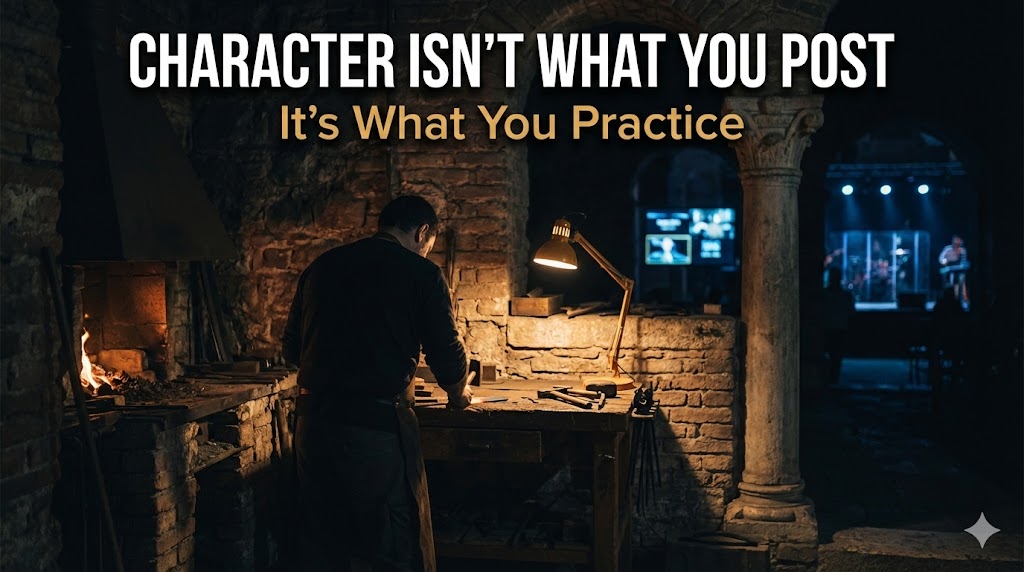
Character isn’t what you post. It’s what you practice.
Ready to build character that doesn’t require an audience? MasteryLab provides frameworks and community for people who are done performing excellence and ready to practice it.