Polish Got Cheap. That's Why Trust Got Expensive.
By Derek Neighbors on July 1, 2026
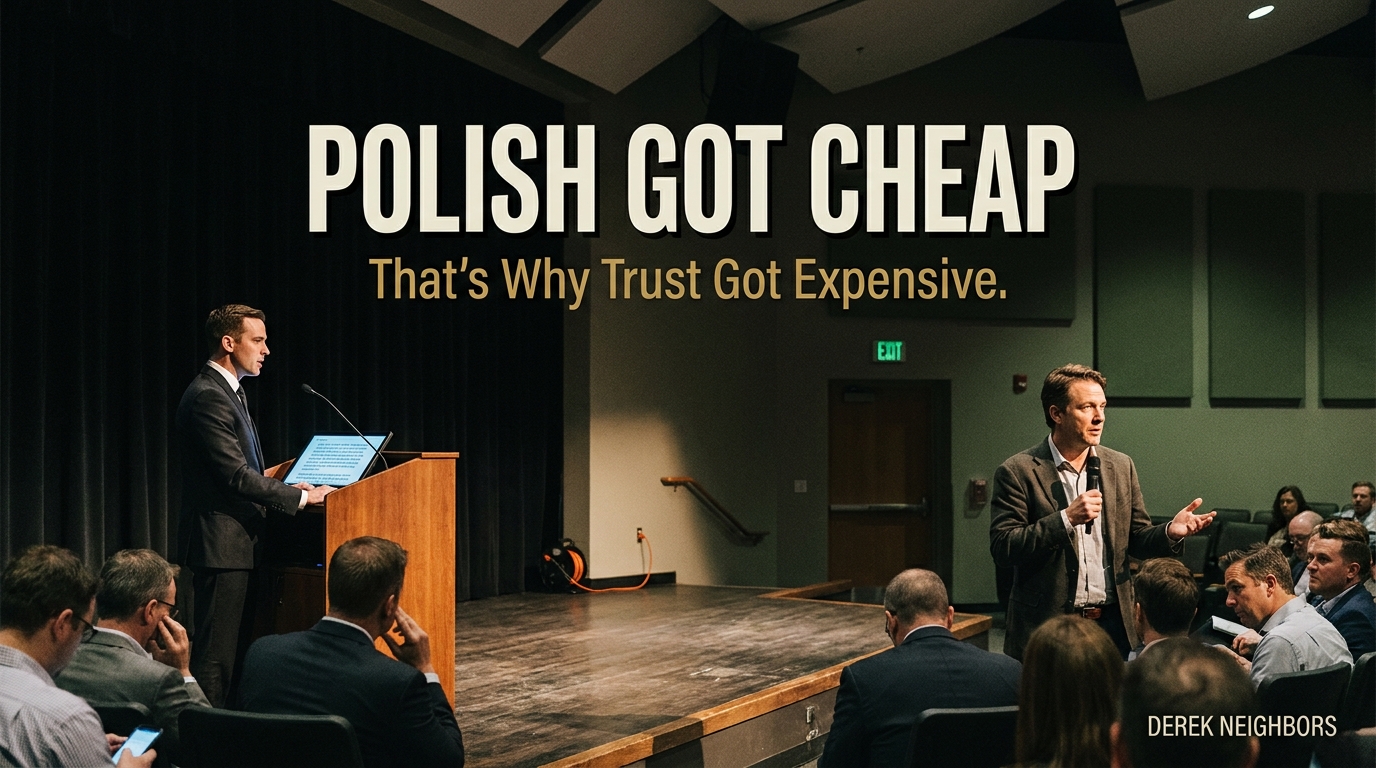
The CEO reads the apology like a man who did not write it.
Every sentence balanced. Every clause symmetrical. The cadence of someone who has been coached within an inch of his life. On paper, it is impeccable. In the room, it lands like a press release with a pulse.
Nobody throws a chair. That would be easier. The room goes quiet in the specific way rooms go when people stop believing the person at the podium is the person who decided anything.
We were taught the opposite rule. Polish meant preparation. Preparation meant respect. A well-crafted statement meant someone sat with the weight long enough to find the right words. Fluency was a proxy for care.
That proxy just broke.
The Paradox Nobody Planned For
Here is the contradiction that is confusing leaders right now.
More polish should increase credibility. Cleaner language should signal competence. Better rhetoric should build trust.
Instead, the most fluent statements in the most important moments are often the least trusted.
The mechanism is economic. The principle underneath it is not, and it is not new. Credibility was never only about being right. It was also about paying visible cost. Time. Risk. Exposure. The chance of saying the wrong thing in public and having to own it. Trust has always tracked the real state of a person more than the polish of the words. AI did not create that law. It only made it impossible to keep ignoring.
For most of history, sounding competent required some of that payment up front. Writing a good apology took hours. Writing a eulogy that did not insult the dead took days. Even a strong internal memo required a human mind to wrestle with tradeoffs until the language stopped lying.
AI removed the cost of sounding right while leaving the cost of being right exactly where it was.
So fluency stopped functioning as proof of care and started functioning as proof of distance. The audience hears: someone generated this, and the person who owes us an answer was not in the room long enough to sound like themselves.
That is the whole paradox. Polish got cheap. Trust got expensive.
What Credibility Was Actually Measuring
The Greeks had a useful split for this. logos meant the account, the speech, the explanation. ergon meant the deed, the work, the thing actually done. Character, Aristotle kept saying, shows up in ergon. logos can be borrowed.
We are living through the moment when logos became trivial to borrow.
The word for stage performance in Greek was hypokrisis. That is where hypocrisy comes from. Not from lying exactly. From playing a part so well the part replaces the person. A flawless script with no performer behind it is not communication. It is theater without an actor, and audiences can feel the empty costume even when they cannot name it.
What they are hungry for instead is closer to aletheia, which people translate as truth but which really means unconcealment. Bringing what is hidden into the open. Credibility in symbolic speech has always attached to unconcealment more than smoothness.
That is why a pause can land harder than a paragraph. Why a corrected sentence can build more pistis than a perfect one. Why the leader who says “I do not know yet, and here is what we are doing while we find out” often passes a test that the leader with the immaculate statement fails.
Presence is the word doing the real work here, so be precise about it. Presence is not merely that you personally produced the words. It is that you bore their cost in view of other people, that you were the one deliberating, risking, and exposed at the moment the words were made. Authorship alone is a signature. Presence is authorship with the cost left visible.
None of this is new in principle. It is new in scale.
Three kinds of speech carry the heaviest load, and all three are getting worse under cheap polish.
Apologies. An apology carries information too, what went wrong and what will change. But that is not the part under test. The audience is checking whether the person who caused the harm will stand in it themselves, not send fluent language to stand there in their place.
Condolences and eulogies. These are not content categories. They are presence categories. The words exist to prove someone showed up.
Strategic reassurance memos. “We hear you.” “We take this seriously.” “Our values guide us.” These fail not because they are polished but because they claim presence while delivering none. A memo that honestly carries information, a product delay or a policy change, can be as polished as you like. A memo that performs a feeling it never paid for cannot. When those lines arrive perfectly balanced and perfectly empty, they read like a system talking to humans about being human.
This is the same structural shift I wrote about in The Gladiators Are Becoming the Emperors, where audiences started rewarding builders who could be verified in real time. Cheap fluency accelerates that filter. The commentator class could survive on logos alone for a long time. Symbolic leadership speech cannot. Not anymore.
Why Live Feels True and Script Feels Hollow
Look at what is winning attention while press-release culture loses it.
Long podcasts where people stumble, restart, and argue. Founders explaining product on camera because nobody else in the building can. Leaders doing live Q&A when a polished statement would let them stay out of reach. Threads where someone crosses out a thought and replaces it with a better one.
None of this wins because messiness is a virtue. It wins because real cost is expensive to fake, and messiness is usually what real cost looks like from the outside. The appearance of struggle will get faked too, the way polish did. What cannot be faked for long is the cost actually paid.
When polish was costly, polish could stand in for presence. Now presence has to show up as presence. Friction is the signal. A visible search for the right word. An admitted limit. A sentence left slightly unguarded because sanding it down would have been dishonest.
That is also why dangerous honesty built on selective truth still works in manipulation, and why cheap fluency fails in repair. The con artist pays in curated truth. The leader pays in exposure. Different currencies. Same market.
There is a related discipline here that people confuse with silence. Costly speech is not fluent speech. parrhesia in the Greek tradition meant frank talk that risked something: status, safety, relationship, career. The credibility came from the risk, not the eloquence.
AI did not invent insincere communication. It industrialized the part that used to require a person to bleed a little on the sentence.
How to Use Tools Without Replacing Yourself
I am not making a luddite case. I use AI constantly. So should you.
Use it for drafts. Use it for research. Use it for structure, translation, compression, and the hundred tasks where the substance matters more than your visible hand in the delivery. The question was never whether the machine can do it. The question is what the doing costs your soul and your credibility when the audience needed you, not a competent paragraph.
Run the symbolic speech test before you send anything high-stakes.
Would the audience feel misled if they learned you did not write this yourself? If yes, your name on it is not enough. Your hand has to be on it.
Does this message transfer presence or information? Quarterly metrics can be information. “We are laying off twelve people in this room” is presence.
Would a flaw make this more believable, not less? If the only version you are willing to release is the one with every edge removed, ask what you are protecting.
Does the audience need your risk or your eloquence? Most leaders pick eloquence because eloquence feels safe. In symbolic moments, safety reads as absence.
That filter is phronesis, practical wisdom, not a ban on tools. It is the discipline of knowing which moments require your rough voice because the roughness is the proof.
Board decks can be polished. Investor updates can be polished. The memo explaining a product delay to the team that built it probably should be polished too, if polish serves clarity.
The layoff conversation with the person in front of you cannot be outsourced to fluency.
The note after a death cannot be.
The apology where you already know the room thinks you are bullshitting them cannot be.
Those are the moments where trust is priced in exposure, and exposure cannot be generated by a model that has nothing to lose.
The Mastery Move
The advanced version of this is not performative vulnerability. People can smell theater from orbit. Staged stumbles are a newer kind of polish.
The mastery move is smaller and harder.
Keep one sentence slightly unguarded because it is true. Admit a limit without turning the limit into a brand. Correct yourself in public when the correction costs you face. Show up live when a statement would let you hide. Repeat small visible costs until people believe you will not outsource the hard parts.
Credibility compounds differently now. Not in the smoothest quarterly letter. In the accumulated evidence that you will stand in the message when the message is costly.
Presence is not a luxury of the secure. The frightened leader and the junior one owe it as much as the confident one, and they usually pay more to give it. Leaders who sound less polished are frequently the ones with nothing to hide about the substance. Leaders who cling to flawless language in symbolic moments are often clinging to distance and calling it professionalism.
The market noticed.
Final Thoughts
We spent decades teaching leaders to sound right. The next decade will belong to leaders who can be seen thinking, seen choosing, seen paying for their words in public.
Polish got cheap. That changed the currency.
Trust now attaches to visible cost: hesitation that could have been edited out, uncertainty disclosed before someone else exposes it, speech that could have embarrassed you and was not sanded away for comfort.
You do not control whether a given room believes you on a given day. You control whether you actually stood in your own words. Do that because it is yours to do, and let the trust catch up on its own time.
Perfect language used to mean someone sat with the weight. In the moments that matter most, the room is listening for proof you still do.
Ready to build credibility that survives contact with reality, not just approval from a prompt? MasteryLab.co is where leaders do the daily work of character under pressure: honest accountability, practice over performance, and community that rewards presence over polish.