Recreate Yourself. Just Don't Mistake the Mask for the Self.
By Derek Neighbors on June 27, 2026
Power vs. Virtue: The 48 Laws Examined
A year-long examination of Robert Greene's 48 Laws of Power through the lens of ancient virtue ethics. Some laws we affirm, some we reframe, some we reject entirely.
The Law
Law 25: “Re-Create Yourself.”
Robert Greene’s instruction: Do not accept the role society hands you. Refuse to be defined by your past or by other people’s expectations. Forge a new identity, one that commands attention and never bores the audience. Take control of your own image instead of letting others assign you one. Be theatrical. Be memorable. Be protean, able to shift your appearance as the situation demands. Become the author of your own persona.
The core promise is real power: stop being a character in someone else’s story and become the deliberate author of your own.
The Tactical Truth
This works, and the part of it that works is worth taking seriously.
Identity is more malleable than most people believe. The role you were handed, the reputation you accumulated by accident, the version of you that calcified in other people’s heads, none of it is fixed. People who passively accept the part assigned to them at twenty-two are often still playing it at fifty, and resenting it the whole time. Greene is right that this is a trap, and right that you can walk out of it.
He is also right that self-presentation carries real weight. First impressions stick. The person who manages how they come across, who controls the frame instead of letting others set it, gets opportunities the equally talented but invisible person never sees. Shedding an old limiting role and stepping into a larger one is a genuine act of power. Anyone who pretends image does not matter has simply lost control of theirs.
So the instinct behind Law 25 is sound. The question is what Greene actually tells you to recreate.
The Character Cost
Read the law closely and you notice what is on the operating table: image, persona, and performance. Greene treats the self as a role to be played for an audience, and the work he assigns is the work of a better costume.
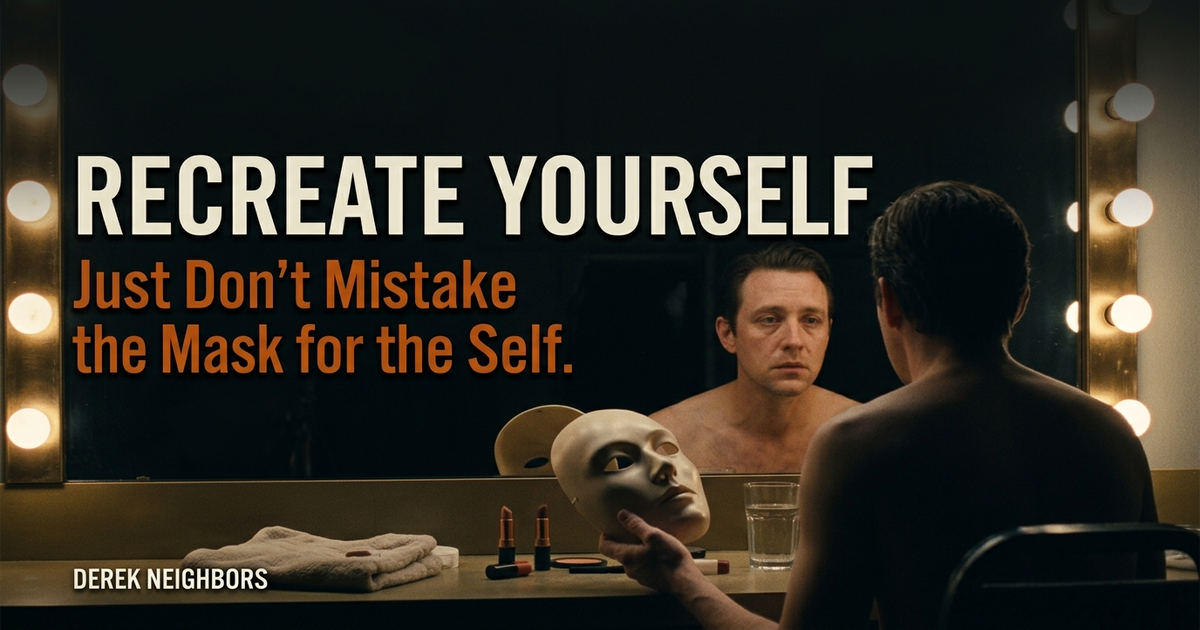
The Greeks had a precise word for the thing you put on to face a crowd. They called it the prosopon, the mask an actor wore on the stage to play a part. The word is worth sitting with, because it later became their ordinary word for “person.” They built the idea of a person on top of the image of a mask, and they never once forgot that the mask is not the one wearing it. Greene’s law erases exactly that line. He does not want you to wear the mask well. He wants you to become it.
That is hypokrisis, the actor’s craft, the root of our word hypocrite. And a mask worn long enough fuses to the face. You get fluent at being perceived and slowly become a stranger to whoever is doing the perceiving. You optimize the surface and starve the substance, because attention rewards the surface and never asks about the rest. The performance is exhausting in a particular way, because it has no intermission. The audience never fully leaves, so you never fully take the mask off, and after a while you are not sure there is a face under there to take it off from.
Then comes the part Greene never mentions. A self assembled for an audience collapses the moment the audience does. The market turns, the followers move on, the room you performed for empties out, and the person who recreated a persona instead of a character is left holding a costume and no one to wear it for. A persona assembled for an audience is a new act, and acts close when the room empties.
The ARETE Alternative
Here is what makes this law worth fighting over instead of simply rejecting: the Greeks believed in self-recreation more than Greene does. They just built it in the opposite direction.
You do not remake the face and hope the substance catches up. You remake the substance and let the face follow. The mechanism has a name. Aristotle called it hexis, a settled disposition formed by repeated action, the way a blade is forged by repeated heat and hammer rather than painted to look sharp. We become just by doing just things, brave by doing brave things, disciplined by doing disciplined things. Character is not declared. It is forged, one rep at a time, until the thing you used to perform becomes the thing you simply are.
That forging happens through askesis, training, and the defining feature of training is that there is no audience for it. The reps that recreate you are done in private, in the unglamorous hours nobody claps for, where there is no image payoff at all. This is the exact inversion of the law. Greene wants you to manage what people see. The forge cares only about what you do when no one is looking, because that is the only place a real disposition gets built.
Aim for metanoia, an actual turning of how you see and act, the kind that changes the person rather than the picture of the person. And it aims at something, at your physis, your own nature, and your telos, the end that is actually yours, rather than at whatever role happens to command the most attention this season. Trend-chasing reinvention swaps one mask for a newer rack.
One honest caution, because this is where the idea gets abused. You can and should steal methods from people further along than you, copy how a master trains and recovers and works. That is apprenticeship. But the moment you start copying who they are instead of how they operate, you are back at the costume rack, building a more impressive prosopon out of borrowed parts. I have made this argument about self-discovery before: method transfers, identity does not.
Ancient Wisdom
The Stoics drew this line harder than anyone, and they drew it using the same theater image Greene uses.
Epictetus told his students to think of themselves as actors in a play. You do not get to choose the part, he said. You get a role assigned by circumstance, short or long, beggar or magistrate, and your only job is to play the part you are given well. It sounds, for a sentence, like an endorsement of the performing life. It is the opposite. The whole force of the metaphor is that the role is external and assigned, while the one who plays it, the prohairesis, the faculty of choice, is never the role. The mask belongs to the stage. The self that wears it belongs to you, and the entire discipline is refusing to confuse the two.
Greene’s Law 25 is the confusion made into a strategy. He tells you to pour your effort into the prosopon and treat the thing underneath as raw material for a better one. The Stoics would say you have it exactly backward. Spend your life perfecting the mask and you wake up one day having misplaced the face. Spend it forging the hexis underneath, and the mask becomes almost unnecessary, because a person of real character does not need to manage the impression of having it. arete, excellence of the actual self, throws its own shadow. The forge produces the thing the facade can only imitate.
The Test
Here is the diagnostic, and it only takes one honest answer.
Imagine the entire audience vanishes tomorrow. No followers, no colleagues watching, no reputation on the line, no one left to impress or convince. How much of who you have “become” would still be standing in that empty room?
The part that remains is the character you forged. It was never for them. The part that evaporates the instant the watching stops was a prosopon all along, and you can stop paying its upkeep. Most people have never run this test, which is why they cannot tell their character from their costume until life empties the theater for them and shows them which was which.
You can recreate yourself. The Greeks would insist on it. Just be certain you are working on the self and not the mask, because only one of the two is still there when the lights go down.
Final Thoughts
Law 25 is built on a true instinct and aimed at the wrong target. Reinvention is real, necessary, and within your power. The error is in recreating the image while leaving the person untouched, which buys you an audience at the price of a self.
The mask is faster. It pays out in attention almost immediately, and it asks nothing of you but maintenance. The forge is slower, costs you comfort, and pays in something the mask can never deliver: a self that holds its shape when no one is watching, because it was built in exactly that condition.
Recreate yourself. Forge the substance, in private, with no one clapping, and let the appearance take care of itself. The mask you can put down. The character you cannot, and would not want to.
If you are done performing a self and ready to forge one, MasteryLab is the framework and the community for people building character in the hours no one is watching.