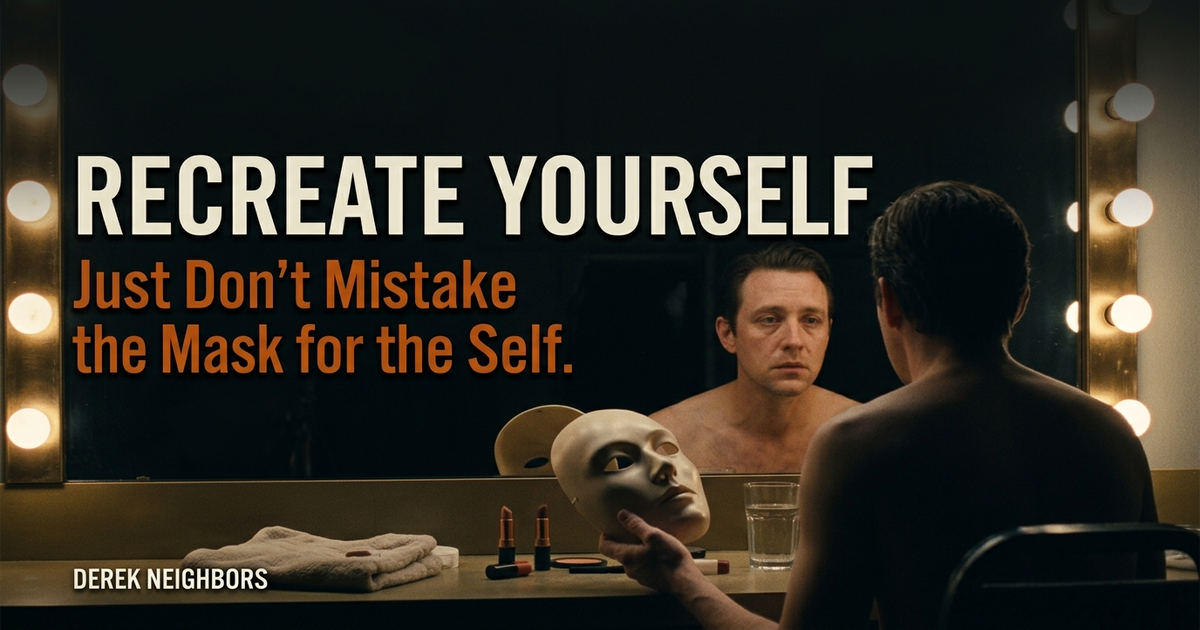
Prosopon (πρόσωπον): Meaning, Definition & Modern Application
PROH-soh-pon
The face, mask, or persona one presents to the world. Originally referring to theatrical masks, it evolved to encompass one's public character, social role, and the interface between inner self and outer presentation.
Etymology
From pros (toward, facing) and ops (eye, face), literally meaning ‘that which is toward the eyes’ or ‘that which faces another.’ The term originated in Greek theater where actors wore masks (prosopa) to portray characters. Over time, it expanded from theatrical mask to face, then to the broader concept of person, personality, and social role. The Romans translated it as persona, which gives us our modern word ‘person.’
Deep Analysis
The concept of prosopon presents a fundamental challenge to modern assumptions about authenticity. Contemporary culture often assumes a ‘true self’ hidden beneath social performances, waiting to be discovered and expressed. The Greek understanding inverts this: the self is constituted through its presentations, not despite them.
In Greek theater, the mask was not a concealment but a revelation. The oversized features of the tragic prosopon made emotions visible to the back rows of the amphitheater. The mask amplified rather than hid. This theatrical origin should inform our understanding: our social roles are not barriers to authenticity but the very medium through which character becomes visible.
Aristotle’s treatment of character in the Nicomachean Ethics illuminates this. Character (ethos) is formed through habituation (hexis). We become courageous by performing courageous acts, just by performing just acts. The performance precedes and creates the inner reality. In this light, the prosopon is not a cover for character but the means of its development. The leader who ‘plays the part’ of a confident decision-maker before feeling confident is not being inauthentic but is engaged in the legitimate process of character formation.
The Stoics, particularly Epictetus, developed this insight through their concept of roles (prosopa in the plural). In the Discourses, Epictetus argues that we have been assigned certain roles: child, sibling, citizen, professional. Wisdom lies in playing these roles excellently while remembering that they are roles. The Stoic does not confuse the mask with the face beneath, nor does she reject the mask as false. She wears it skillfully, knowing it serves a purpose.
This creates a productive tension. On one hand, the mask enables social function. Without agreed-upon roles, cooperation becomes impossible. The mask of ‘manager’ or ‘colleague’ provides scripts that allow coordination without constant negotiation. On the other hand, over-identification with the mask produces what modern psychology calls ‘false self’ pathology. The person who cannot remove the executive mask at dinner cannot access intimacy.
The philosophical challenge is discernment: knowing which mask serves the moment, knowing when to remove it, and maintaining coherence across masks such that they express rather than fragment identity. Plato’s critique of the sophists in dialogues like the Gorgias reveals the danger: those who master mask-wearing (hypokrisis) without grounding in truth (aletheia) become shape-shifters serving only self-interest. The mask becomes the person, with nothing beneath.
Yet Socrates himself was accused of wearing masks. In the Symposium, Alcibiades complains that Socrates presents an exterior of ugliness and irony that conceals inner beauty and seriousness. Socratic eironeia (irony) is itself a kind of mask. The difference is purpose: Socrates’ mask serves inquiry and the other’s development, while the sophist’s mask serves manipulation.
For leadership, this creates a paradox. Leaders must wear masks of confidence when uncertain, calm when anxious, optimism when worried. Yet leaders must also be transparent, vulnerable, authentic. The resolution lies not in choosing one or the other but in understanding that strategic presentation serves those being led. The leader’s mask of calm during crisis is not deception but care. It creates space for others to function. The test is whether the mask serves others or merely protects the self.
The deepest insight of prosopon may be ontological: we are our relationships, our roles, our presentations. There is no homunculus behind the masks pulling strings. The masks go all the way down. Or rather, the masks and what lies beneath are continuously creating each other. This should not provoke despair but recognition: the choice is not between mask and authentic self but between masks that develop character and masks that degrade it.
Modern Application
You navigate multiple roles daily: leader, colleague, mentor, family member. Understanding *prosopon* means recognizing that these roles are not deceptions but necessary interfaces for different contexts. Your task is to ensure coherence across your masks so that each persona serves your authentic purpose rather than fragmenting your identity.
Historical Examples
Pericles of Athens demonstrated masterful use of prosopon across radically different contexts. Thucydides records how Pericles could deliver the soaring idealism of the Funeral Oration, inspiring Athenians with the nobility of their cause, yet also conduct the cold strategic calculations that made the Peloponnesian War strategy possible. With citizens, he wore the mask of democratic champion. With allies, the mask of imperial administrator. With enemies, the mask of implacable resolve. Plutarch notes that Pericles was criticized for this versatility, accused of being different men to different audiences. Yet Plutarch also argues that Pericles maintained a singular purpose across his masks: Athenian greatness. The masks were instruments of that vision, not contradictions of it.
Socrates presents a more complex case. In Plato’s dialogues, he famously claims to know nothing while clearly possessing profound insight. Alcibiades in the Symposium describes Socrates as a Silenus statue: ugly on the outside but containing golden gods within. This is prosopon as philosophical method. The mask of ignorance invites others into inquiry. The ironic exterior protects philosophical truth from those who would misuse it. Socrates’ mask served education rather than concealment, revelation rather than hiding.
Marcus Aurelius, in his Meditations, grappled explicitly with the tension between his inner philosophical life and his public role as emperor. In Book 1, he thanks the gods for giving him a grandfather who taught him to withdraw from the public image (prosopon) that impressed others. Yet Marcus spent decades maintaining exactly such an image. The resolution appears in his repeated reminders to himself that the role of emperor is assigned by fate and must be played well. His philosophical practice was not escape from the mask but preparation for wearing it without being consumed by it.
How to Practice Prosopon
Start each morning by identifying the three primary roles you will inhabit today. Write them down and ask: What does excellence look like in each role? What behaviors serve each context?
Conduct a weekly ‘mask audit.’ List every significant interaction from the past week. Note which persona you employed and whether it served the situation. Look for patterns where your masks conflict or where you felt inauthentic.
Practice conscious role transitions. When moving from one context to another (work to home, meeting to meeting), take thirty seconds to consciously acknowledge the shift. Ask: Who do I need to be now? What does this context require?
Seek feedback from trusted colleagues about how your different personas land. Ask: Do I seem like the same person in meetings as in one-on-ones? Where do you see inconsistency?
Create a ‘core character statement’ of twenty words or fewer that should remain constant across all your roles. Review it monthly. When your masks conflict with this core, something must change.
Track moments of discomfort when wearing a particular mask. This discomfort often signals either growth opportunity or values violation. Distinguish between the two through reflection.
Application Examples
A startup founder must present confidence to investors while acknowledging risks to the board, and show vulnerability with her co-founders to process genuine fears. Each conversation requires a different emphasis, a different mask.
Prosopon reveals that these are not contradictions but contextual wisdom. Each audience needs different information delivered differently to make good decisions and provide appropriate support.
A man struggles because he is ‘different people’ with his aging parents than with his professional peers. With his parents, he becomes deferential, almost childlike. At work, he is decisive and commanding.
The concept shows that role-shifting is natural, but coherence matters. The question is whether both masks express valid aspects of character or whether one context forces betrayal of core values.
During layoffs, a CEO must communicate difficult news with appropriate gravity while maintaining enough composure to answer questions. Her natural response would be tears and withdrawal, but that would not serve her people.
Prosopon validates the temporary suppression of personal response in service of role. The mask of composed leader is not false but is a gift to those who need her to function.
A consultant realizes he unconsciously adopts different speech patterns with different clients. With tech startups, he is casual and fast. With traditional corporations, he is formal and measured.
This code-switching is prosopon in action, not manipulation but attunement. The test is whether adaptation serves genuine communication or merely tells people what they want to hear.
A new manager feels like an impostor when directing people who were recently her peers. The ‘manager mask’ feels foreign, forced, fake.
Prosopon normalizes this discomfort as the friction of role assumption. The mask will feel natural only after it has been worn long enough to shape and be shaped by the wearer.
Common Misconceptions
Many assume that prosopon implies deception, that ancient Greek thought endorsed strategic falseness. This misreads the theatrical origin. The mask revealed emotion to the back rows of the amphitheater. It was technology for communication, not concealment. Your professional persona is not lying to colleagues but making yourself legible in context.
A related error conflates prosopon with modern ‘personal branding.’ Brand is external image management calculated for advantage. Prosopon is role performance aimed at excellence within legitimate social functions. The difference is purpose: branding asks ‘how do I appear?’ while prosopon asks ‘what does this role require of me?’
Finally, some interpret prosopon as proving there is no authentic self, only performances. This overcorrects. The Greeks recognized that something wears the masks, makes choices about them, and can wear them well or poorly. Prosopon does not eliminate the wearer but situates identity in the dynamic relationship between inner character and outer presentation.
I spent years believing that good leadership meant being the same person everywhere. Authenticity, I thought, required consistency. Then I led a team through a genuinely terrifying acquisition where our jobs were uncertain for months.
My authentic feeling was panic. Sharing that panic with my team would have been ‘authentic’ in a narrow sense but catastrophically unhelpful. So I wore a mask of calm I did not feel. I processed my fear with my wife, my coach, my journal. With my team, I was measured, present, focused on what we could control.
At first, this felt dishonest. Then a team member told me that my steadiness during those months was the only thing that kept her from looking for another job. My mask had served her. My ‘inauthenticity’ had been a gift.
This taught me that prosopon is not about being fake. It is about being wise. Different contexts require different presentations not because truth changes but because what serves people changes. The investor needs confident brevity. The direct report needs patient explanation. The peer needs candid debate. I am being authentic in all three if each presentation serves genuine purpose.
What I watch for now is coherence across masks. I can be more formal in the boardroom and more casual with my team, but my values should be visible in both. When I catch myself wearing a mask that contradicts my core commitments, I know something is wrong. Either the role demands compromise I should not make, or I am hiding rather than serving.
The question I ask myself: Would I be ashamed if the people who see one mask could see all my masks? If not, I am wearing them well.
Frequently Asked Questions
What is the difference between prosopon and hypokrisis?
*Prosopon* refers to the mask or role itself, the interface you present. *Hypokrisis* is the art of playing that role well, the skilled performance. One is the what, the other is the how. You can wear a mask (*prosopon*) poorly or excellently (*hypokrisis*).
Is wearing different masks inauthentic?
The ancient Greeks would find this question strange. Authenticity is not about presenting one fixed self everywhere but about ensuring your various presentations serve genuine purposes. A leader who speaks differently to the board than to frontline workers is not being fake but contextually wise. The problem arises only when masks contradict your core character.
How did prosopon become the word for 'person'?
The theatrical mask became a metaphor for one's public face, then for one's role in society, then for the individual who plays those roles. Christian theology later used *prosopon* to discuss the persons of the Trinity, cementing its meaning as 'person.' Our identity, the word suggests, is inseparable from how we present ourselves to others.