You Can't Buy Better Judgment With a Bigger Raise.
By Derek Neighbors on August 8, 2026
The raise landed on a Friday.
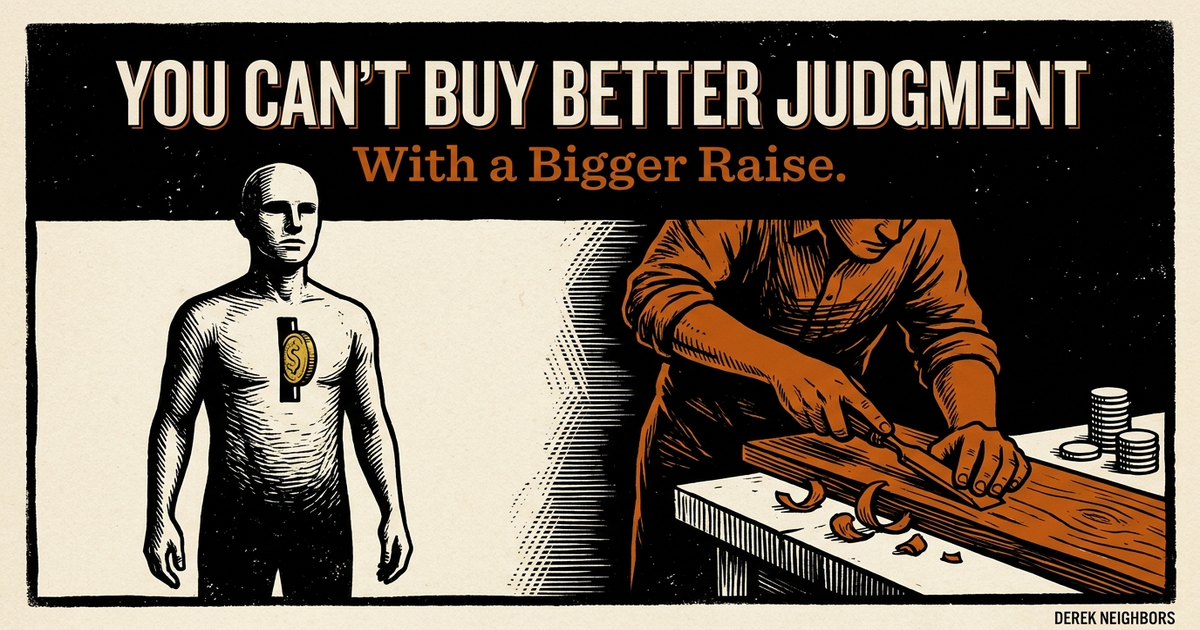
By Monday the work got careful in the wrong direction. People checked every edge for personal risk. The designer who used to push a sharp option now sent three safe ones and waited. The engineer who used to own a hard call started asking who would sign the risk. The manager who approved the raise expected more energy. What they bought was narrower judgment with a higher invoice.
I have sat on both sides of that table. I have approved money hoping it would unlock courage and watched courage leave the room. I have also watched myself, earlier in my career, turn a fair paycheck into a meter and treat the meter like professionalism.
Traditional management still treats compensation like a volume knob. Turn it up, get more performance. For simple, mechanical, or still-underpaid work, that is often roughly true. For judgment work, work that needs unfinished thinking, taste, or risk under uncertainty after pay is already fair, the knob often turns the wrong way.
Fair Pay Is the Beginning, Not the Lever
The healthy starting state is simple. Pay people well enough that money stops being the daily crisis. When rent is a panic, nobody has spare attention for excellence. Removing that panic is justice and leadership hygiene, not strategy. Fix underpayment first. Do not diagnose coin-operated capture while the person is still unpaid relative to the market.
The cousin essay on retention is “If Money Is Why They Stay, Money Is Why They’ll Leave”. That piece is about loyalty that only lasts until a better offer. This one is narrower. It is about what happens to the quality of thinking when you keep using money as the tool that is supposed to improve complex work.
Fair pay is the beginning state. The trouble starts when leaders treat the next raise as the performance system.
Stage One: The Raise Becomes the Dial
After the money crisis ends, many managers keep the same habit. When someone goes flat, checks out, or will not stretch, the first move is still a compensation conversation.
Sometimes the person is underpaid relative to the market, and the raise is justice. Sometimes the person is bored, miscast, or afraid, and the raise is a bribe. It buys temporary motion. It does not rebuild the reason to care about the work.
I have watched leaders burn six months of budget on people whose real problem was a dead telos, a missing aim for the work itself. The paycheck got heavier. The aim stayed empty. The empty aim did not notice the deposit.
Stage Two: Stakes Narrow Judgment
For simple, countable tasks, higher stakes can sharpen speed. For work that needs taste, risk, and unfinished thinking, higher financial stakes often compress the field of vision.
People start optimizing for not losing the raise rather than for doing the work well. They avoid the option that could embarrass them, send the safe recommendation, and spend the meeting managing their exposure. You can watch the field of options shrink in the meeting notes. Wider judgment leaves the room.
The useful claim is about attention, not greed. Complex work needs wide attention. Money-as-threat narrows it. The raise that was meant to buy excellence purchases caution instead. The thesis stays scoped: mechanical output and genuine underpayment can still move with money. Judgment work after fair pay usually does not.
phronesis, practical wisdom, is the faculty that sees which move fits this situation. When the inner question becomes “what protects my compensation,” phronesis is no longer running the call. Fear of the meter is.
Stage Three: Coin-Operated Identity
Left long enough, the pattern settles into character.
Every task arrives as a negotiation. Every stretch asks what is in it for me this quarter. Help becomes overtime. Ownership becomes a surcharge. Employment continues while craftsmanship exits.
Plato named a ruling love of wealth philochrematia. Aristotle named the hunger that never fills pleonexia. You do not need the Greek to see the modern form. You see it when a capable adult cannot discuss the work without scanning for the next chip. Worth, axia, gets confused with rate. The person stops asking whether the work was excellent and starts asking whether the work was billable to their private ledger.
The sacrifice test already showed that what you give up first reveals what you love. Coin-operated talent sacrifices craft first. The standard drops before the paycheck does.
arete cannot live there. Excellence is the actualization of rational capacity in the work. Reading every act through rate fails that actualization. It does not answer to a fed meter. prohairesis, the faculty of deliberate choice, still belongs to the person, manager or individual contributor. Trading judgment for a fed meter is available to anyone with a paycheck. They can choose the craft again. They can also keep choosing the meter. Naming the meter “market realism” still leaves excellence out of the room. Underpayment is a justice problem to fix. Once pay is fair, the obligation to pursue craft remains universal. Scarcity in the past does not excuse coin-operated assent forever.
Stage Four: The Leader Keeps Paying the Tax
Here is the expensive part for the person signing the checks.
You do not control another person’s ruling love. You control whether pay is fair, whether you name the pattern, whether you offer a redirect, and whether you keep funding the stall.
You already paid fairly. Then you paid again for motivation. Then you paid again because the last raise “wore off.” Each round bought a little motion and a little more entitlement. The judgment did not return. The invoice did. A thicker receipt can look like renewed excellence while craft stays gone.
Leaders stay in this loop because releasing someone feels harsher than funding them. Years of funded mediocrity costs the team that carries the gap, and costs the person who never has to face that the work no longer holds them. Nice leaders ruin people in more than one register. Paying the coin-operated tax is one of them.
Standards die when measuring stops. They also die when money becomes the only measure that gets a meeting. The standards piece from this week is “Your Standards Didn’t Slip. You Stopped Measuring.”. This piece is the money cousin: you kept measuring pay and stopped measuring judgment.
The Advanced State: Quiet Money, Loud Craft
The mature pattern looks almost boring from the outside.
Pay is fair, competitive, and rarely the main conversation. People know where they stand. Raises track contribution and market reality instead of panic management. Motivation lives in the work: a hard standard, a real stake in the outcome, a team that notices quality, a telos big enough to organize effort without a constant tip jar.
In that state, a raise can still matter. It can recognize growth. It can correct a market miss. It does not have to manufacture the will to do excellent work. That will either lives in the person’s relationship to the craft or it does not.
How to Stop Paying the Tax
1. Run the fair-pay audit. Is money still a real crisis for this person relative to the market and their role? If yes, fix pay first. Do not moralize poverty into a character flaw, and do not skip to “they’re coin-operated” while justice is still unpaid. If no, stop pretending another deposit is the development plan.
2. Run the stakes test before you “motivate” with money. Ask what the work actually requires. If it is mechanical output, incentives may help. If it is judgment, taste, or courage under ambiguity, a raise-as-lever is likely to buy caution. Choose a different tool: clearer standard, better coaching, different seat, or a harder problem worth caring about.
3. Name the conversation early. When every ask becomes a compensation negotiation, say so. “I want to talk about the pattern. Fair pay is settled. The work still needs ownership that does not wait for a meter.” Early naming is cheaper than late resentment.
4. Redirect once, then release. Offer one clean path back to craft: a defined standard, a stretch with support, and a purpose larger than the invoice. Give it a real window. If the person stays coin-operated after fair pay and a clear redirect, stop funding the pattern. Release can be the kind move when funding the stall only delays the truth.
5. Check your own comfort purchase. Leaders reach for raises because money conversations feel cleaner than truth conversations. Ask whether you are buying your own relief. If the answer is yes, you are shopping for comfort instead of leading.
Final Thoughts
You cannot buy better judgment with a bigger raise.
You can buy temporary motion and a quieter complaint for a quarter. You can even buy the appearance of action while the real problem, a dead relationship to the work, keeps rotting under the receipt.
Pay fairly. Then build the conditions where craft matters again. When someone has opted into the meter and will not opt back out, stop paying the tax.
Ready to build teams where excellence is not rented by the raise cycle? MasteryLab is the forge for leaders who pay fairly and still demand craft.
FAQ
Do pay raises ever improve performance?
Yes, for simple, mechanical, or underpaid work where money still blocks focus. Once pay is fair and the work requires judgment, creativity, or risk, raising financial stakes often narrows attention and makes people careful in the wrong way. Fair pay removes a problem. Using pay as a performance lever on complex work can create a new one.
What does coin-operated mean at work?
Coin-operated means the person reads every task, favor, and stretch through compensation first. Effort arrives when the meter is fed and stalls when it is not. The work is no longer a craft with a standard. It is an invoice with a body attached.
How is this different from paying people fairly?
Fair pay is table stakes. It should be competitive enough that money stops being a daily crisis. The failure mode is treating the next raise as the primary tool for getting better judgment, better taste, or better courage on hard calls. Those goods are not sold by the hour.
What should a leader do when someone only responds to money?
Confirm that pay is already fair. Then name the pattern early: every ask has become a negotiation. Offer one clear redirect back to the standard and purpose of the work. If the person stays coin-operated after fair pay and a clean redirect, stop paying the tax. Release is kinder than years of funded mediocrity.