Why Some People Hold Under Pressure and Others Snap
By Derek Neighbors on June 20, 2026
Two people take the same hit. A deal collapses, a diagnosis lands, a project they bled for gets killed in a single meeting. One of them holds. They feel the full weight of it and stay standing. The other one snaps. Not always loudly. Sometimes they just go quiet and never quite come back to full strength.
The usual story says the first person had more willpower. They reached into some inner reserve and the other one came up empty. We talk about character the way we talk about a fuel tank: you have a certain amount, you spend it down under stress, and when the gauge hits zero you break.
That model is wrong, and you can prove it from your own life. The fuel tank cannot explain why the same person holds one month and folds the next over something smaller. It cannot explain why the people who look toughest, the ones who never admit anything is hard, are so often the first to shatter when real load arrives. And it cannot explain why some people seem to get steadier the longer the pressure lasts, which is the opposite of a tank running dry.
The Stoics ran a better model. They did not think character was a substance you store. They thought it was a structure you hold together with tension. And they had a precise word for that tension.
Character Is Load-Bearing
Start with how load-bearing things actually work, because a person under pressure is a load-bearing thing.
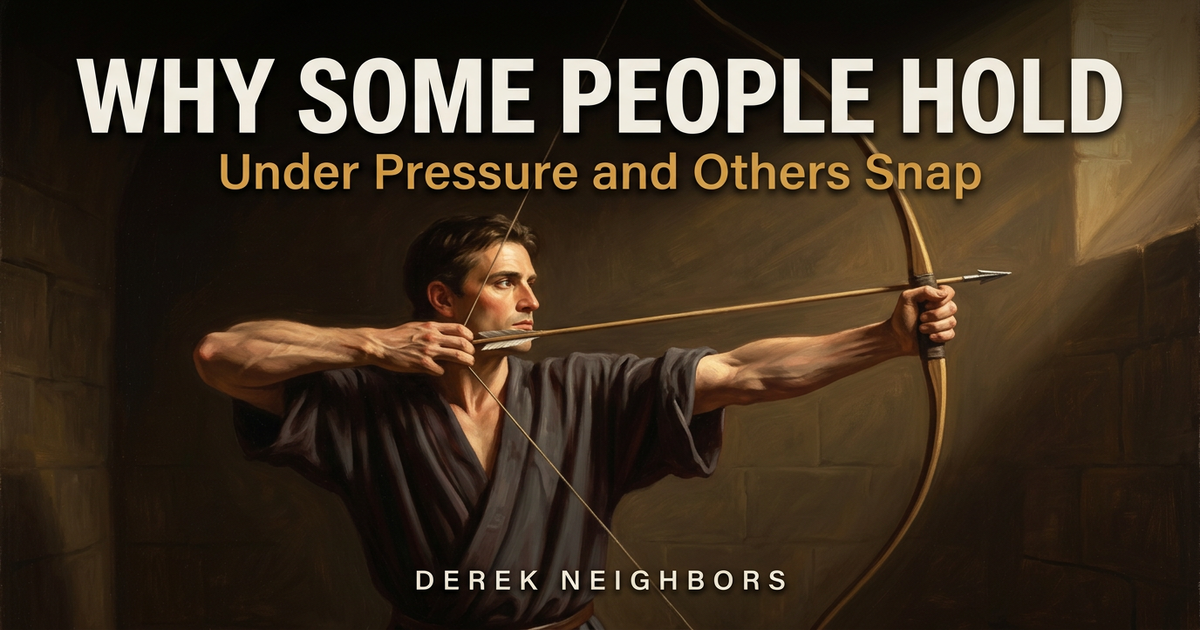
A bridge does not hold up traffic because it has a large quantity of strength sitting in a tank somewhere. It holds because tension is distributed through the whole structure, every cable and member pulling against every other one. A guitar string does not make a note because it contains music. It makes a note because it is held at the right tension. Too slack and there is nothing, no tone at all. Too tight and it snaps the moment you touch it. A muscle is not strong because it is full. It is ready because it carries tone even at rest, a low background tension that means it can act the instant it is asked.
In every one of these, the thing that determines whether the structure holds is not how much it contains. It is the tension running through it. Slack fails by collapsing. Over-tightness fails by snapping. The middle, taut and elastic at once, holds.
The Stoics applied exactly this picture to the human soul, and they were not being poetic. It was their physics.
The Stoic Science of Tonos
In Stoic physics, a fine active material called pneuma runs through everything that exists. What gives any object its cohesion, what makes it one thing instead of a pile of parts, is the inward and outward tension of that pneuma. The Stoics called that tension tonos.
They built a whole ladder out of it. At the lowest level, tonos shows up as hexis, the bare cohesion that holds a stone together. A notch higher, in plants, the same tension becomes physis, the force of growth. Higher still, in animals, it becomes soul, the tension that lets a creature sense and move. And in a human being it rises into reason itself. Your capacity to decide something and then actually hold to it is, in this model, the highest and tightest form of tonos in nature.
Which means character has a tone the way a string has a tone. The Stoics named the good state eutonia, good tension, a soul taut enough to hold its shape under weight and elastic enough to flex without cracking. They named the failure atonia, slackness, a soul with no holding power, drifting and giving way the moment it is asked to bear anything.
Cleanthes, who led the Stoa after Zeno, went furthest with this. He described virtue itself as a kind of strength or striking power of the soul, a matter of tonos rather than knowledge alone. You could know exactly what the right thing was and still fail to do it, because knowing is not the same as having the tension to carry the knowing into action. This is why the Stoics never reduced arete to information. A well-informed slack soul is still a slack soul.
The reverse holds too, and it is the half people forget. A taut soul aimed at the wrong thing is not virtue either. A disciplined tyrant has magnificent tone: steadiness, follow-through, nerve under load, all of it bent toward harm. Tension is the precondition of character, not character itself. eutonia only becomes arete when reason aims it at something worth holding. Tone is the engine. The good is the direction. A strong engine pointed at a cliff is not an achievement. Everything that follows about building tone assumes you have already done the harder work of deciding what the tone is for.
Marcus Aurelius lived inside this distinction. He keeps returning, in the notebook we call the Meditations, to one image: stand upright, not held upright. A column that holds its own line under load has tone. A thing propped up from outside collapses the instant the prop is removed. He was an emperor maintaining his own tension under the heaviest load a person can carry, and he knew the difference between the two from the inside.
The Two Ways a Soul Fails
Once you see character as tension, the two failure modes get clear, and they are opposites.
The common one is slackness. This is atonia, the soul that carries no resting tension because nothing in its day ever asked for any. It looks fine in good weather. It drifts pleasantly, keeps its commitments while they remain comfortable, and means well. Then a real load lands and it simply gives way, because there was no tension there to bear the weight. A slack rope does not lower a heavy object gently. It lets it drop and then jerks tight and shock-loads itself to failure. Most people who snap under pressure snap this way. They were not depleted. They were loose the whole time and the first heavy thing found them out.
The rarer one is rigidity. This is the person who clamps down so hard, refuses to admit anything is heavy, and white-knuckles every situation, that they have no elasticity left at all. They look like the strongest person in the room right up until the moment they shatter. An over-tightened string snaps not because it was weak but because it had no give. I wrote about this kind of brittle toughness in the story you tell about pain: composure that depends on pretending you feel nothing is a held breath, and it runs out of air at the worst possible time.
Real holding power lives between the two. Taut enough to bear weight, loose enough to absorb a shock and return to shape. eutonia is a tuning, not a maximum.
Why Comfort Makes You Slack
Here is the part that matters for anyone living now. A modern life is engineered to remove load. Every friction smoothed, every wait shortened, every difficulty optional and one tap away from being skipped. We treat that as the goal. The Stoics would have read it as a machine for manufacturing atonia.
Tension is built by load and lost by its absence. A muscle no one uses does not stay neutral. It goes slack and then it atrophies. A soul that is never asked to do anything hard does the same thing, quietly, while everything feels fine. Comfort is dangerous in a way it never feels dangerous, because going slack is an active process and comfort is how it runs. Avoiding strain feels like protecting your strength. It quietly drains the tone instead, and you find out the day you reach for it under real weight and come up with nothing.
This is the deeper reason behind a point I keep making, that your environment will beat your discipline every time. An environment with no load in it does not leave your character where it found it. It loosens it by the week.
How to Build Tone
You build tone the way you build it in a body, by keeping the system under regular, chosen load instead of waiting for a crisis to test tension you never trained.
The active ingredient is the choosing. What the Stoics called prohairesis, the faculty of choice, is what tunes the tension. Load by itself does not build tone, or every crushed and exhausted person would be the strongest among us. A life of relentless, unchosen hardship can break a soul or train it into helplessness as easily as it can harden one. The variable is never the weight alone. It is whether a will is meeting the load on purpose or simply being buried under it. That is why you train with load you elect to carry. The chosen rep is where the choosing itself gets strong, so the faculty that has to hold under the unchosen load is one you have actually used.
Keep a small difficulty in every day. Voluntary hardship works because a character that carries a little load every day is never fully slack when the unchosen load lands. This is the whole mechanism behind carrying a hundred pounds up a mountain on purpose. You are maintaining tone, not punishing yourself.
Distribute the load instead of clamping one point. A structure holds because tension runs through all of it, not because one cable does everything. Train the whole thing: the body, the sleep, the relationships, the commitments you keep when no one is watching. When stress arrives it gets spread across a tensioned structure instead of landing entirely on one already-strained part that then snaps.
Tune, do not max out. The goal is the right tension, not the most you can stand. A soul clamped to its absolute limit has no room left to absorb a surprise, and life is mostly surprise. Strong and elastic beats strong and brittle every time the load is one you did not see coming.
And load-test on purpose, in low stakes. Tone that has only ever existed in theory is not there when the real weight comes. Choose hard things you do not have to do, while the cost of failing is small, so the tension is already built and already familiar when the stakes are not small.
The Diagnostic
Three quick reads. If small inconveniences already knock you off your commitments, you are running slack, carrying atonia into a life that has not even tested you yet. If you hold beautifully until you crack all at once and surprise everyone including yourself, you are running rigid, strong with no give. If you can feel a heavy thing fully, name it honestly, and keep moving anyway without either collapsing or clamping, that is tone. That is the state worth building toward.
Frequently Asked Questions
These short answers double as the article’s structured data; they sit in the page text so AI search engines and human skimmers can pull them directly.
What is tonos in Stoic philosophy?
tonos is the Greek word the Stoics used for tension or tone, the active force that holds a thing together. In Stoic physics, a fine material called pneuma pervades everything, and its inward and outward tension gives every object its cohesion. The same principle was applied to the soul: the tonos of a person’s reason is the tension that holds character together under load. Strong, well-tuned tonos, which they called eutonia, produces steadiness and virtue. Slack tonos, called atonia, produces collapse. Cleanthes described virtue as a kind of strength or striking power of the soul, a matter of tension rather than knowledge alone.
Why do people snap under pressure?
People rarely snap because they ran out of willpower. They snap because their character had no resting tension before the load arrived. A structure holds or fails by how tension is distributed through it, not by how much is stored in it. A person whose daily life asks nothing of them carries no tone, so the first serious load finds them slack and they give way. A second, less common failure is the opposite: someone clamps down so rigidly that they have no elasticity left, and the sudden load snaps them like an over-tightened string.
What is the difference between eutonia and atonia?
eutonia is good tension, a soul taut enough to hold its shape under pressure and elastic enough to flex without breaking. It shows up as steadiness, follow-through, and composure that does not depend on circumstances being easy. atonia is the absence of that tension, a slackness that looks like drift and collapse under mild stress. The Stoics treated atonia as a real failure of character, not a mood, because a slack soul cannot carry out what reason has already decided.
How do you build inner tension or resilience?
You build tone the way you build muscle tone, by keeping the system under regular load rather than waiting for a crisis to test it. Keep a small chosen difficulty in your day so your character is never fully at rest. Distribute the load by training the whole structure so no single point bears all the weight. And tune rather than max out, since the goal is the right tension, not the most. Tone built in low-stakes reps is the tone that shows up when the stakes are real.
Final Thoughts
Under real pressure you almost never rise to the occasion. You fall to the level of your tension. The pressure itself is not yours to govern. It arrives whenever it wants, in whatever size it wants, and asks one question: how much tone were you carrying before it got here. The load is not up to you. The tone is. Everything you decided to keep easy in the weeks before the load shows up in your answer.
This is good news, because tone is trainable and the reps are cheap. A small chosen difficulty held every day is worth more than any amount of resolve summoned in the moment, the same way a string kept in tune is ready for a song that a slack one will never play. The work is not dramatic. It is the quiet maintenance of a tension nobody can see until the day it is the only thing holding you up.
Stand upright. Do not wait to be held upright. The load is coming either way, and it will find exactly the tension you built.
If you are ready to build the disciplines that turn excellence into a way of life, MasteryLab.co is where the work begins.