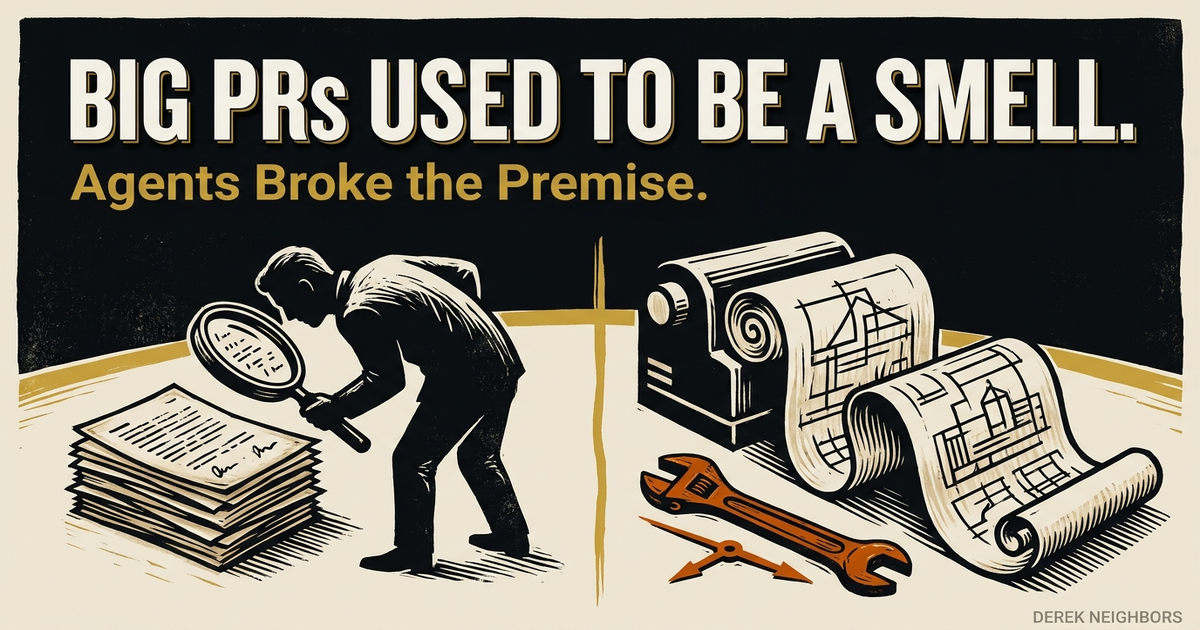
Big PRs Used to Be a Smell. Agents Broke the Premise.
By Derek Neighbors on August 10, 2026
A good friend who ships agentic workflows said the quiet part out loud: the pull requests are huge, and it bothers him.
Not because he is anti-AI. He is deep in the software factory. Agents plan, implement, test, and open the PR. The discomfort is craftsman discomfort. He came up through clean code, careful reviews, and the moral certainty that a big PR is a smell. I know that certainty from the inside. Two years ago I would have died on that hill, treating big PRs as moral failure and small ones as virtue.
Then I asked the only question that matters when a rule feels sacred: why was the rule true?
The Myth
The myth says big pull requests are always bad engineering.
You hear it in the Ruby community, in clean-code shops, in every hallway where craft still means something. The SmartBear-era guidance that human code review loses the plot past a few hundred lines became culture. Small batches from manufacturing became religion for git. Teams built CI gates, agent hooks, and guilt around line count. The rule felt like taste. Underneath, it was a proxy for human limits.
The myth survives because it used to protect real things. It still protects them when a human is the only brain in the loop. The cargo cult starts when the loop changes and the slogan does not.
The Reality Check
Reason one: a human reviewer can only carry so much of the codebase in working memory.
A big PR forces you to track A changing B changing C, plus side effects you cannot keep on the mental whiteboard. Smaller slices let you reload context, understand the local system, and catch stupid interactions before merge. The limit is biological, not taste. My friend’s disgust is the nervous system remembering how review actually fails when the diff outruns attention.
Reason two: blast radius.
If the deploy goes wrong, a small change set gives you a short list of suspects. Humans are slow at production forensics. Logs, data, and half-remembered intent fight you. Narrowing the search with a small PR was kindness to the on-call human and to the customers living inside the blast.
Now run the same reasons through an agentic shop.
The agent is not a slightly faster junior. Relative to human working memory, it is a different class of machine. It can hold more files, more paths, more test surface, and more interaction hypotheses in one pass than you can babysit in an afternoon. If the old size limit existed to protect the human verifier, you are artificially constraining the new verifier to a human brain.
Blast radius still exists. Physics did not repeal failure. What changes is cleanup speed when the factory is real. Agents with logs, queries, traces, and rollback can walk a failure path in minutes that would have burned a human week. If a blast levels a city block and rebuilding the block takes eighteen years, you worship containment. If you can rebuild the block in three minutes, downtime is still real for the people inside it, and you still owe quality. Fast rebuild reduces how much craft you should measure by containment alone. It does not make the outage free. You stop pretending line count is the same thing as safety.
The premise breaks when verification and recovery are also agent-grade. If a tired human is still the only verifier and the only fixer, the old small-PR premise still holds. Agents do not erase it by writing more lines.
I am watching orchestration that already behaves this way. Agents break work into stories. Each story gets acceptance criteria, tests, and a commit. Stories roll into an epic. The PR for the bigger goal is large. The commit history stays atomic. If something goes wrong, you still have seams to reverse. The big PR is the packaging for a machine that already did the small work. Pretending the packaging must also be tiny adds process without adding proof.
The Hidden Cost
Keep the old rule as absolute and you tax the new system for comfort.
Generation got cheap. Review, verification, and human attention did not. Teams that force every agent run into two-hundred-line human comfort food pay a fixed-cost tax: more PR handoffs, more context switching, more waiting for a human who cannot read at agent volume anyway. Field notes from AI-heavy projects already show larger diffs and thinner human review. That is a real danger when the human remains the bottleneck. It is also a signal. The bottleneck moved. You cannot get 2014 craft back by demanding tiny PRs from agents that already ship whole features. That demand just slows the factory.
There is a second cost: fake excellence.
Line count becomes a purity test. People feel virtuous for tiny PRs while recovery is slow, tests are weak, and nobody can ask an agent to prove what broke. techne is systematic skill aimed at making something well. Counting lines without counting verification and recovery abandons techne for doxa: received opinion that once tracked reality and now tracks reputation.
The Truth
The small-PR rule was never “lines are sin.”
It was “size the change to what the verifier can honestly hold, and to what the fixer can honestly unwind.” Humans needed small. Agents change the verifier and, in a real factory, the fixer. So the unit changes.
What still earns respect:
Atomic commits inside larger goals. Archaeology beats mythology when you need to reverse one story without torching the epic.
Tests and acceptance criteria that tell the truth about behavior. A huge PR with lying tests is still garbage. A huge PR with hard checks and machine-readable proof is a different animal.
Observability and rollback. If your agents cannot see production, claims about fast recovery are empty. Build the logs and rollback paths before you say blast radius is under control.
Behavior-sized seams when a human still has to vouch for risk. Migrations, auth, money movement, and shared infrastructure may still deserve staged landing. The mean sits between micro-packages that add process without proof and reckless mega-diffs nobody can verify or unwind. Size to verifiable behavior and recoverable risk. That is phronesis: practical wisdom about this change, not a religion about all changes.
What no longer earns respect:
Treating PR line count as a moral score while your recovery time is measured in human days.
Throttling agents so a human can pretend to review volume no human will actually read.
Calling yourself a craftsman for small diffs when the real craft is a system that can prove behavior and restore service at machine speed.
The Shift
Do the metanoia. Change the mind, not only the tooling.
The duty does not change with your stack. Every team owes honest verification and honest recovery. Tooling changes the method. It does not cancel the obligation. A shop without agents still owes a change size matched to the real human verifier. A shop with agents still owes proof, seams, and restore drills. Missing telemetry is not permission for sloppy judgment.
Ask your team two questions on the next scary PR. First: who is actually verifying this, human attention or an agent loop with tests and evidence? Second: if this burns, how fast can we prove the cause and restore service? If both answers are still “a tired human staring at a diff,” keep the old size discipline and stop lying about agent readiness. If both answers are machine-grade, stop bullying the packaging.
In your control today: write down median time to restore a bad deploy, require atomic commits that map to stories, and refuse merge without evidence you would trust in an incident. Those moves do not wait on destiny. They are choices.
I am not arguing for reckless mega-diffs as a personality trait. I am arguing against cargo-culting a human-era constraint into an agentic operating system. The bots are here. They can author more of the code, open more of the PRs, and clear more of the failures when you build the eyes and the tests. Capacity is not an excuse to get lazy this week. You can fight the shift with slogans from the clean-code decade, or you can update the craft to match the factory.
arete is excellence of function. The function of a change process is safe progress: progress you can prove and restore without pretending humans read what they cannot. Aesthetically small diffs are not the goal. When agents hold the context and rebuild the block fast, clinging to small-PR piety is often fear of a world where your old virtue is no longer the scarce skill. The deeper excellence is the courage to revise a sacred rule when its premises change. Better logs and faster rollback serve that judgment. They are not the whole of arete.
Embrace the factory. Keep the atomic commits. Measure recovery. Let the PR be as large as the goal the machines already proved. Or keep shrinking diffs for comfort while someone else’s agents ship the future past you.


