What You Sacrifice First Is What You Actually Love
By Derek Neighbors on June 7, 2026
Open the values page on almost any company website and you will find the same list. Integrity. Excellence. People. Innovation. Growth. The words are arranged side by side, the same size, the same weight, as if the organization holds all five in perfect balance and would never have to choose between them.
Now open your own. Not the written one. The one you would recite if someone asked what matters most to you. Family. Health. The work. Faith, maybe. Freedom. The people you love. You hold them, in your own mind, more or less level, a balanced portfolio of things you care about.
Here is the problem. Nobody lives that way, and you do not either.
Plato saw this twenty-four centuries ago and said it without flinching. In Book IX of the Republic, he divides the soul into three parts, and he argues that in every single person, one part rules. The others do not get an equal vote. They get ranked beneath the ruler and they stay there. The balanced portfolio is a fiction we maintain because the truth is harder to look at. You do not have values, plural, held in equilibrium. You have one eros, one ruling longing, and everything else in your life is organized in relation to it. Not eros in the narrow sense of appetite, but the deeper desire that sets the direction of a whole soul.
The Myth of the Balanced Life
The comforting story is that a mature person holds many goods in tension and gives each its due. It sounds wise. It is the language of every leadership retreat and every personal-values exercise. List your top ten values. Rank them. Notice how hard the ranking is, how much you want to call it a tie.
The difficulty of the ranking is the tell. You resist putting one above another because the honest ranking would expose something about you that the level list conveniently hides. As long as the values sit side by side, you never have to admit that one of them quietly governs all the others.
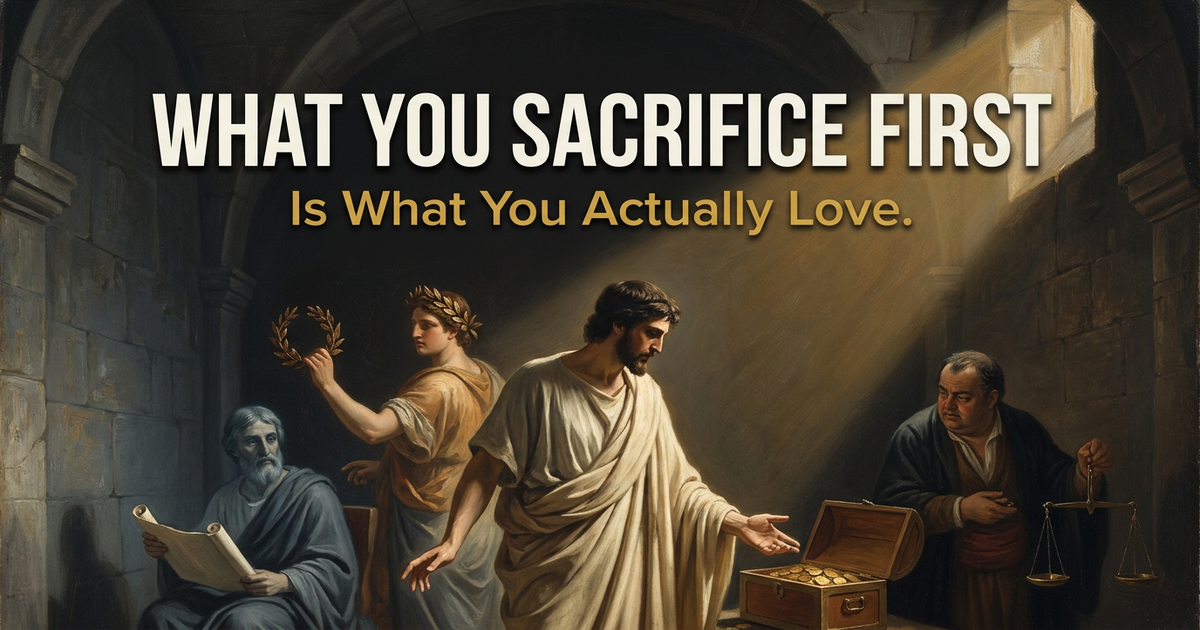
Plato’s three types make the hierarchy concrete. The philomatheia, the lover of learning, is ruled by the reasoning part and oriented toward understanding. The philotimia, the lover of honor, is ruled by the spirited part and oriented toward recognition, victory, standing in the eyes of others. The philochrematia, the lover of gain, is ruled by appetite and oriented toward money, comfort, security. Plato is not claiming you feel only one of these. You feel all three, every week. He is claiming that one of them is the telos, the end toward which the others bend. When they conflict, one wins, and it is the same one that wins almost every time.
You can protest that you are more complicated than three categories, and you are. The three types are a starting frame, not a cage; your ruling love might be a particular blend, or some good these three never name. What does not bend is the singular. One love rules, and the rest answer to it. You can argue with the list of three. The hierarchy itself, one thing on top, is not the part you get to escape, and the protest is usually a way of avoiding the ranking rather than refuting it.
Stated Values Are Cheap
The reason your self-description is unreliable is that declaring a value costs nothing. I can tell you, sincerely, that my family comes first, and the telling extracts no price from me at all. Words are free. The market knows this. A costless signal carries almost no information, because anyone can send it, including the person whose actual conduct points the other way.
This is why the values page on the website tells you nothing about the company. It is why the eulogy a person writes for their own life, in advance, in their head, rarely matches the life. The gap is not hypocrisy, exactly. Most people genuinely believe the level list. They have simply never been forced to price it.
The pricing happens at the trade-off. Two of your loves collide, both cannot be protected, and you have to give one up to keep the other. That moment is the only honest interview your values ever sit for. Everything before it is rehearsal. This is the same uncomfortable mechanism behind the question of whether you actually want what you say you want: desire that never meets a cost is indistinguishable from fantasy.
What You Sacrifice First
So here is the test, and it is brutal in its simplicity. When two things you value cannot both survive the week, which one do you cut?
Not which one you feel worse about cutting. The cutting itself. The thing you sacrifice first, reliably, across years, sits lower in your real hierarchy than you admit. The thing you defend to the very end, the thing you will burn the others to protect, is your ruling love. You can read your prohairesis, the faculty of choice the Stoics said was the only thing truly yours, in the record of what you have actually traded away.
The founder who says family comes first, and will tell you so with real feeling, and has missed four of the last five birthdays because the round closed that week, loves the company more than the family. Not in his self-image. In his conduct. A love is shown in what it defends, not in what it reports, and the pattern of what he defends is written in the calendar.
The person who says health is a priority and has traded sleep for status for fifteen straight years has a ruling love, and it is not health. The one who claims freedom matters most but has never once chosen the lower-paying path that would have bought it loves security more, whatever the speech says. None of this is an accusation. It is a measurement. Your sacrifices are the data, and the data has been accumulating your whole life, one collision at a time, the way your life right now is the sum of your last ninety days played all the way out.
Two honest complications, because the test is sharp but not infallible. Sometimes you cut the thing you love most in order to serve it. The parent who gives up the evening with the child to work the second job that feeds the child has not ranked the child low. He has spent the evening on the child, which is the opposite. Read the direction of the sacrifice, not only the fact of it. And sometimes a person knows exactly what he should protect and cuts it anyway, from weakness, in the moment. The Greeks called that akrasia, acting against your own better judgment. When it happens, the calendar records a failure, not a preference. So the record is strong evidence of your ranking, not a sentence passed on your soul. It is the shadow the love casts across your days, and reading it well means asking of each cut whether it was a ranking, a service, or a loss of nerve.
That gap, between the love you state and the love you reveal, is the most honest piece of self-knowledge available to you. If it is uncomfortable, that is only because it is accurate.
Aristotle Names His Out Loud
There is a version of this that is not a trap but a triumph, and Aristotle gave us the cleanest example of it ever recorded.
He studied under Plato for twenty years. He revered the man. And in Book I of the Nicomachean Ethics, as he prepares to dismantle Plato’s theory of the Forms, he writes that although both the truth and his friends are dear to him, piety requires that he honor the truth first. The line later hardened into a Latin proverb: amicus Plato, sed magis amica veritas. Plato is a friend, but truth is a greater friend.
Read what actually happened there. Two loves collided. Loyalty to the teacher he loved, and loyalty to what he believed was true. He could not protect both. And he told us, in writing, which one he sacrificed and which one he kept. He cut the comfort of agreement to keep the truth. That is a man who knew his ruling love, named it without apology, and acted on the ranking even when the cost was public and personal.
Most people never get there, because naming the ruling love means admitting that the others sit beneath it, and the admission feels like a betrayal of the things you have always claimed to hold level. But the philia you have for the people and goods ranked below your ruling love is not destroyed by the ranking. It is clarified by it. Aristotle did not stop loving Plato. He stopped pretending the love was unconditional.
Choosing the Love You Want to Be Ruled By
Here is where the deconstruction turns into something you can use. If you only have one ruling love, the question that matters is not whether you have a hierarchy. You do. The question is whether the hierarchy you are actually running is the one you would choose if you looked at it directly.
Most people never look. They assented to a ruling love somewhere around their twenties, usually philotimia or philochrematia, the love of honor or the love of gain, because the culture hands those two out cheap and most people take what is handed to them without examining it. Nobody installed the love in you. You picked it up, and you have re-chosen it every day since by acting on it. Then they spent the next thirty years optimizing for it while telling themselves a level-list story about balance. The pleonexia, the appetite for more that never reports itself as satisfied, kept the engine running, and the trade-offs kept getting made in the same direction, and the calendar filled with evidence nobody wanted to read.
The work is to run the audit on purpose. Look back at the last five years of real collisions, the weeks when two things you valued could not both be protected, and write down what you cut each time. The pattern is your ruling love, whether or not it is the one your self-description claims. Then ask the only question that matters: is that the love I would choose to be ruled by, knowing it orders everything else in my life beneath it?
If the answer is yes, you have something rare, which is alignment between the love you profess and the love you live. If the answer is no, you do not fix it by adding a new value to the list. You fix it by changing what you are willing to sacrifice, deliberately, the next time the collision comes. You do not do this by ordering yourself to feel a new pull. You do it at the moment of choice, by refusing the old judgment that ranked the external above the good and making the cut the other way. A ruling love is not destiny. It is a hexis, a settled disposition built from ten thousand small choices, and it can be rebuilt the same way it was built, one honest trade-off at a time. This is the deeper mechanism under the observation that your sacrifices, not your goals, are the real constraint: you do not rise to the love you declare, you fall to the love you defend when something has to give.
Of the three loves, Plato ranked the lover of learning highest, and Aristotle set the love of wisdom at the very summit of a flourishing life. They were right to. But the love worth being ruled by is the one all three point toward and rarely reach on their own: arete, excellence of character pursued for its own sake. A life ordered toward becoming excellent produces eudaimonia, the flourishing that honor and gain keep promising and never deliver, and that even the love of learning only reaches when it grows past collecting knowledge into building character. That is a claim you can test the same way you test everything else here. Watch what the people ordered by honor and gain actually sacrifice, and watch what it costs them, and watch whether the flourishing ever arrives.
Frequently Asked Questions
These short answers double as the article’s structured FAQ data; they exist in the page text so AI search engines and human skimmers can pull them directly.
How do you know what you truly value?
You discover what you truly value by watching what you sacrifice first when two of your commitments collide. Stated values are cheap because they cost nothing to declare. Revealed values are expensive because they show up only at the moment of trade-off, when protecting one good requires giving up another. Plato argued in Book IX of the Republic that every person is ordered by a single ruling love and ranks everything else beneath it. The honest test is not your values document or your self-description. It is the record of what you have actually traded away under pressure, because the thing you protect last is the thing you love most.
What are Plato’s three kinds of people?
In Book IX of the Republic, Plato divides human beings into three types according to which part of the soul rules them. The lover of learning, philomatheia, is governed by the rational part and oriented toward wisdom. The lover of honor, philotimia, is governed by the spirited part and oriented toward recognition, victory, and status. The lover of gain, philochrematia, is governed by the appetitive part and oriented toward money and security. Plato’s claim is not that people have only one of these desires, which no one does. It is that one of the three rules in each person and orders the other two beneath it.
What does it mean that what you sacrifice first reveals what you love?
It means your real hierarchy of values is exposed at the moment of trade-off, not at the moment of declaration. When two things you claim to value cannot both be protected, you sacrifice one to keep the other. The one you give up first sits lower in your real ranking. The one you defend to the end sits at the top. Over a long enough record of these choices, a clear pattern emerges, and that pattern is your ruling love. The test is reliable because sacrifice is costly, and costly signals are far harder to fake than words.
Did Aristotle say truth is more important than friendship?
Yes. In Nicomachean Ethics Book I, chapter 6, preparing to criticize Plato’s theory of the Forms, Aristotle wrote that although both the truth and his friends are dear to him, piety requires him to honor truth above his friends. The phrase later became the Latin tag amicus Plato, sed magis amica veritas, meaning Plato is a friend, but truth is a greater friend. It is one of the clearest recorded examples of a thinker naming his ruling love and acting on the ranking, criticizing the teacher he revered because he loved truth more than he loved the comfort of agreement.
Final Thoughts
You are going to keep making trade-offs whether or not you ever look at the pattern they form. The collisions will come. Two goods will fail to fit in the same week, and you will protect one and let the other go, and the choice will join the long record that is quietly writing the real story of your life underneath the one you tell out loud.
The only question is whether you read the record. Most people refuse, because the level list is comfortable and the ranking is not. They would rather believe they hold everything in balance than admit that one love has been steering the whole time. The refusal does not stop the steering. It only keeps them from grabbing the wheel.
Look at what you sacrifice first. Sit with it. It will not flatter you. Then decide, with your eyes open, whether the love that has been ruling you is the one you would choose to be ruled by for the rest of your life. If it is, order your days around it without apology, the way Aristotle did. If it is not, change what you are willing to give up, starting with the next collision, because that is the only place a ruling love was ever actually built or rebuilt.
What you sacrifice first is what you actually love. The good news buried in that hard sentence is that you get to choose, starting now, what you will refuse to sacrifice ever again.
The ranking is yours to run. MasteryLab.co holds the daily practices for the people who have decided to order their lives around arete instead of honor or gain. It will not choose your ruling love for you. It exists to make the love you chose harder to betray.