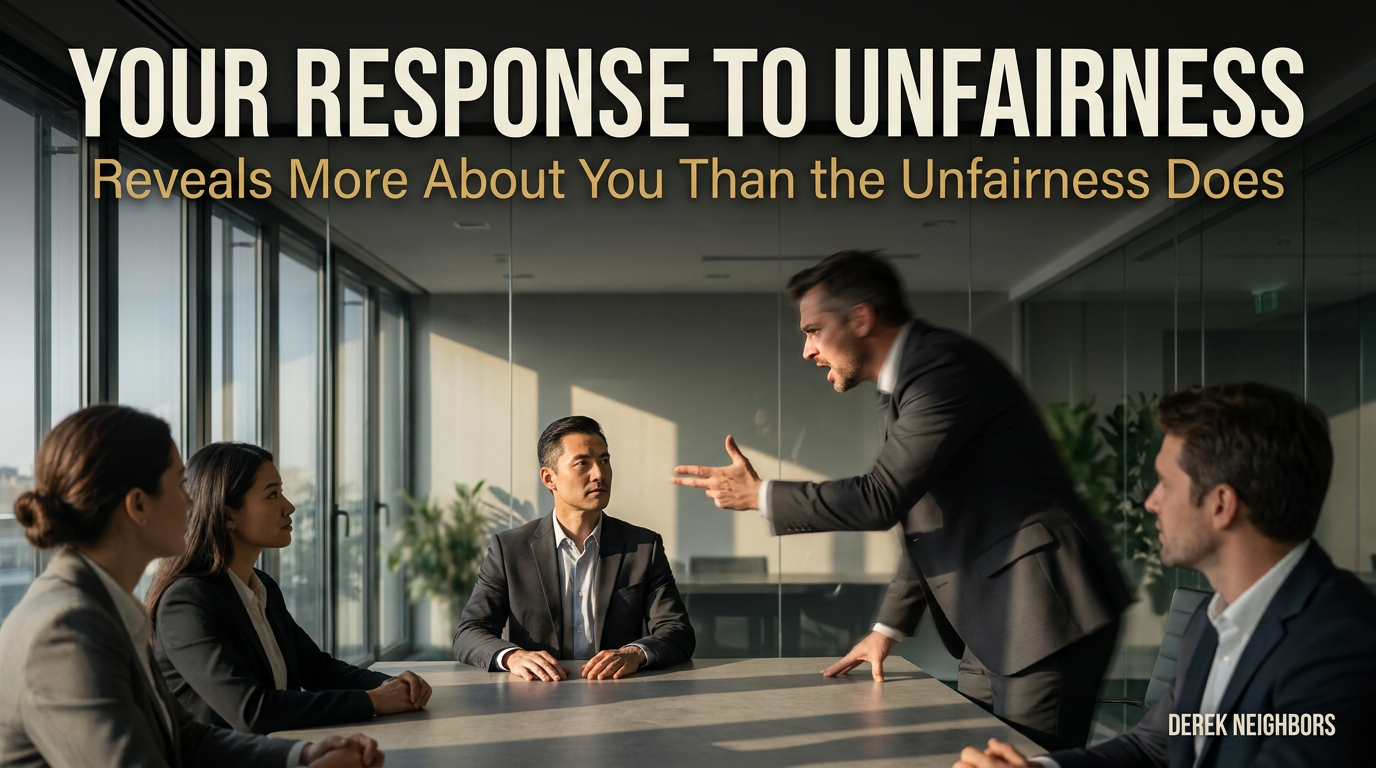
Your Response to Unfairness Reveals More About You Than the Unfairness Does
By Derek Neighbors on June 26, 2026
Three leaders sit in the same board meeting when the chair publicly corrects one of them over a decision that was already approved. Same room. Same audience. Same humiliation.
The first leader’s jaw tightens before the sentence finishes. By the break, they are lobbying allies to undermine the chair. By the quarter, the board is managing their feud instead of the business.
The second leader pauses. Asks one clarifying question. Restates the decision criteria without attacking the chair. By the next meeting, the room trusts them more, not less.
The third leader says nothing in the moment. That night they post a vague quote about betrayal on LinkedIn. By the end of the month, half the team has picked sides in a conflict that never needed to exist.
Same unfairness. Three trajectories. We tell the story as if the provocation were the plot. It is not. The response tier is the plot.
The Question Nobody Asks
We treat unfairness as a test of the world’s justice. Was this deserved? Who was wrong? What should happen to the offender?
Those questions matter for HR and for courts. They do not matter for character formation in the ten seconds after the hit lands.
The question that actually predicts your next year is simpler and harder: what did you optimize for in your first response?
Winning the exchange. Recruiting witnesses. Disappearing. Or making the situation clearer for everyone still in the room.
Most leadership training skips this layer. It teaches messaging, stakeholder maps, difficult-conversation frameworks. All useful after the reflex fires. None of it touches the reflex itself.
The Evidence Across Domains
Watch long enough and the pattern stops looking random.
In organizations: The executive who responds to public correction by escalating spends the next six months proving the board wrong instead of proving the strategy right. The one who absorbs and redirects spends six months earning the room back. Same offense. Opposite compounding.
In teams: A coach benches a star player for a reason the player considers unfair. One player sulks, recruits teammates into a faction, and tanks chemistry. Another trains harder, asks what standard they missed, and returns sharper. The benching was identical. The response built two different seasons.
In history: Marcus Aurelius opens the Meditations by listing what he learned from his predecessor Antoninus Pius, including this: he could absorb insult without losing composure or judgment. Not by pretending the insult did not land. By refusing to let the insult become the governor of his next move.
In my own training: On desert runs where there is no audience and no scoreboard, I replay hard moments from the week and watch the first sentence my mind tries to write. It is rarely noble. Often it is a verdict, a fantasy of a perfect comeback, or a collapse into “this always happens to me.” That sentence is more honest than any values deck I have ever drafted.
Different domains. Same structure. The external event is the setup. The internal tier is the test.
The Hidden Pattern: Response Tiers
After enough cases, four tiers emerge. Not as personality types. As trained defaults that fire before strategy gets a vote.
Reflex tier: Ego protection. Immediate retaliation, proving them wrong, matching intensity to save face. Organizations often reward this as “passion” or “fighting for the team.” What it actually trains is a room that learns to manage your temper instead of the problem.
Performance tier: Righteous victimhood. Moral language, hurt visible to the audience, a subtle invitation for witnesses to pick a side. This feels like integrity. It functions like theater. The goal is not resolution. The goal is to be seen as the wronged party.
Suppression tier: Numb compliance. Go quiet, absorb it, hope it passes. Often confused with Stoic apatheia. It is not. apatheia is freedom from being controlled by passion. Suppression is fear choosing silence and calling it maturity.
Integrated tier: prohairesis engaged. Assess what happened. Choose a proportionate move. Sometimes that is andreia, moral courage to speak or act despite cost. Sometimes it is sophrosyne, restraint because the stronger move is to lower the temperature. Sometimes it is megalopsychia, greatness of soul that refuses to be moved by a small slight because the aim is larger than the exchange.
The Greeks had a word for why the same person keeps running the same tier: hexis, a stable disposition built by repetition. You do not rise to the occasion. You fall to your training. The tier you run at 4 p.m. on a bad Thursday is the tier you have rehearsed in a thousand small moments nobody recorded.
Between stimulus and response lies a gap. In that gap lives prosoche, attentive care over your own faculty of choice. When prosoche sleeps, the tier runs itself. When prosoche is awake, phronesis gets a chance to speak before ego does.
Why This Matters More Than the Offense
Unfairness is inevitable. Boards have bad days. Markets lie. People with less skin in the game get credit. Partners betray trust. The offense will vary. The tier pattern will not, unless you train it.
Three implications follow.
First, your team mirrors your tier within days, not quarters. They do not copy your mission statement. They copy what you did when you felt disrespected. If you escalated, they learn escalation is how power works here. If you performed hurt, they learn to recruit allies before solving problems. If you stayed usable, they learn the room can stay usable even when the hit was real.
Second, organizations systematically misread Reflex and Performance tiers as leadership. Speed, certainty, moral heat. All read as conviction from a distance. Up close they are instability wearing a suit.
Third, you cannot outsource your tier to policy. HR can define respectful conduct. It cannot run the ten seconds before you open your mouth. That territory is yours alone.
Your response to unfairness reveals more about you than the unfairness does because the unfairness was external. The response was yours. And the response is what everyone in the room will imitate tomorrow.
How to Train the Integrated Tier
Insight without repetition changes nothing. hexis is built the way Aristotle said every virtue is built: by doing the integrated move until it becomes who you are.
Track the first sentence. After the next hard moment, write the literal first sentence your mind offered before you spoke. Not the polished version. The raw one. Do this for two weeks and you will see your default tier without guessing.
Run a 72-hour replay. What tier actually ran? Reflex, Performance, Suppression, or Integrated? Label it without shame. Shame keeps the tier hidden. Labels make it trainable.
Ask the leader test before you reply: Does this move make the problem smaller or larger for everyone still in the room? If larger, you are serving ego even when the ego wears moral language.
Practice prosoche in low stakes. The colleague who interrupts. The driver who cuts you off. The email that could be read as a slight. The gap is shorter in small moments. Train there so the gap exists when the board chair speaks.
Watch masters, do not interview them. The leader who stays usable under provocation is showing you hexis in real time. Study the move, not the speech about the move.
Frequently Asked Questions
What does your response to unfairness reveal about your character?
It reveals which response tier you have trained, not how you feel about justice in the abstract. Reflex tier leaders escalate to protect ego. Performance tier leaders recruit an audience. Suppression tier leaders go numb. Integrated tier leaders assess and choose a proportionate move that leaves the problem easier to solve. The tier you run under pressure is the character your team will mirror within days.
What is prohairesis and how does it relate to reactions?
prohairesis is the Stoic name for the faculty of moral choice, the part of you that decides how to respond once the first impulse has fired. It does not eliminate anger or hurt. It sits between the hit and the reply and asks whether your next move serves virtue or serves your ego. Leaders with trained prohairesis feel the same provocation as everyone else. They simply refuse to let the first impulse write the script.
How do Stoics respond to provocation without being passive?
Stoic apatheia is not numbness. It is freedom from being controlled by passion. Marcus Aurelius still acted. He still removed people who harmed the state. The difference is that action came from judgment, not from the need to win the exchange. sophrosyne tells you when restraint is the stronger move. andreia tells you when moral courage requires speaking or acting despite cost. Passivity is letting fear choose silence. Integration is choosing silence because it serves the larger aim.
Can you train yourself to respond differently to unfair treatment?
Yes, because response tier is a hexis, a stable disposition built by repetition, not a one-time act of willpower. Track the first sentence your mind writes after a provocation. Replay within 72 hours and label which tier ran. Practice prosoche, deliberate attention in the gap before you speak. Over months the integrated tier becomes default because you have rehearsed it in view of others, not because you memorized a values statement.
Final Thoughts
The world will keep being unfair. That is not the variable worth obsessing over.
The variable is which tier runs when the unfairness lands. Reflex, Performance, Suppression, or Integration. Your team is watching. Not your values slide. Your first move.
Build the tier you want copied.
If you want accountability for training the gap instead of performing values you cannot sustain under pressure, MasteryLab.co is where that work happens with people who treat character as craft, not content.