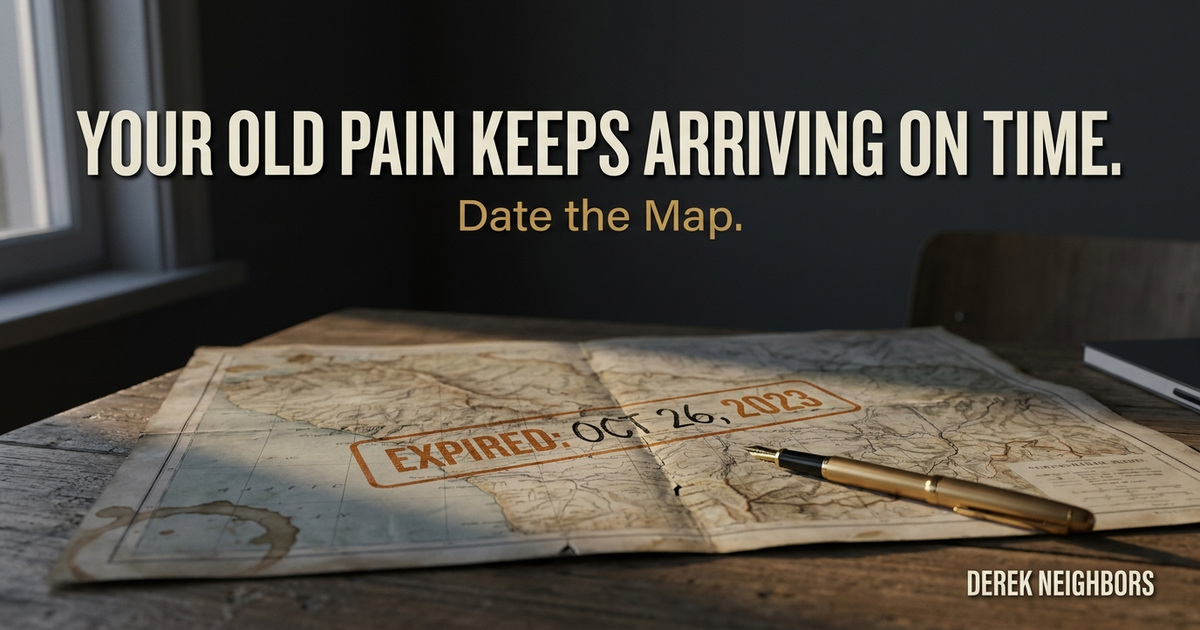
Your Old Pain Keeps Arriving On Time. Date the Map.
By Derek Neighbors on August 7, 2026
You know the feeling before you have a name for it.
A short email. A delayed reply. A tone in a meeting that is slightly cooler than yesterday. Nothing catastrophic is happening in the room. Your body does not care. Heart rate climbs. Jaw locks. The story arrives fully formed: here it comes again.
People call that a trigger and then argue about whether the trigger is valid. That argument is usually a waste of time. The spike is real. The more useful question is older and simpler.
When was this map drawn?
The Symptoms
Alfred Korzybski put the line into the culture: the map is not the territory. The line helps, and it still leaves out the failure mode that wrecks most weeks.
An undated map, in plain terms, is a once-accurate reaction you still treat as current without checking when it was true. The more dangerous failure is that map. A model that fit a real danger in 2014 still fires in 2026 as if the building never changed ownership. A reaction trained by one boss, one parent, or one betrayal keeps landing on people who did not earn it. The present looks mild. The nervous system treats it like the old fire.
You see the symptoms everywhere capable people work. A short “we need to talk” can send someone into execution prep when the agenda is a schedule change. A partner goes quiet while solving a work problem, and the other person builds a whole case for abandonment before dinner. Ordinary feedback tastes like the shame from a classroom fifteen years ago. The intensity is punctual. The calendar of the wound is still running.
People often call this overreacting. More often you are reacting on time to the wrong year.
That is why shame about “disproportion” rarely helps. Having a map does not make you crazy. Running a map with no revision date is what keeps costing you. A hard origin can earn gratitude without earning permanent obedience. Dating the map does not require pretending the past was soft. Bad history also does not excuse undated assent. The obligation lands on anyone who can notice a spike and ask what year it belongs to.
The Assessment
Before you fix anything, dig once.
Ask when this reaction was first accurate. Not metaphorically. Literally. What year. What room. Which person taught your body that this cue meant danger, rejection, humiliation, or loss of control. If you cannot name a context, you are already looking at a map that has outlived its paperwork.
Ask what facts in this room would force the same conclusion today. Not vibes. Facts a skeptic could check. If the only evidence is the intensity of the feeling, you are reading the map and calling it the territory.
Ask what label your body used: abandonment, ambush, failure, disrespect. Labels travel light. They cross decades without updating their passport. Events are heavier. Events have times, places, and witnesses.
Look for the maps that once protected you. Those are the sticky ones. A childhood that required hypervigilance produces an adult who still scans for ambush in a decent team. A job that punished hesitation produces an ex-employee who cannot sit through a quiet Saturday without manufacturing urgency. The map worked. That is why it survived. Survival is not the same thing as current truth.
If you have already done work on the scar you think everyone sees, you know impressions can feel certain while being wrong. This is the next cut. Certainty is one problem. Expiry is another. A map can be wrong because it was never true, or wrong because it stopped being true and nobody stamped the box.
The Diagnosis
The Stoics gave better machinery for this than most modern trigger talk.
An impression arrives. They called it phantasia: the first appearance in the mind, the raw claim that something means something. You do not control the first spike. You control whether you stamp a date on it and whether you grant it authority. That grant is sunkatathesis, assent. Between the spike and the story you treat as law sits the only freedom that matters in the moment.
What usually gets skipped is the date field.
They also named prolepsis: preconception, the template that lets you recognize a situation before you finish analyzing it. Healthy prolepsis is speed with a revision habit. Expired prolepsis is speed with loyalty to a dead context. Wild fantasies hurt. Accurate old models that never got retired hurt worse, because they still feel like perception.
That is why the most damaging maps are the ones that were once accurate. A false story you never believed is easier to drop. A true story from another year feels like betrayal to question. Questioning it is maintenance. The past earned the map. It does not get permanent admin rights.
Watch what repeated undated assent does to character. hexis is disposition formed by repetition. Every time you obey 2014 in 2026, you train the disposition to treat history as a live feed. The body gets better at arriving on time. That punctuality is trained habit, not fate you must obey. The present gets less of a hearing.
Obeying an expired model also fails arete at the root. Excellence requires rational contact with what is in front of you. When loyalty to an old map replaces that contact, you aim your best effort at a room that no longer exists. The familiar appearance of the old story feels like truth because you have seen it before. Present judgment is still the work.
This is distinct from your old job still running you. That piece names one common undated map: workplace urgency after the badge is gone. The same mechanism shows up in marriage, parenting, money, friendship, and leadership. The domain changes. The missing date stamp does not.
It is also distinct from natural feeling as a permission slip. Natural impulse can be real and still wrong for the role. An undated map can be historically earned and still wrong for today. Both refuse the lazy move that turns a body event into legislation.
The Treatment
Skip the identity overhaul. Build a dating practice.
1. Date stamp the spike. When the intensity lands, write one line: “This map was accurate in __.” Fill the blank with a year, a job, a house, a person. If the blank stays empty, that is data. An undated map hates paperwork.
2. Run a territory check. List three present-tense facts that would force the same conclusion today. Not interpretations. Facts. “They have not replied in four hours” can be a fact. “They are done with me” is a map. If you cannot find three present facts, shrink the intensity and wait before you act. The three-fact test cuts unearned alarm. It does not ask you to ignore a live threat you can actually point to today. If present facts earn the alarm, keep the response sized to those facts. Dating the map never gives you a pass to dismiss danger you can still name.
3. Separate label from event. Name the word your body used, then name the observable event in one sentence a stranger could verify. “Abandonment” might sit on top of “my friend rescheduled dinner.” The label may belong to an older night. The event belongs to this afternoon.
4. Write the revision sentence. One line only: “This map was true in __. Today the territory is __.” Say it out loud if you have to. You are not erasing the past. You are refusing to let the past keep the admin password.
5. Delay assent for ninety seconds. prohairesis is the faculty of choice. It needs a gap. Ninety seconds is enough to keep you from sending the message, picking the fight, or rewriting the relationship based on a museum piece. prosoche is the attention that notices the spike before the spike becomes policy. Practice the notice. Then practice the pause.
None of this asks you to pretend you were never hurt. It asks you to stop paying interest on a loan that already matured.
The Prevention
Do a weekly map audit. One reaction from the week. One date. One update. Ten minutes. Friday works. Keep the page boring and specific. Over a quarter you will see which maps still earn their keep and which ones only arrive on time out of habit.
Do not romanticize the old maps that once saved you. Gratitude can be honest while obedience stays optional. A hypervigilant map that kept you safe in a bad house can still ruin a good team if you never revise it. Thank the map for the years it worked, then take back the authority.
Leaders need this more than they admit. Your team does not experience your childhood. They experience your present reaction. If your “high standards” are actually an undated fear of humiliation from a prior room, people will feel the heat and miss the standard. Dating your maps is operational clarity with a body attached.
The story you tell about pain multiplies what the event alone would cost. Dating the map cuts the multiplier. You still feel. You stop confusing loyalty to history with accuracy about now.
Final Thoughts
arete still requires that contact with the present. Excellence built on stale perception aims hard effort at a room that no longer exists. You can train hard and still miss because the target in your head has the wrong date printed on it.
Old pain is punctual. That is its talent. When the train pulls in, check whether today’s station matches the ticket before you board.
Date the map. Then decide what the feeling is allowed to run.
FAQ
What is an undated map?
An undated map is a mental model that was accurate in one time and place and still runs your reactions in a present that no longer matches it. Korzybski taught that the map is not the territory. The undated map is worse: it was a good map once, so it feels trustworthy while it misreads the room you are actually in. Dating the map means naming when it was true before you treat today’s feeling as today’s fact.
What is prolepsis and how does it relate to outdated reactions?
prolepsis is a Greek term for preconception or anticipation, the mental template that helps you recognize and prepare for situations. Useful prolepsis lets you move fast. Expired prolepsis applies last year’s template to this year’s facts. When an old wound taught you that silence means danger, that preconception can still fire in a quiet room that is only quiet. Keep the useful preconceptions. Revise the ones that no longer fit the territory.
Is this saying triggers are fake or that I should suppress them?
No. A trigger is real as a body event. The mistake is treating the intensity as proof that the present matches the past. Suppression pretends the reaction is not there. Dating the map lets the reaction be present while you check whether the current facts earn the old story. You can feel the spike, name the year it came from, and still choose a response sized to today.
How do I date a reaction in the moment without overthinking?
Keep it to three short moves. Write or say the year or context when this reaction first made sense. List three present-tense facts that would force the same conclusion today. Then wait ninety seconds before acting on the intensity. If you cannot find three present facts, shrink the intensity and wait. If you can name present facts that earn the alarm, size your response to those facts. Dating the map interrupts unearned obedience. It does not ask you to dismiss a live threat.
Skip another framework that only explains why you feel what you feel. Practice until expired maps get harder to obey than to date. That is what MasteryLab is for: present-tense perception trained hard enough that old pain stops getting to run the calendar.