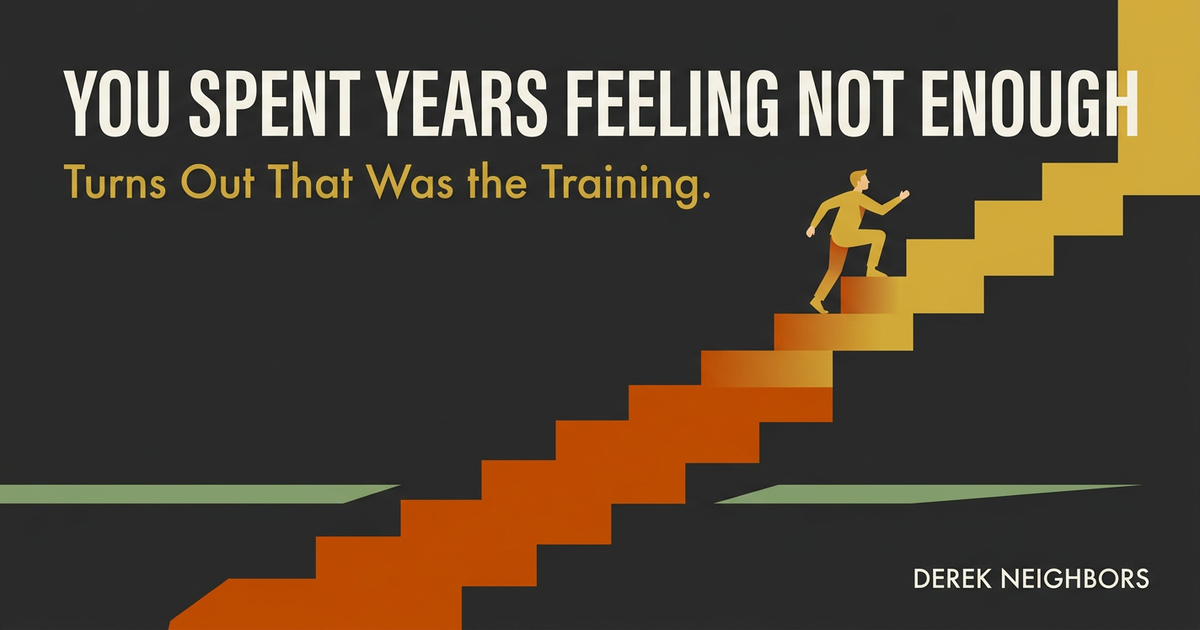
You Spent Years Feeling Not Enough. Turns Out That Was the Training.
By Derek Neighbors on June 28, 2026
There is a feeling a lot of people carry out of their younger years and never quite name. Not a crisis. A hum. The quiet sense that you were a little behind. That everyone else got handed a manual you somehow missed. That whatever you did was good, and also somehow a half step short of what it should have been.
You learned to function around it. You got things done. But the hum stayed under the floor, and on the bad days it got loud enough to sound like a verdict.
Most people spend decades trying to silence that hum. Some manage it and go quietly dead. Some never manage it and go slowly bitter. Both groups are convinced the feeling is an enemy.
I want to make the opposite case. The ache of not being enough was not measuring your worth. It was pointing. And the years you spent feeling behind taught you the one thing comfort never can.
The Misreading
The feeling shows up looking like information about you.
You feel “not enough,” and somewhere along the way the brain drops the gap and reads it as “you are not enough.” A statement about distance becomes a statement about value. That single edit is where most of the damage happens. The gap was real and useful. The verdict was invented and toxic, and you have been carrying the invented part as if it were the real one.
From that misreading, people take one of two exits.
The first exit is to numb it. You chase enough achievement, enough validation, enough comfort to finally quiet the hum. This works for about a week at a time. Then the bar moves and you are short again, so you reach for a bigger dose. Achievement becomes anesthetic. You are not building anything. You are medicating a feeling you never understood.
The second exit is to let it harden. The ache curdles into resentment, into a running internal monologue about how you got cheated, how the deck was stacked, how it is not your fault. This feels like self-protection. It is surrender that has learned to call itself realism. You have taken a feeling that was trying to move you and frozen it into a story about why you cannot move at all.
Both exits believe the same lie. That the ache is a wound to be closed. It is not a wound. It is an engine, and you have spent years trying to turn it off.
The Turn
The Greeks had a working word for felt deficiency. They called it endeia, which means lack, or want, the experience of not having. Here is what matters about how they used it. endeia was not a diagnosis. It was a beginning. Hunger is endeia. Desire is endeia. Every reach toward something you do not yet have starts in the felt absence of it.
Read that one more time, because it inverts the whole thing. Lack is where motion comes from. A creature that felt complete would never move. The ache you have been treating as proof of your inadequacy is the same ache that makes anyone reach for anything better than where they are.
This is the turn the ancients called metanoia, a change of mind so deep it reorganizes how you see. Nothing about your past has to change. The facts stay the facts. What changes is the reading. The feeling that you were never enough stops being a report card and becomes a compass. It was never telling you what you were worth. It was telling you where you were aimed.
What the Ache Was Building
Now go back and reframe the years.
While you felt not enough, you kept reaching. When comfortable people hit good enough and stopped, you could not stop, because the hum would not let you. That refusal to settle was not a character flaw. It was effort against resistance, what the Greeks called ponos, productive toil, the labor that actually costs you something.
And here is the part the motivational posters miss. ponos repeated enough times stops being something you do and becomes something you are. Aristotle had a word for that, hexis, a disposition built by repetition until it runs without permission. You did not just survive the feeling of being behind. You got schooled by it. Every time the ache pushed you to close a gap, it was laying down a default, training a reflex to reach.
That kind of shaping has a name too. paideia, the formation of a person through what they undergo. The kid who felt a step behind learned, by necessity, how to close distance. That is a skill. It is a rare and valuable one. And comfort has no way to assign it, because comfort never makes you feel the gap in the first place.
The people who never felt not enough did not get a better deal. They got a quieter one, and a softer engine, and most of them stopped climbing the moment the climbing got optional.
The Discipline This Requires
I have to be honest about the edge of this, because the reframe turns into garbage if you flatten it.
Not every not-enough feeling is fuel. Some of it is real damage, the residue of someone who told you that you were less, and that kind needs healing, not a fresh coat of motivational paint. The work is learning to tell two aches apart that feel almost identical from the inside.
The good ache points, and you can tell because it points at something you can name. A standard inside the work itself. The person you are trying to become. A specific skill you can see and do not yet have. That is what enough means here. Not an arbitrary bar, not whoever happens to be ahead of you, but the actual shape of the thing done well. The bad ache names nothing. It only tells you that you are worthless and hands you nowhere to go. Keep the one that aims at a real target. Set the other one down, and if it is old damage, get it healed instead of fed.
Even with the good ache, there are two ways to ruin it.
You can numb it, which kills the engine and feels like peace right up until you notice you have stopped becoming anything.
Or you can worship it. This is the subtler trap. You build an entire identity out of insufficiency. You never let yourself arrive, never allow a win to land, because some part of you believes that the moment you feel enough, the engine dies. So you stay permanently dissatisfied and call it ambition. It is not ambition. It is the same old verdict, renamed as a virtue so you never have to question it.
The mature move is the narrow path between those two. Keep the engine, drop the verdict, reach hard without self-contempt. And by engine I do not mean the blind craving that wants more of anything in reach. I mean the trained habit of reaching that reason aims at a standard worth it. That distinction is the whole game, because from the outside the healthy reacher and the permanently dissatisfied look identical. Here is how you tell them apart. The healthy one can let a win count before the next climb. It can name the standard it reaches toward. It does not pull its worth out of the gap. The trap can do none of those. It cannot rest, it cannot tell you what it is chasing, and it feeds on the distance as if the distance were proof of something. Same motion. Opposite root.
Aiming It
A few things that turn this from an idea into a practice.
Audit the ache. The next time the hum gets loud, ask one question. Is this pointing at something or just punishing me? If it is pointing, follow it. If it is only punishing, you are not getting information, you are getting abused by your own narration, and the move is to stop listening, not to obey. Either way the feeling does not get to drive. It is an impression, not an order. You judge it and decide what to do next, and the duty to do the next thing well holds whether the ache showed up useful that morning or useless.
Pay the gap some gratitude. The distance between where you are and where you want to be did the opposite of holding you back. It helped build most of what you already have. A lot of what you are proud of, you made in part because you could not leave the gap alone.
Build from lack, not from loathing. The motion is identical. The fuel is everything. You can chase a higher standard because you honor what you could become, or because you despise what you currently are. From the outside they look the same. One of them compounds for forty years. The other one burns you to the ground and calls it discipline.
Let the arrival be allowed. eudaimonia, the flourishing the Greeks pointed all of this toward, was never the end of reaching. It is reaching without the wound underneath. You are allowed to feel the lack and keep climbing and also, on a good evening, to look at what you built and let it be enough for the length of one breath. That is rest, not a lowered bar. The standard holds. You step back to it in the morning. The engine does not die when you pause. It rests. Then it reaches again.
Final Thoughts
The feeling that you were never enough did not break you. It built the part of you that refuses to coast, the part that closes gaps other people learn to live with, the part that is reading this far into an article about itself.
That engine cost you something to install. The years of feeling behind were the price. You already paid it. The mistake now would be to spend the rest of your life trying to dismantle the one thing that hardship actually gave you.
Stop trying to cure the engine. Aim it. The ache was never the problem. The verdict you attached to it was, and the verdict was never the truth, only a habit, and habits come apart with work. So start the work. Drop it, keep the drive, and point the whole thing at a real good instead of a bigger pile. Aimed at becoming someone worth being, the same hunger that once hurt you turns into the arete it was always reaching for.
Building the kind of character that can reach hard without self-contempt is the work we do at MasteryLab.co. If the engine inside you has been running on the wrong fuel, come learn to aim it.