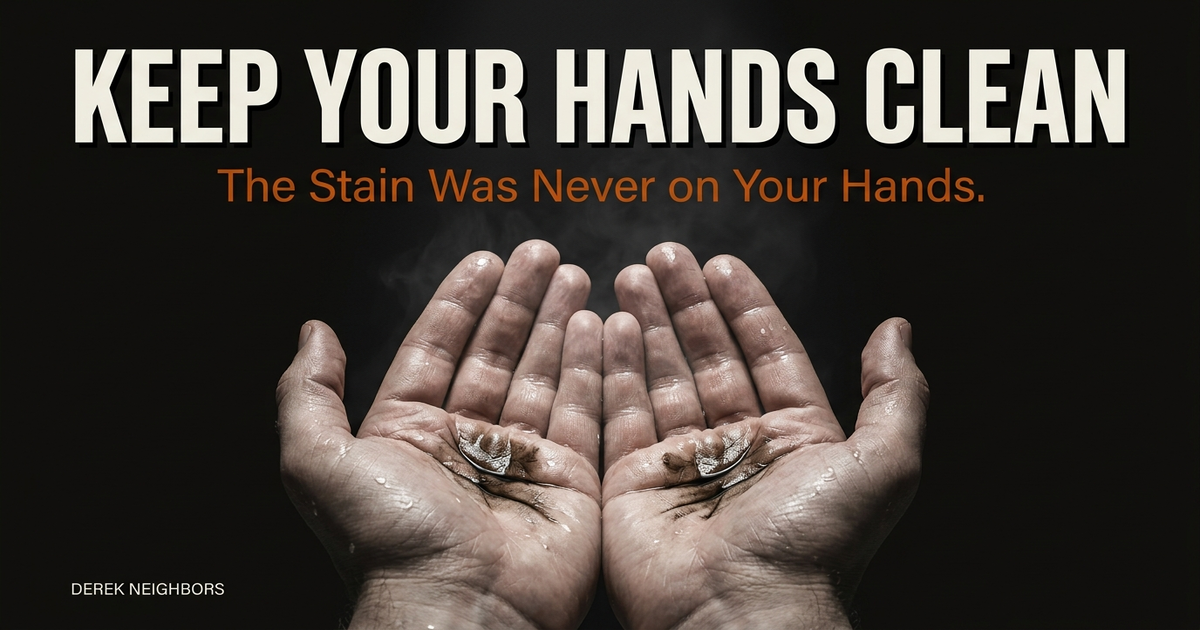
Keep Your Hands Clean. The Stain Was Never on Your Hands.
By Derek Neighbors on June 29, 2026
Power vs. Virtue: The 48 Laws Examined
A year-long examination of Robert Greene's 48 Laws of Power through the lens of ancient virtue ethics. Some laws we affirm, some we reframe, some we reject entirely.
The Law
Law 26: “Keep Your Hands Clean.”
Robert Greene’s instruction is about reputation as armor. You must seem a paragon of civility and efficiency. Your hands are never soiled by mistakes or nasty deeds. The way you maintain that spotless appearance, Greene says, is by getting others to do the soiling for you. Use a cat’s-paw, someone who carries out the unpleasant work while your name stays nowhere near it. Keep a scapegoat on hand, someone to absorb the blame when something goes wrong, so the fault lands on them and never on you.
The promise is a clean record. You get the outcomes of dirty work without the marks of it. Other people hold the knife and other people take the fall, and you walk through it all looking untouched.
The Tactical Truth
This works, and pretending it does not would be dishonest.
Reputation is a real asset, maybe the most undervalued one in a career. A clean record compounds. People extend trust to the person who has never visibly done anything ugly, and that trust becomes access, benefit of the doubt, the first call when an opportunity opens. Greene is right that protecting your name matters, and right that the world judges fast and judges by what it can see.
He is also right about deniability. Distance from a deed is genuine protection. When something blows up, the people who get burned are usually the ones whose fingerprints are on it, and the person who arranged things from two steps back often walks away clean. Anyone who has watched an organization assign blame knows this. The fall rarely lands where the decision was actually made. It lands where the hands were. Greene noticed an ugly mechanism that runs through most institutions, and he described it accurately.
So the instinct underneath the law is not crazy. Guard your reputation. Do not let yourself be the one holding the bag for a mess. The question is what Greene actually tells you to do with that instinct, and what it does to you over time.
The Character Cost
Here is the thing the whole strategy depends on and cannot deliver. Greene is selling clean hands. He cannot sell clean hands. He can only sell the appearance of them, and the appearance is not where the problem lives.
The Greeks had a precise word for this. They called it miasma, the pollution that attaches to a deed and to the person who willed it, regardless of who witnessed the act or whose hands physically carried it out. miasma was not a feeling or a reputation. It was treated as a real condition, something that clung to you and to everything around you until the deed was actually answered for. And here is the feature that dismantles Law 26 completely: it tracked the doer and not the appearance. You could not wash it off by being unseen. You could not transfer it by handing the act to someone else.
Run Greene’s law against that and it falls apart. Use a cat’s-paw and you have not avoided the deed. You caused it. In Greek terms you are the aitia, the responsible cause, the same way a general who gives an order owns the killing though he never lifts a blade. What you actually did was take one stained act and add two things to it. You added cowardice, because you would not be seen doing what you chose to do. And you added a second victim, because you dirtied another person’s hands to keep your own looking clean. The cat’s-paw does not remove the stain. It doubles the harm and sells the double as innocence.
The scapegoat is worse, because it is public. It is the same accounting error as taking credit for work that was not yours, run in reverse. One move pulls the good that belongs to someone else toward you; the other pushes the bad that belongs to you onto them. Sacrifice one person to protect your image and you have taught everyone watching exactly what you do to people who become inconvenient. They will not forget it. From that moment, every clean thing about you gets re-read. Your spotless record stops looking like evidence that you do no harm and starts looking like evidence that you have never been caught. The people whose loyalty you most need are precisely the ones who watched you discard someone, and they are quietly doing the math on their own future with you.
Then there is the cost you pay where no one can see it. Live by deniability long enough and you get fluent in it. You get good at arranging your involvement so that it does not show, and the faculty you use to hide a deed from other people is the same one you use to hide it from yourself. You start to believe your own clean hands. You lose the ability to give yourself an honest account of what you actually did, which is the one capacity a person needs in order to ever get better. The mask of innocence does not just fool the audience. Like any mask worn long enough, it eventually fools the wearer, and a person who cannot see their own hand in things is finished as a moral agent, however clean the record looks.
The ARETE Alternative
The strange part is that the law is right. You should keep your hands clean. It is simply wrong about how.
Greene means keep your hands apparently clean. Virtue means keep them actually clean, and the actual version turns out to be the most literal reading of the instruction. If a deed would stain you, the move is not to find a cat’s-paw. The move is to not do the deed. There is no proxy involved, no clever distance, no scapegoat in reserve. You keep your hands clean by not doing the thing that dirties them. The law, read honestly, is good advice. It just forbids the entire toolkit Greene hands you for following it.
That leaves the harder case, the one Greene is really speaking to, where an ugly thing genuinely has to be done. Someone has to be let go. Hard news has to be delivered. An unpopular call has to be made and someone is going to be angry about it. These are not stains. These are the necessary unpleasant work of any serious life, and the difference between them and a stain is entirely in how you handle them. The Greeks would point you to andreia, courage, and courage here means one specific thing. You do the hard thing yourself, in the open, with your name on it.
The cat’s-paw exists for one reason, to spare you the discomfort of being seen doing what you decided to do. andreia is the willingness to be seen. Its opposite is deilia, cowardice, and reaching for a cat’s-paw is cowardice no matter how efficient it looks. The leader who delivers the hard news himself, who takes the blame for the team’s failure instead of routing it to a subordinate, who signs his own unpopular decisions, has genuinely clean hands. Not the laundered kind. The real kind, the kind that come from arete, excellence of character, which survives scrutiny instead of depending on avoiding it.
Notice what does not change in the virtuous version. Unpleasant things still get done. The work does not get softer or more pleasant. What changes is that your name sits on your own choices, which means there is no stain to hide, because you are not pretending the choice was someone else’s. A Greek court did not ask whose hand moved. It asked who was the aitios, the responsible cause. Reality runs the same audit. Consequence eventually finds the place where the decision was actually made, and the only person it cannot embarrass is the one who was already standing there in the open.
Ancient Wisdom
The Greeks dramatized this more relentlessly than any culture before or since, and their central example is built precisely on the failure of clean hands.
In Oedipus Rex, a plague sits on the city of Thebes. The cause is miasma. A polluting deed has gone unanswered, and the whole city suffers under it until the deed is brought into the light. Here is the detail that should end Law 26 forever. Oedipus’s hands look clean. He did not know what he had done. By every standard of appearance and even of intent, he is innocent, and the pollution is his anyway, because miasma attaches to the deed and the doer and does not negotiate about who was watching or what they understood at the time. If pollution clings even to the man who acted in genuine ignorance, consider how little protection it offers the man who arranged the deed on purpose and hired someone else to hold the knife. Greene’s reader thinks distance is safety. The Greeks would tell him distance is nothing. The deed knows whose it is.
The Stoics took the same truth inward. Epictetus taught that the only thing fully yours is your prohairesis, your faculty of choice. Everything else, your body, your reputation, the hands of the people who work for you, can be taken or borrowed or arranged. Your choices cannot. They are the one thing that is unambiguously yours. So when you choose a deed and hand its execution to a cat’s-paw, you have given away the only part that was ever in question and kept the only part that actually stains. The cat’s-paw holds the knife, which was never the point. You hold the choice, and the choice is the thing.
You do not need the Greek texts to feel this. Shakespeare wrote the most famous version of it. The Macbeths murder by arrangement and disguise, and Lady Macbeth tells herself that a little water clears them of the deed. The play is the slow refutation of that line. “Out, damned spot,” she says later, scrubbing at a hand that is already clean, because the stain was never on the skin. It was on the choice, and there is not enough water in the world for that.
The Test
Here is the diagnostic, and it only works if you answer it honestly.
Think of the last unpleasant thing that needed doing where you came out of it looking clean. Now ask which kind of clean it was. Did you stay clean because you did not do the thing, or because someone else’s name is on what you decided? Those are completely different conditions that produce the identical spotless record, which is exactly why the record cannot tell you which one you are.
There is a sharper version of the same question. If everyone could suddenly see precisely who caused what, with no distance and no disguise left, would your reputation survive the reveal? Clean hands survive it. They were already clean, in the open, with nothing arranged. Laundered hands do not survive it, because laundered hands were always a bet that the reveal would never come. If your innocence depends on no one ever seeing clearly, it was never innocence. It was good positioning, and positioning is the one thing miasma was specifically designed to ignore.
Final Thoughts
Law 26 is a strategy for looking innocent. Virtue offers a strategy for being innocent, and being innocent turns out to be the only kind of clean that lasts, because an appearance can always be audited and a deed cannot be outsourced. The water never reaches the choice.
So keep your hands clean. Greene had the right words and the wrong method. Do not do the thing that stains you, and you will not need a cat’s-paw. When a hard thing genuinely must be done, do it yourself, in the open, with your name on it, and there will be no stain to hide because you will not be pretending the choice belonged to anyone else. The people holding the knives and the blame in your story are not protecting you. They are carrying what you were too afraid to carry, and everyone can see it but you.
The stain was never on your hands. It was on the choice. That is the part to keep clean, and it is the one part no one else can keep clean for you.
If you are done arranging your way around the hard things and ready to lead with your name on your own decisions, MasteryLab is the framework and the community for people building character in the open, where it counts.