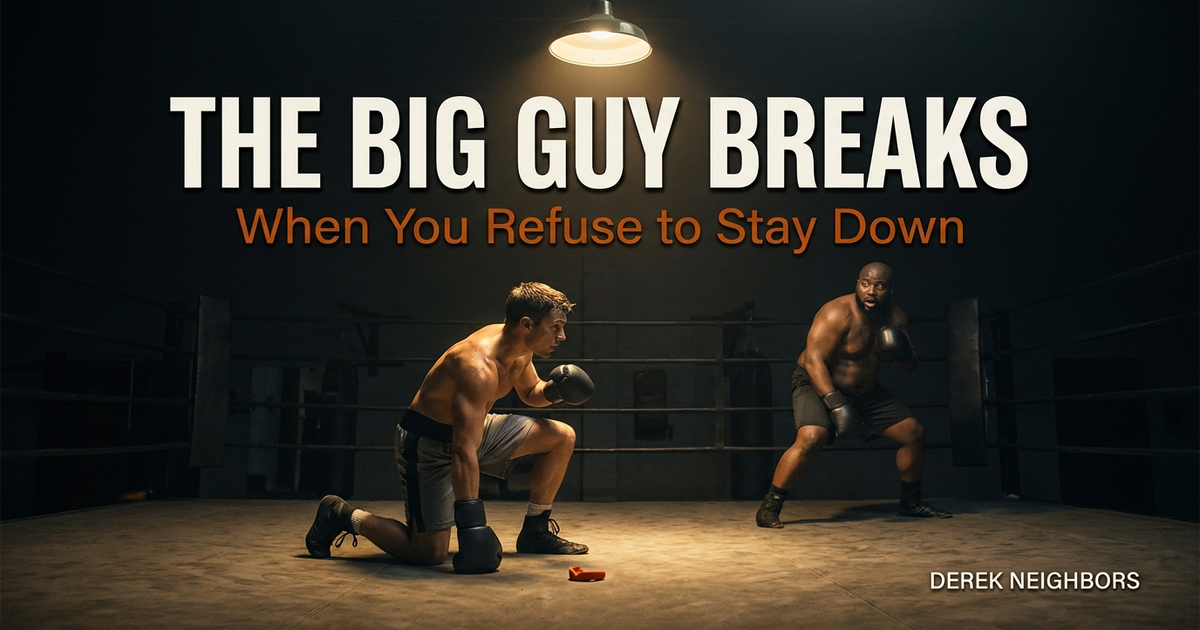
The Big Guy Breaks When You Refuse to Stay Down
By Derek Neighbors on August 11, 2026
Incumbents confuse position with invincibility.
Budget, headcount, brand, and a win from three years ago that still gets retold in the all-hands. The story sounds like strategy. It is often a lullaby. Size can buy time. It cannot buy a psyche that holds when someone smaller keeps standing after every punch.
The Setup
I have watched this in rooms that had nothing to do with boxing.
A market leader that stopped shipping hard problems because the category “belonged” to them. A senior engineer who stopped taking reps because juniors were supposed to struggle, not them. A founder who treated a Series B as permanent weather. In each case the advantage was real, and the armor was only a story about what size meant.
Rocky IV made the pattern legible for a mass audience, even if people remember the montage more than the psychology. The big guy enters with science and certainty. The little guy enters as stubborn flesh. Round after round, what matters is not the score. What matters is what happens inside the person who expected the other one to stay down.
That expectation is the soft middle of power. It shows up in product roadmaps, career ladders, local politics, and family arguments. Anywhere one side has been winning long enough to stop training for resistance. The same duty holds when there is no brand and no budget: a hard conversation you keep dodging, a training block you skip because nobody is watching, a craft practice you abandoned after one ugly week. Size is not required for the obligation.
The Journey
The early rounds are ugly for the smaller party.
They get hit. They lose rounds on the cards that matter in public. They look foolish to people who only watch outcomes. The useful thing they do is refuse the ending the room already wrote, then stand, reset their feet, and come forward again. andreia is the courage to face the next exchange. karteria is the endurance that makes the next exchange possible after the tenth one, not only the first.
I have been the little guy more than once. Early consulting years. Building when nobody cared. Competing for work against shops with nicer logos and longer case studies. The punches were not cinematic. They were silent noes, delayed payments, and rooms where I was the cheapest-looking option. What changed the dynamic was not a clever positioning slide. It was showing up again after the week that should have ended me. Clients do not always say this out loud. They feel it. Persistence under load is information.
Now watch the big guy across the same stretch.
At first, the blows they land confirm the story that size, process, and brand still work. Then the other person stands again. Something in the chest changes. Not fear of losing yet. Irritation that the expected ending is late. The Greeks named the spirited part of the soul thumos. Pride, nerve, the heat that wants honor. When thumos is healthy, it fuels effort. When thumos is welded to “I cannot be touched,” every refused ending feels like insult. Companies break this way too. The capability is still there. The spirit starts defending a story instead of doing the work.
The room notices before the leader admits it. People stop bringing the hard problems to the person who needs the win to stay pretty. Rivals start probing. The incumbent starts needing the underdog to look tired, because tired would restore the old ending.
The Turning Point
Then the little guy lands one clean punch.
It does not have to be the finishing blow. It has to be undeniable. A customer switches. A demo works in public. A junior ships the thing the senior said was impossible. A challenger brand steals a headline the market leader assumed was permanent. The physics of that punch are often ordinary. The damage is not. It hits the story that made size feel like destiny.
That is hubris in the structural sense, not the cartoon sense. Easy times expose allegiance. Wins can blind you without making you loud. You stop sparring. You stop asking who could hurt you. You start needing the other person to cooperate with your myth. When they refuse, the first real contact feels catastrophic because you had already spent the lead as if it were armor.
I have been the big guy in smaller arenas too. Title in the room. Reputation that arrived before I did. The dangerous season was not the season I was challenged. It was the season I started waiting for the challenge to get tired. Waiting for the other person to tire is hubris with a calendar invite.
Courage still needs judgment. Aristotle was clear that andreia sits between cowardice and recklessness. Getting up to repeat the same stupid charge is not excellence. Getting up, learning, adjusting aim, and staying in the exchange is. phronesis decides whether the next stand is craft or ego. It can also command exit from a corrupt contest or an unworthy aim. The ban is on quitting because someone else’s size assigned your ending. The underdog who never updates is romantic and broke. The underdog who updates and still refuses the assigned ending is dangerous.
The Resolution
If you are the little guy, stop waiting for a fair ring.
Fair is rare. Refusal is trainable. Make a season of it. Absorb the hits that are tuition. Drop the hits that are waste. Keep a short ledger: what hurt, what you changed, what you will try in the next round. Not all failure is tuition. The ones that teach you how to stand differently are. Your real edge is that the incumbent needs you to stay down more than you need them to like you.
If you are the big guy, keep a grit budget.
Train under load while you are still ahead. Hire people who will punch your ideas in private before the market does it in public. Notice the moment you start narrating inevitability. Inevitability is usually a nap. The habits that built the lead are the habits that protect it. Soft landings feel earned. They often erase the formation that made the landing possible. A hard start can be worth more than a soft arrival for this reason. It leaves karteria in the body.
Neither role owns virtue by default. The little guy can become cruel the minute they get a lead. The big guy can recover the minute they admit the punch landed and return to practice. arete is the quality of the next action after contact, not a story you get to tell because you started behind.
The Principle
Position is not armor. Refusal under load is the force that breaks false armor.
Budget, brand, and last year’s win are appearances. They can be mistaken for invulnerability of soul. arete is activity under real resistance, not a pile of advantages you store after a win. A lead that stops taking contact stops being excellence and becomes unused advantage.
You control whether you stand, adjust, and train under load. You do not control the rival’s size, the crowd’s scorecards, or whether the first clean punch lands this week.
Getting better can feel like getting worse when you enter a harder pond. This piece is the cousin of that feeling on the other side of the rope. The pond can also contain an incumbent whose identity depends on you quitting. Your job, if you are climbing, is to keep standing long enough for their story to fail in public. Your job, if you are defending, is to refuse the nap that story offers you.
Practices
Standing audit. After any hard week, write one sentence: did I stay down because the work was wrong, or because the ending felt assigned? Wrong work gets a pivot. Assigned endings get another round.
First-punch log. When you are ahead, log the first undeniable hit from a smaller rival within 24 hours. No spin. Name what landed and what training it demands. Speed here is respect for reality.
Grit budget for incumbents. Put difficulty on the calendar while you still have margin: a public demo with risk, a sparring partner with permission to be rude, a metric you cannot hide. Comfort without load is how thumos goes soft.
Underdog season rules. Pick a 90-day window. Define the arena. Define what “getting up” means in verbs (ship, call, submit, publish). Define the learning loop after each hit. Then stop negotiating with the fantasy that the big guy will grant you a clean narrative.
Mean check. Before the next stand, ask whether the move is courage or ego. If you cannot name what you will do differently after rising, you are protecting pride. If you can name the adjustment and still rise, you are practicing andreia with phronesis.
The big guy breaks when the story of being untouchable meets a person who will not stay down. Be careful which side of that sentence you are writing with your week.
FAQ
What is the Drago principle in competitive dynamics?
It is the pattern where an incumbent’s confidence is tied to the belief that size, budget, brand, or past wins make them untouchable. When a smaller rival keeps absorbing hits and standing back up, the incumbent’s story cracks before the scoreboard does. The first clean punch from the underdog then lands harder than the physics suggest, because it hits identity, not only performance.
What is the difference between andreia and karteria?
andreia is active courage, the willingness to confront difficulty and act despite fear. karteria is patient endurance, the capacity to bear prolonged hardship without yielding. In a long fight, andreia is the decision to get up again. karteria is the ability to keep doing that across rounds, quarters, and years.
Is refusing to stay down the same as stubbornness?
No. Aristotle treated courage as a mean. Reckless charging with no learning is not andreia. The useful refusal includes phronesis: you get up, you adjust, you keep the aim worthy. phronesis can also command exit from a corrupt or unworthy contest. The ban is on quitting because someone else’s size assigned your ending. Stubbornness protects ego while endurance protects the work.
If I am the incumbent, what should I do with this?
Stop treating position as armor. Keep a grit budget the way you keep a product budget: train under load, seek honest sparring, and notice when you start needing the other person to stay down for your story to hold. The habits that built the lead are the habits that protect it.


